RMIT University
Melbourne, Australia
RMIT is Australia's largest dual-sector university and one of the most industry-connected institutions in the Asia-Pacific. Its city campus sits in the centre of Melbourne — consistently rated among the world's most liveable cities — and its degrees in technology, engineering, design and business are built around work-integrated learning: internships, industry projects and placements are part of the curriculum, not an afterthought. For Indian students, RMIT combines a QS Top-120 credential with Melbourne's job market and Australia's post-study work rights.
#119
QS World Ranking 2027
1887
Founded
90,000+
Students (all campuses)
Top 25
Art & Design (QS subject)
RMIT at a Glance
#119
QS World Ranking 2027
AUD 38-51K
Tuition/Year (PG)
2-3 yrs
Post-Study Work (Indians)
#1
City Campus Location

Dr. Karan Gupta's Strategic View
Why RMIT Is a Strong Choice
Industry-Embedded by Design
RMIT began as a working men's college in 1887 and never lost its applied DNA. Today it is Australia's largest dual-sector university, and its teaching model is built around work-integrated learning: internships, live industry briefs, and placement subjects are credit-bearing parts of degrees.
For international students this matters more than rankings. The single biggest barrier to a graduate job in Australia is local experience — RMIT's model means you graduate already having it. Employers across Melbourne co-design curriculum and recruit directly from capstone projects.
For Indian students, this converts directly into post-study outcomes: with up to 3 years of ECTA work rights after a master's, starting your job search with Australian project experience on your CV is a decisive advantage.
Melbourne: The City as Campus
RMIT's main campus is not adjacent to Melbourne — it is woven into the city's central business district. Lecture buildings sit between laneway cafés, corporate towers and the State Library. Melbourne is consistently rated among the world's most liveable cities, with the largest student population in Australia and a deep cultural scene.
Practically, the CBD location means part-time work, internships and networking are a tram ride away — often a walk. Students in suburban campuses spend hours commuting to opportunities that RMIT students step out of class into.
Melbourne is expensive — plan for AUD 2,000-2,900 per month — but part-time work rights (48 hours per fortnight) at Australian minimum wages (among the world's highest) offset living costs meaningfully.
World-Class Design, Honest Rankings
RMIT's overall QS ranking (=119 in 2027, its best in twenty years) understates its flagship strength: Art & Design, where RMIT consistently ranks in the world's top 25 — above many universities with far bigger overall brands.
If you are a designer, architect, or creative technologist, evaluate RMIT against design schools — Parsons, RCA, Pratt — not against generalist universities. On that comparison, RMIT delivers comparable studio education at a fraction of the cost, in a city with a real creative industry, with post-study work rights the US cannot match.
For engineering and technology, RMIT is solidly ranked and practice-led; for pure research careers, the Go8 research universities are the better path. Choose based on what you actually want to do after graduation.
Campus & Student Life
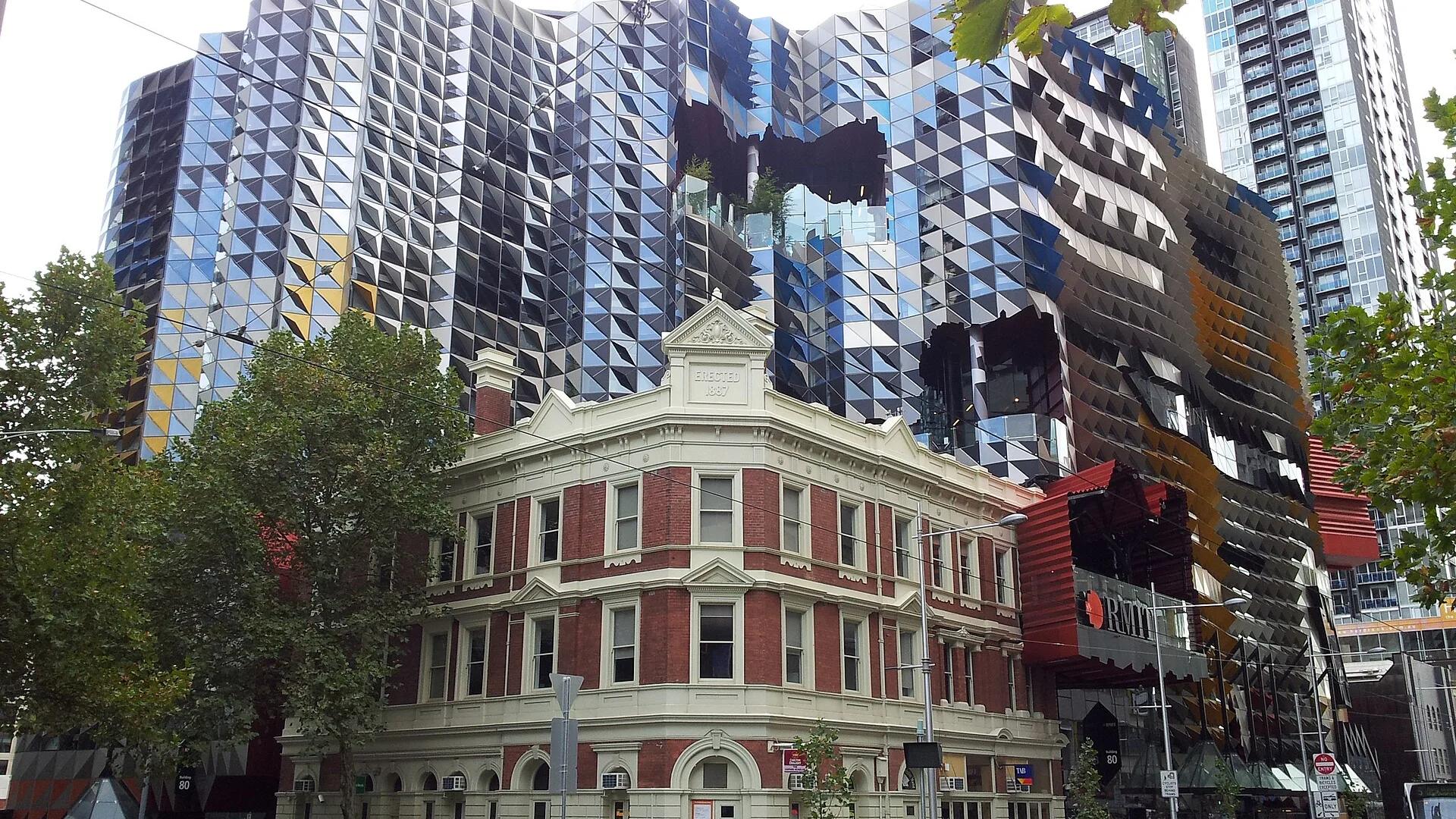
RMIT's City campus spans Melbourne's CBD with iconic contemporary architecture. Two additional Melbourne campuses (Brunswick, Bundoora) host specialised programmes.
True CBD campus
Embedded in central Melbourne — employers, culture and transport at the door
Design & maker facilities
Studios, fabrication labs and galleries among the best in the region
100+ clubs and societies
Large, diverse international student community with strong Indian student association
Programs at RMIT
Master of Information Technology / Computer Science
RMIT's IT and computer science programmes are built with industry input from Melbourne's growing tech sector. Coursework covers software engineering, cloud, cybersecurity and AI, with capstone projects delivered for real industry clients. Melbourne hosts significant operations of major banks, consultancies and tech companies, and RMIT's city-campus location puts students minutes from employers.
Master of Engineering (multiple specialisations)
Engineering at RMIT spans mechanical, electrical, civil, aerospace and manufacturing, with strong laboratory infrastructure and Engineers Australia accreditation. The university's dual-sector heritage means programmes stay close to industry practice — a genuine advantage for employability-focused students.
Design (Communication, Industrial, UX) — Bachelor & Master
RMIT is ranked in the world's top tier for Art & Design in the QS subject rankings — the strongest design brand in Australia. Studios are practice-led and portfolios built here carry weight with employers globally. For creative Indian students who want a globally recognised design education at a fraction of US/UK cost, RMIT is the standout Australian option.
Master of Business Administration (MBA)
A practical, industry-connected MBA in central Melbourne with strong emphasis on experiential projects. Not a ranking-chaser like Melbourne Business School — but significantly more affordable and well suited to career-changers targeting Australian industry.
Aviation & Aerospace programmes
RMIT is one of the few universities in the region with its own aviation training heritage, flight training partnerships and aerospace engineering depth — a niche where it competes with far higher-ranked universities.
RMIT runs two semesters (February/March and July intakes) — the July intake is a genuine option for students who miss the main cycle, unlike many US universities. Most master's programmes are 1.5-2 years, which qualifies graduates for Australia's post-study work visa.
Admission Requirements
RMIT is accessible for well-prepared Indian students: the university evaluates on academic record and English proficiency rather than entrance exams, and has an active admissions presence in India. Competitive programmes (design studios, some engineering specialisations) assess portfolios or require higher cut-offs.
Under the Australia-India ECTA agreement, Indian graduates of Australian master's degrees are eligible for up to 3 years of post-study work rights — longer than most other nationalities receive. Combined with Melbourne's job market, this is one of the strongest work-outcome pathways available to Indian students anywhere.
Master's Programs
- MS Information Technology
- M.Eng (Mechanical/Electrical/Civil/Aerospace)
- Master of Data Science
- Master of Cyber Security
- Master of Design (various studios)
- Master of Analytics
MBA Program
- Full-Time MBA (Melbourne CBD)
- Executive MBA (part-time)
What Type of Student Gets In?
Practical and career-driven — motivated by real projects over theory
Independent — city universities suit self-starters
Portfolio-builders: designers, makers, engineers who ship things
Strategic about using post-study work rights to build a career
Indian students treat RMIT as a 'backup' to Go8 universities and then are surprised when the design or IT graduate from RMIT gets hired faster than their Go8 friends. Rankings measure research; employers in Melbourne hire experience. Pick RMIT deliberately for the industry-embedded model — not accidentally as a fallback.
Costs & ROI
Fees vary by programme — verify the exact figure on RMIT's fee schedule before budgeting. Students can work up to 48 hours per fortnight during term. Under ECTA, Indian master's graduates get up to 3 years of post-study work — the earning window materially changes the ROI calculation versus a 1-year UK master's.
| Level | Tuition |
|---|---|
| Postgraduate (2026) | AUD 38,400 - 50,880/year |
| Undergraduate | AUD 35,000 - 48,000/year |
| Living Costs (Melbourne) | AUD 2,000 - 2,900/month |
Salary Ranges
Career & Industry
Melbourne's corporate ecosystem
RMIT's city campus is embedded in Melbourne's CBD — the university's work-integrated learning places students into banks, consultancies, government agencies and startups across the city as part of their degrees.
Engineering & aerospace industry
Long-standing partnerships across Victoria's manufacturing, infrastructure and aerospace sectors feed capstone projects and graduate recruitment.
Application Timeline
12-18 Months Before
- Shortlist programmes and check portfolio requirements for design
- Understand the Genuine Student visa requirement
- Research scholarships (RMIT offers international merit awards)
9-12 Months Before
- Take IELTS/TOEFL
- Build portfolio for design programmes
- Prepare SOP and references
6-9 Months Before
- Apply directly or via agent — rolling admissions for both Feb and July intakes
- Apply for merit scholarships
3-6 Months Before
- Accept offer and pay deposit
- Lodge Student Visa (subclass 500) with GS statement
- Arrange OSHC health cover (mandatory)
1-3 Months Before
- Arrange accommodation — CBD student housing or share-houses in Carlton/Brunswick
- Plan finances — Melbourne is Australia's second-most expensive city
Arrival
- Attend orientation
- Set up bank account and tax file number (for part-time work)
- Explore Melbourne's laneways — the city IS the campus
RMIT vs Peers
RMIT vs University of Melbourne
RMIT: Industry-embedded curriculum, world top-tier design school, CBD campus, more accessible admissions, lower fees
Other: Top-20 global ranking, stronger research and brand prestige, Go8 network, stronger consulting/finance placement
Compare →RMIT vs Monash University
RMIT: Central Melbourne location (Monash's main campus is suburban Clayton), design leadership, practice-led teaching
Other: Higher global ranking, larger research output, stronger in medicine/pharmacy, bigger global alumni network
Compare →RMIT Is Right For...
- Students prioritising job outcomes and industry experience over brand prestige
- Creative students — RMIT design is world top-tier
- Engineers and technologists who want practice-led teaching
- Students targeting Melbourne's job market with ECTA's 3-year work window
- Those who want a true city-campus experience
RMIT Is Not Right For...
- Students chasing maximum global brand recognition (choose a Go8 if admitted)
- Those wanting a traditional green campus — RMIT is vertical and urban
- Research-career aspirants targeting PhD pipelines at research-intensive universities
- Students on tight budgets who have not planned for Melbourne living costs

Dr. Karan Gupta's Advice
FAQs: RMIT for Indian Students
Is RMIT good for Indian students?
Yes — particularly for IT, engineering, design and business students who prioritise employability. RMIT's industry-embedded degrees, Melbourne location, and the ECTA provision giving Indian master's graduates up to 3 years of post-study work make it one of the strongest outcome-focused choices in Australia. The Indian student community is large and well supported.
How does RMIT compare to the University of Melbourne?
Melbourne is a Go8 research university ranked in the world's top 20 — it wins on prestige, research and brand. RMIT wins on industry integration, design education, practical teaching, and often on graduate job-readiness. If you have the profile and budget for Melbourne and want the brand, choose Melbourne. If your goal is a job in industry — especially in design or technology — RMIT is a deliberate, defensible first choice.
What is RMIT's tuition for international students in 2026?
Postgraduate international fees range from AUD 38,400 to 50,880 per year depending on programme; undergraduate fees are broadly AUD 35,000-48,000. Always verify the exact fee for your programme on RMIT's official fee schedule. Merit scholarships for international students can reduce this meaningfully.
How long can Indian students work in Australia after RMIT?
Under the Australia-India ECTA agreement, Indian nationals completing an Australian master's degree are eligible for up to 3 years on the Temporary Graduate visa (bachelor's graduates get 2 years; first-class STEM/ICT honours can also get 3). This is more generous than the standard provision and is a major strategic advantage for Indian students choosing Australia.
Related Articles
The ₹0 List: Free Opportunities That Actually Strengthen a Student’s Profile
The best summer opportunities are not always expensive. Discover selective ₹0 programs that can demonstrate genuine student achievement.
Demonstrated Interest in US College Admissions: What Students Need to Know
Demonstrated interest can strengthen US college applications, but only when students know which universities value it and engage genuinely.
IMO Olympiad Explained: The Official Pathway in India
Two exams in India are called IMO. Only one is the official pathway to India's International Mathematical Olympiad team.
Want to Study at RMIT?
Get expert guidance from Dr. Karan Gupta: Harvard alumnus, 27+ years of global admissions experience guiding 160,000+ students worldwide.