NYC Apartment Scams: A Student’s Guide to Renting Safely

Dr. Karan Gupta is a Harvard Business School alumnus and career counsellor with 27+ years of experience and 160,000+ students guided. His insights on Study Abroad come from decades of hands-on experience helping students achieve their goals.
Every August and September, thousands of students arrive in New York City needing an apartment quickly. That urgency is exactly what rental scammers exploit.
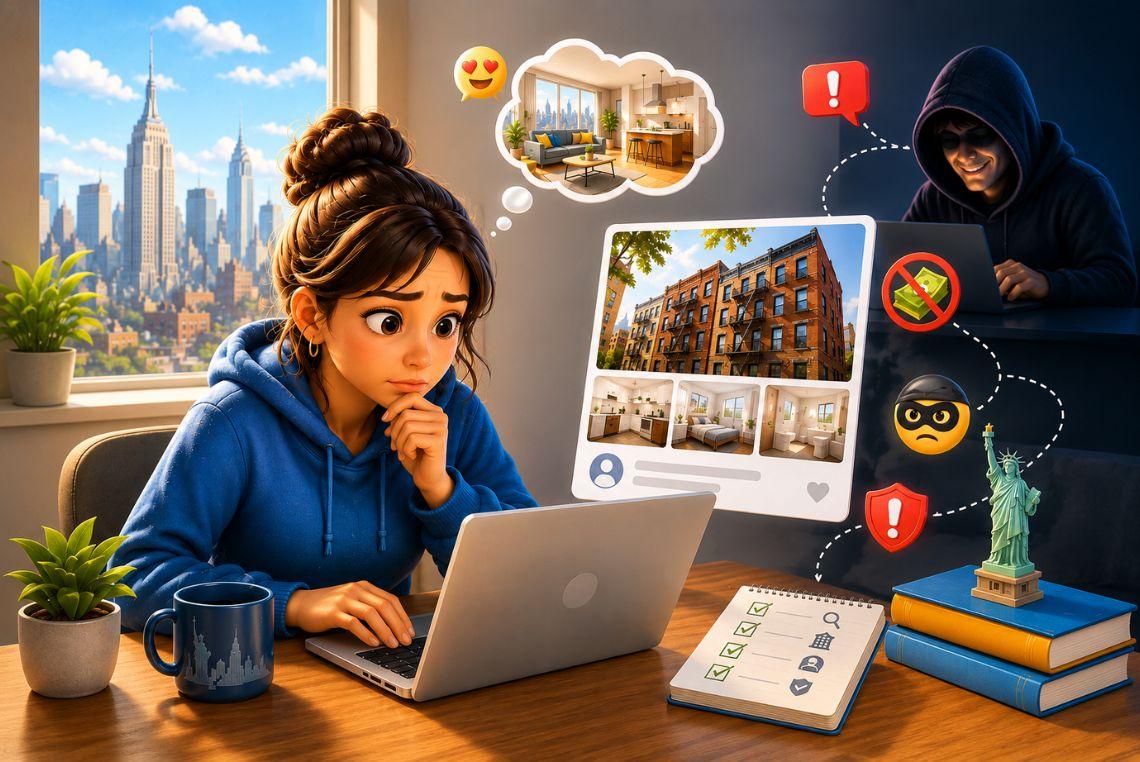
A student sees a beautiful apartment on Craigslist, Facebook Marketplace, or another online platform. The rent looks surprisingly reasonable. The location is perfect. The person responding claims to be the landlord or agent.
Then comes the story: “I’m currently abroad, so I can’t show you the apartment. But I can send you the lease. Just pay the security deposit, and I’ll hold it for you.”
The student sends $5,000.
Free Tool
Free Profile Evaluation
Get an honest AI assessment of your study-abroad profile in 2 minutes.
Try it free →The “landlord” disappears.
The apartment either does not exist, is not available for rent, or belongs to somebody else entirely.
This is not a theoretical risk. The Federal Trade Commission reported in December 2025 that consumers had reported nearly 65,000 rental scams and approximately $65 million in losses since 2020. People aged 18–29 were three times more likely than other adults to report losing money to a rental scam. Facebook was the most commonly reported starting point, followed by Craigslist.
For international students, the risk can be even greater. They may be searching from India or another country, may not know how New York rentals work, and may feel enormous pressure to secure housing before classes begin.
The good news is that most NYC apartment rent scams reveal themselves if you know what to check.
Here is the complete NYC apartment checklist: what is legal, what is a red flag, and how to verify a listing in about 30 seconds before sending money or personal information.
Why NYC Apartment Rental Scams Target Students
Scammers look for situations where the victim is under pressure.
A student arriving in New York has several disadvantages:
- They may be searching from thousands of miles away.
- They may not understand NYC rental practices.
- They may have limited U.S. credit history.
- They may be unfamiliar with brokers and landlord requirements.
- They may be competing for apartments before the fall semester.
- Their parents may be making payments remotely.
- They may believe that paying quickly is the only way to secure a good apartment.
That combination creates an ideal target.
The scammer does not necessarily need to create a completely fake apartment. The FTC says scammers often copy legitimate rental listings, change the contact information and repost the property elsewhere. Some even copy listings for properties that are actually for sale.
That means a listing can look completely authentic and still be fraudulent.
How an NYC Apartment Rent Scam Usually Works
The typical scam follows a predictable sequence.
1. The listing looks unusually attractive
The apartment has excellent photos, a desirable location and a rent that appears lower than comparable apartments.
The scammer wants you to think:
“If I don't act now, someone else will take it.”
2. The scammer creates a believable identity
They may present themselves as:
- The landlord
- A property manager
- A real estate agent
- An existing tenant subletting the apartment
They may also send a convincing lease, identification document or photos.
None of these proves that they control the apartment.
3. There is an excuse for why you cannot see it
Common explanations include:
“I'm travelling.”
“I'm overseas.”
“The current tenant is away.”
“I'll send the keys after you pay.”
This is one of the biggest warning signs.
NYC's own guidance tells renters not to make advance payments before viewing a property and not to complete an application containing personal information before seeing the apartment.
4. Urgency enters the conversation
You may hear:
- “There are five other applicants.”
- “Send the deposit today.”
- “I can only hold it for a few hours.”
- “Someone else is ready to pay.”
- “Classes are starting, so you need to decide now.”
Pressure is not proof of a scam by itself. But pressure combined with an inability to view the apartment is a major warning sign.
5. The money disappears
The scammer may request a deposit, first month's rent, application fee or “reservation fee.”
The FTC specifically warns renters to be cautious when someone insists on cash, gift cards, cryptocurrency or wire-transfer services such as Western Union or MoneyGram. These payments can be extremely difficult to recover.
The NYC Apartment Checklist:
What Is Legal and What Is a Red Flag?
Before your child signs a lease, use this checklist.
Generally legitimate
A physical viewing is possible.
You or someone you trust can see the actual apartment before committing.
The person can establish their connection to the property.
A landlord, management company or legitimate broker should be able to explain who owns or manages the apartment.
The lease identifies the relevant parties and property.
Do not treat a PDF lease as proof that the person sending it has authority to rent the apartment.
Fees are disclosed clearly.
New York City has specific rules governing rental fees, including important changes under the FARE Act.
The security deposit is within the legal limit.
New York law generally limits a security deposit to no more than one month's rent.
The apartment appears legally occupiable.
NYC's Department of Buildings recommends checking building history, violations and permits and looking for basic safety features before signing a lease.
Major red flags
“I am abroad and cannot show the apartment.”
“Pay first, and I will send the keys.”
“You have to wire the deposit immediately.”
The rent is dramatically below comparable apartments.
The landlord refuses an in-person or trusted-person viewing.
You are asked for sensitive personal information before viewing the property.
The listing appears under different names or contact details on different websites.
The person creates artificial urgency.
The payment recipient does not match the verified landlord, management company or legitimate transaction.
You are pressured to use cryptocurrency, gift cards or money-transfer services.
NYC's immigrant-services guidance specifically warns renters against advance payments before viewing, wire transfers and applications containing personal information before seeing the property.
The FARE Act:
An Important NYC Rental Rule Parents Need to Know
There is another important development that every student renting in New York City should understand.
The Fairness in Apartment Rental Expenses (FARE) Act took effect on June 11, 2025.
Under the law, a broker representing the landlord generally cannot charge the tenant a broker fee. Landlords and their agents must also disclose other fees that the tenant is required to pay in the listing and rental agreement.
This is particularly important because many families are unfamiliar with NYC's traditional broker-fee system.
The FARE Act does not mean that every broker fee is illegal. A tenant can still choose to hire their own broker and pay that broker. What the law prohibits is a landlord's broker passing their fee on to the tenant.
So if a student is told:
“You must hire me and pay me a broker fee before you can rent this apartment,”
Stop and verify exactly who the broker represents and why the fee is being charged.
Do not simply assume that a large “broker fee” is a normal cost of renting in NYC.
How to Verify an NYC Apartment Listing in 30 Seconds
You do not need to become a real estate expert.
Before sending money, run this quick test.
Step 1: Search the exact address
Put the complete street address into Google.
Look for:
- Other rental listings
- Real estate websites
- Property management websites
- Sale listings
- Different contact names
- Different rental prices
If the same apartment appears online with a completely different contact person, investigate before proceeding.
Step 2: Search the person's name and phone number
Search the landlord, agent or management company.
Add terms such as:
“scam”
“complaint”
“review”
“rental”
The FTC recommends searching for the property owner or rental company and checking what others report about their experiences.
Step 3: Confirm that the apartment can actually be viewed
This is the most important test.
Ask for an in-person viewing.
If the student is still in India, have a trusted person in New York visit it.
If nobody can physically see the apartment, do not send the deposit simply because the listing looks convincing.
The FTC recommends having someone you trust view the property if you cannot visit personally.
Step 4: Check the building
NYC's Department of Buildings advises prospective tenants to research building history, violations and permits through its Buildings Information System. It also recommends checking for smoke and carbon-monoxide detectors, two ways to exit in case of fire, natural light and ventilation, and other basic safety conditions.
This takes longer than 30 seconds, but it is worth doing before signing.
Why Photos, Video Tours and Leases Are Not Enough
A common mistake is assuming that sophisticated documentation means the listing must be genuine.
It does not.
A scammer can download real apartment photographs.
They can copy a legitimate listing.
They can create a professional-looking lease.
They can conduct a video call.
They can even provide a real address.
The question is not:
“Does this look legitimate?”
The question is:
“Can I independently verify that this person has the legal authority to rent this specific apartment?”
That distinction matters.
The FTC has reported that scammers increasingly copy genuine listings and manipulate contact information. It has also warned that scammers may use self-guided tours or lockboxes to make fraudulent listings appear legitimate.
So even seeing a property is not the end of your due diligence. Verify the person and the transaction as well.
What About Sending a Security Deposit?
A security deposit itself is not suspicious.
A legitimate landlord can require one, and New York law generally limits it to one month's rent.
The problem is sending a large amount of money to an unverified person for an apartment you have not independently confirmed.
Before paying, ask:
- Have I physically seen the apartment?
- Have I verified who owns or manages it?
- Does the person I'm paying have authority to rent it?
- Does the lease identify the correct property and parties?
- Are all required fees clearly disclosed?
- Is the payment recipient consistent with the verified transaction?
- Have I independently searched the address and contact details?
If you cannot answer these questions, stop.
What If the Student Is Still in India?
This is where parents need to be particularly careful.
The student does not need to personally fly to New York before every apartment decision.
But somebody should physically verify the apartment.
That could be:
- A trusted family friend
- A relative
- A university contact
- A legitimate housing professional
- A trusted person already living in NYC
A virtual tour can be useful as an additional step, but it should not replace independent verification when the other party is asking for thousands of dollars.
And never let the approaching semester become an excuse to skip due diligence.
A legitimate apartment may be difficult to secure. That is frustrating.
Losing $5,000 to a scam is worse.
What If You Have Already Been Scammed?
Act immediately.
Save everything:
- Screenshots of the listing
- Emails and WhatsApp messages
- Phone numbers
- The lease or documents sent to you
- Payment receipts
- Bank details
- Names used by the person
- URLs for the original listing
- Copies of advertisements
Do not delete the conversation simply because it is embarrassing.
NYC's FARE Act guidance also recommends retaining evidence such as text messages, screenshots, receipts and contact information when making a complaint.
Contact the financial institution or payment provider immediately and ask whether the transaction can be stopped or recalled. Report the suspected fraud to the appropriate authorities and platform where the listing appeared.
Speed matters because some payment methods are difficult or impossible to reverse.
The 10-Second Rule Every Parent Should Teach
Before your child pays for an NYC apartment, teach them this sentence:
“I will not send money until I have independently verified the apartment, the person renting it and the payment.”
That one rule can prevent an enormous financial loss.
And remember the four simplest rules:
- See the apartment before paying.
- Never let urgency override verification.
- Be extremely cautious with irreversible payment methods.
- Verify the landlord, property and fees independently.
The NYC apartment market can be complicated, particularly for students arriving from another country. But complexity is not an excuse to rush.
A good education decision should not begin with a bad housing decision. Families planning a U.S. education should spend as much time understanding the college, academic fit and admissions strategy as they do arranging accommodation. The right preparation reduces expensive mistakes long before a student arrives on campus.
Explore Related Resources & Tools
Free tools and expert services from Karan Gupta Consulting
Frequently Asked Questions
How can I tell if an NYC apartment listing is a scam?
Is it safe to rent an NYC apartment without seeing it first?
Can an NYC landlord charge a broker fee in 2026?
How much can a landlord charge for a security deposit in New York?
What should I do if I paid an NYC rental scammer?
Why Choose Karan Gupta Consulting?
- 27+ years of expertise in overseas education consulting
- 160,000+ students successfully counselled
- Personal guidance from Dr. Karan Gupta, Harvard Business School alumnus
- Licensed MBTI® and Strong® career assessment practitioner
- End-to-end support from career clarity to visa approval
SHARE THIS ARTICLE

Dr. Karan Gupta
Founder & Chief Education Consultant
Harvard Business School alumnus and India's leading career counsellor with 27+ years guiding 160,000+ students to top universities worldwide. Licensed MBTI® practitioner. Managing Director of IE University (India & South Asia).