Is a Foreign Degree Still Worth It? What I Told Raj Shamani

Dr. Karan Gupta is a Harvard Business School alumnus and career counsellor with 27+ years of experience and 160,000+ students guided. His insights on Study Abroad come from decades of hands-on experience helping students achieve their goals.
Watch the full two-hour episode on YouTube (FO574, 14 October 2026). The frameworks are also mapped on karangupta.com/figuring-out.
Every year Indian families spend crores on a foreign degree. This week I sat down with Raj Shamani on Figuring Out to answer one question honestly: in 2026, is it still worth it?
The short answer is that it depends on who you are, what you will study, and how you are paying for it. The long answer took two hours. You can watch the full episode on YouTube. This post is the version you can read in fifteen minutes, with the frameworks I use in my own counselling room laid out in one place.
A note before we start. I have counselled students for nearly three decades, and I have watched the same cycle repeat in every destination country. Policies open, policies close, and families who planned their lives around a visa rule get caught in the middle. So nothing below is a prediction about visas. It is a way of thinking that survives whatever the visa rules do next.
Free Tool
Scholarship Finder
Find scholarships you actually qualify for, by country, level and profile.
Try it free →The first question is not "which country"
Raj asked me what the single first question should be before a family even considers studying abroad. My answer surprised him: what are you going to study, and will that course get you the future you are imagining?
Take marketing. I am a humanities student myself and I love the subject. But if you think you will go abroad and market products better than a local can in their own country, it will not happen. Add analytics to it, make it marketing analytics, and you have a chance. The same logic applies to finance, which is why I push students towards computational or mathematical finance. Throw in your quant.
Once the course is clear, the plan becomes clear. If you want a London Business School education to come back and build a company in India, go, because you will not get that education here. If you want to work in Silicon Valley, go to Stanford or Northwestern, because you will not get there directly from Mumbai. Country comes last. Course, then specialisation, then the specific universities whose career reports show their graduates doing what you want to do.
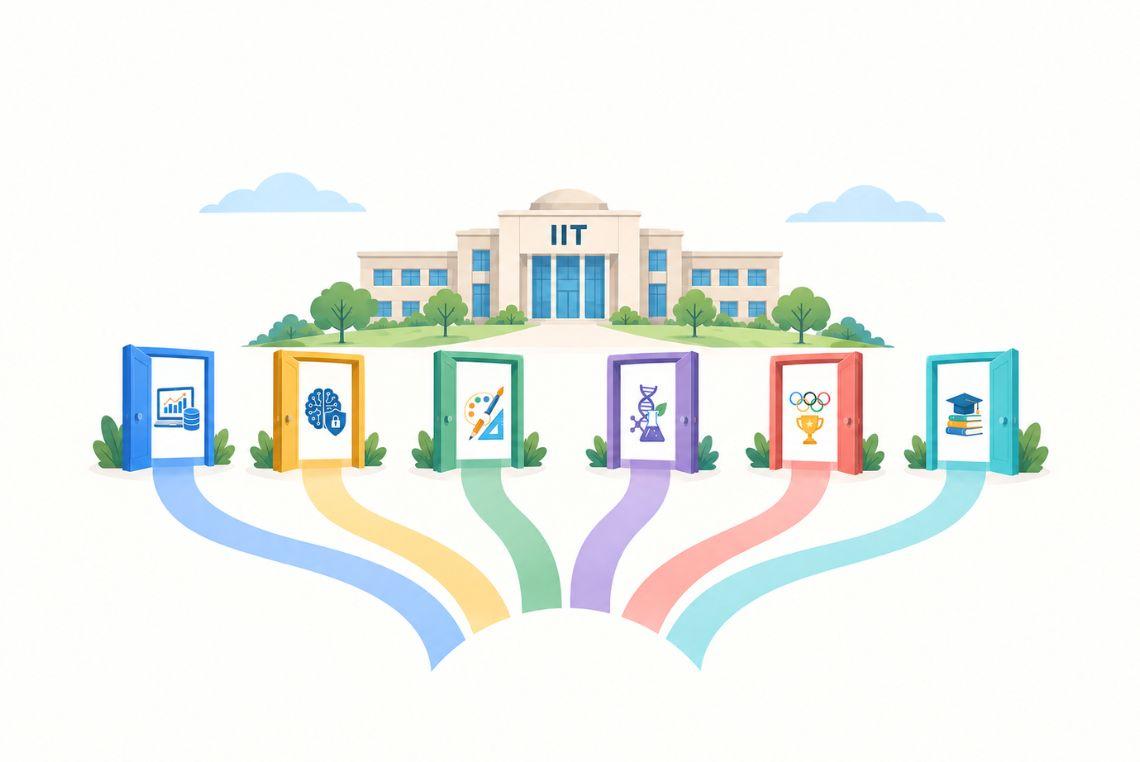
There is also an uncomfortable truth about capacity. India does not have the seats for its talented students. Roughly 14.75 lakh students sit the JEE for about 18,000 IIT seats, and 2.58 lakh sit the CAT for a few thousand IIM places. For many bright students, going abroad is not aspiration. It is the only door that is open.
Six students, six different answers
Raj put six profiles in front of me and asked where each one should go. The answers show why a blanket "study abroad is dead" headline is useless. The same budget and the same year produce opposite advice depending on the student.
| Profile | Who they are | My call |
|---|---|---|
| The safe bet | 70% academics, ₹25 lakh budget, wants no debt and a stable job | Do not go. An ISB-type MBA in India at ₹24 lakh CTC is the safer bet. If this student were a 95% student headed to MIT, I would take the risk with them. At 70%, I do not have their back abroad. |
| The risk taker | Top 10% talent, published research, can fund ₹1 crore, wants AI, robotics or EV | Go to the US, and only the top: Ivies, MIT, Stanford, Caltech, Berkeley. A STEM master's gives three years of OPT. If the H-1B does not come, she returns and builds something. This is the student I want to send. |
| The budget hustler | 18, decent academics, nursing, ₹15 lakh a year, wants to stay abroad long term | Apply to a mix of US, UK and Europe because nobody knows which country stays open. Smart play: three years of UK undergrad at ₹15 to 20 lakh a year, then a one-year US master's. She lands in the US job market having paid for one US year instead of four. |
| The PR chaser | Will study anything, just wants permanent residency | Australia and New Zealand still have a PR path. Canada gives PR but not jobs. Learn Spanish or French and look at Europe's entrepreneurship visas. Pick quant-heavy, tech-heavy or healthcare courses, or renewable energy. |
| The prestige hunter | Excellent academics, ₹2 crore plus, wants an Ivy name | The US by default, since all eight Ivies are there. Outside the US, Imperial, NUS, IE and ESADE carry the same weight. Map the universities first and the dots cluster in America. |
| The 30-year-old stuck at ₹1 lakh a month | Indian bachelor's and master's, average, wants to earn properly | An MBA, not a master's, because peer learning with 22-year-olds will frustrate him. A STEM or finance concentration. Then target schools where 90% of the class is placed within three months. Even at a state school in New York costing about ₹1.5 crore, a starting package of $200,000 to $250,000 is realistic in a quant-heavy field. |
The pattern across all six is the same. Clarity about the course, honesty about the money, and a university chosen from its outcome data rather than its brochure. If you want to see which of the six you are closest to, answer the two questions I asked on the show.
The Five Removals Test
This is a test I developed for students who are not sure whether they want the university or the idea of the university. Remove five things, one at a time. If the university still seduces you after all five are gone, go.
- Remove the brochure. No glossy photographs, no testimonials, no outcomes for a minute. What is the actual content of the course? Who are the faculty? Who will you sit next to?
- Remove the logo. Hide the brand for ten minutes. You do not know whether this is MIT, NYU or a university nobody has heard of. Do you still want to study this?
- Remove the people. If nobody in your life knew this university existed, would you still go?
- Remove the expectations. Mom studied finance. Dad expects marketing. Society expects a name it recognises. Take all of that off the table.
- Remove the job fantasy. Forget the imaginary offer from the imaginary company. The job is a separate decision made by a separate entity, which I come back to below.
Most students who are going abroad to party, or to escape, do not survive the third removal. Those students should not go, and their parents usually do not know that this is the real motive.
There is no predictable country
Raj asked me which country will still be welcoming in three or four years. I could not name one, and I would not trust anyone who does.
I have watched the same cycle for three decades. A politician announces that the population is ageing and the country needs Indian talent. Universities fill up. Housing, healthcare and rent buckle. The rules tighten, the headlines say the country is closing, and a few years later the welcome returns. Canada is the freshest example. It took in anyone for diploma and trade programmes, the system went haywire, and in 2024 it self-corrected with 61% fewer international students.
The United States is in the middle of the same correction. Our own survey of 825 universities this year showed roughly a 17% decline. But look at who is still getting through: students going to good universities, with a plan and the money to pay for it. Students headed to community colleges and sub-par programmes are the ones being turned away. That is a correction, not a closure. The US still has the most jobs and the most people who stay back, whatever the H-1B headlines say.
Germany is the one I would watch. Public universities now teach in English for free, the ambassador is saying "please come", and students are arriving in halls. My prediction is that Germany will self-correct exactly as Canada did, because it cannot generate jobs for that many graduates. Australia changed its rules nine times in about two years. The Middle East is attractive but has only a handful of recognised campuses, such as NYU Abu Dhabi and Birmingham in Dubai.
So the rule is simple. Do not build your life on a visa policy, because it will change. Build it on a course, a university and a plan that still make sense when the policy moves. You can compare post-study work rights and PR paths across 14 countries in the Visa & Work Rights Simulator.
What to study: marry your field to data
Students default to three courses abroad: computer science, finance and marketing. Computer science was a dream and has become a nightmare, marketing graduates come back like headless chickens, and finance still pays. None of that is the point. The point is what you attach to the field you actually enjoy.
I used to tell every student to learn Python. AI now codes better than any of us, so that advice sounds outdated. It is not. Python still lets you debug what AI writes, understand what AI builds, and work in machine learning. The principle is the same in every subject:
- Economics becomes behavioural economics or econometrics
- Health becomes bioinformatics
- Law becomes legal data science
- Psychology becomes human-computer interaction
- Business becomes understanding what machine learning can do for your business, the way the founder of Uber understood surge pricing without writing the code himself
- Even graphic design becomes showing a client why your logo beats the one an AI generated in ten seconds
If you can walk into any interview ten years from now and show how you use AI with your field, you will still be valuable. If your basic skill is the thing AI replaced, you are already gone.
Two areas nobody is talking about. The first is renewable energy. Everyone is studying AI and nobody is asking where AI gets its electricity from. Energy was the evergreen career for the oil and gas generation, and renewable energy is the same bet for this one, in any country. The second is Global Capability Centres. In the late 1990s the world outsourced call centres to India. Today it outsources research, AI, product and design. India has around 2,100 GCCs with about $100 billion in revenue employing more than 2.3 million people, concentrated in Bengaluru, Hyderabad and Mumbai. They pay better than the average Indian employer, and a foreign degree that links to what they have outsourced is a direct route in. Both are mapped, with official links, on the 3 Opportunities page.
What a degree is actually worth: brand, judgment, network
Information is free. If a university thinks it can charge you three crores for information, that university is dead. What it can charge you for is judgment, and that is the test of whether your degree was worth it. After the course, do you know how to question what you are told? Can you tell convincing from correct? If you cannot, the degree did not do its job.
I apply three tests to any degree, including my own.
Brand. I will admit it. When I applied to Harvard, the first reason was that I wanted to be in the number one school in the world. Brand carries forward. A student from one of Asia's best schools has a better shot at Stanford, and a Stanford graduate has a better shot at McKinsey. India's chase for IIT and IIM is the same instinct.
Judgment. Harvard rejected me the first time. The average age in the programme was 42 and I was 34, so they said I was too young. I called the director, explained the work I do and its impact, and she took me in the next term with a scholarship. That is judgment in action: a denial is the end of a decision, not the end of the process. Judgment can be taught, mostly through case studies, where you debate real decisions and real outcomes until you can see what a good decision looks like.
Network. Harvard changed my seat every week so I could not settle into a comfortable group. Eight of us lived together and argued cases every evening. Earlier this year one of those classmates called to tell me he had become the President of Benin. He married another classmate. That is what a university's network should be able to do for you.
Rankings do not measure any of this. A university ranked first goes to eighth next year, and eighth goes to sixteenth. I use rankings only to map which schools are in the top tier. After that I go to the data the university is legally required to publish: where did last year's graduates actually go, and did they set up the kind of businesses I want to set up? That data is my reality, not a number.
The money: a better ROI formula, and how to fund it
Parents arrive with one formula: tuition plus living costs, divided by the salary, equals the years to pay it back. That formula works for an IIM, an SPJIMR or an ISB because India has placement cells. The university takes on the job of placing you, even if it is not in your dream job, because it needs 100% placement for next year's batch.
Placement cells do not exist outside India. Universities abroad have career management centres. They train you for interviews, polish your resume and introduce you to alumni, but the onus of finding the job is yours. So the Indian formula breaks the moment you cross the border.
The formula I built live with Raj has two parts. X is the job, career or business the degree leads to. Y is the personal transformation: the judgment, the network, the ability to live alone and figure things out. Your ROI is X plus Y. Raj added the point that Y compounds. Two graduates may start on the same salary, but the one who learned to network, to be resourceful and to lead is far ahead ten years later. You cannot put a price on Y, which is exactly why families ignore it. Run the X half of the formula for your own numbers in the Cost Calculator.
Money should not be the reason you do not go. The funding routes most families never use:
- Education loans from Indian state and private banks now go up to about ₹1.5 crore, as long as the loan stays under 80% of tuition plus living costs. Banks judge the course too, so a recognised university and a recognised course matter.
- Co-signer-free loans from private lenders if you are admitted to a top university. They lend the entire fee with no guarantor, because the brand on your admission letter is their guarantee. Nobody funds a state-school education that way. Everybody funds a Harvard one.
- Teaching and research assistantships at the graduate level. Twenty hours a week with a professor, tuition waived, plus a monthly stipend. Your entire master's can be free.
- Need-based aid at the Ivies and other private schools. You declare family income, assets and expenses, and if they admit you they fund the gap. I have had students granted 98% of need who paid about $2,000 on a $100,000 fee.
- Named scholarships such as Erasmus Mundus, which adds about €1,400 a month to the tuition, the Tata Cornell and J.N. Tata scholarships, and India's own National Overseas Scholarship for lower-income students from certain communities. Search them by country and course in the Scholarship Finder.
- Government skilling money in India itself. The current AI programme pays undergraduates around ₹1 lakh, master's students around ₹2 lakh, and PhD students ₹70,000 to ₹80,000 a month plus a research grant.
Then there is the hack. Not every university gives merit aid and not every university gives need aid, so university selection is the first scholarship strategy. Once you hold one offer, show it to the other universities and ask them to match it. We make universities bid against each other for good students. It is not unheard of. It is now quite common.
Building a profile: the three boxes
Can an average student be made into a good one? Always, and the method is not flowery. Academics and test scores decide which band of universities we target. After that, every profile on the admissions table is read through three boxes.
- Capable. Leadership, sport, debate, drama, Model UN, chess, hiking, scuba. The box that shows you can do many things.
- Credible. Evidence that you are serious about your intended major. A paper in a Scopus-indexed journal, articles, internships, online courses in the field.
- Memorable. One passion project that defines you. A startup, an NGO, the one thing people remember. I had a student who had trained in judo for three years and cared about women's safety. We put the two together: she taught self-defence to underprivileged women, and that became her story.
The boxes must read as one person, not three different children. Get the coherence right and you do not just get into the university you are aiming for. You get the scholarship from it, because this is a real profile, not a spun one. The boxes change for undergraduate, graduate and PhD applications. The thinking does not. The Profile Evaluator scores the three boxes for your own profile.
Visas: the officer needs a reason to deny you
The visa is the monster every family fears, and the US visa most of all. Here is what I actually see. If you are going to a good university, your rejection chances are under 1%. When the officer looks at an I-20 from Carnegie Mellon or NYU, they need a reason to deny you, and you would have to badly mess up the interview to give them one.
The rejections are happening somewhere else. The officer sees an I-20 from a random state university and asks: do you know where this is? Do you know the city, the state, anything about why you chose it? The student fumbles, and the visa is denied. In my view the US is deliberately giving visas to the best and turning away students headed for community colleges and average programmes. That is the correction I described above, and you will see it continue.
The social media rule is real. Your profiles must be public for the last five years, and the US does not want students who have posted against its government or who will arrive on campus and protest about issues that do not concern them. Whether that is right is not for me to judge. I will only say that India would deport a foreign student who did the same thing here. If you have strong political views and you love posting them, be honest with yourself: the US is not the country for you right now. Europe and the UK do not check, and they will take you happily.
In almost three decades I have never had a student denied a visa for a political post. But I have had many denied because they could not explain why they chose their university.
Counsellor or agent? Ask who is paying
India confuses two professions. A counsellor works with your child: strengths, weaknesses, the right course, the right university, the exercises I walked Raj through above. An agent is a contractor of a university, and the agent's job is to send you to that university.
Here is how the chain works. A university has an aggregator. The aggregator has an agent. The agent has a sub-agent, who is the person sitting across from a family in Mumbai. When someone tells you their counselling is free, ask: free for whom? Everyone in that chain is being paid. If an agent is paid by five universities, they will never recommend the sixth, and a student with a brilliant profile ends up at a substandard university because that is where the commission is.
Not every agent is bad and not every counsellor is good. What matters is transparency about who is paying the person advising you. A UK survey found that 55% of UK universities use agents, so the business is real and it is not going away. Protect yourself in three steps: treat "free" as the first red flag, go to the university's own website and call them, and find an alumnus who will tell you first-hand what the education was like.
The cautionary tale is the student who lands in a village in Italy where only one professor speaks English, or the medical student in Eastern Europe who returns to find the degree is not recognised and the licensing exam is one most of them fail. A medical dream can shrink to a paramedical job that way. If you spend that much money without speaking to ten people first, I am sorry, but you are to blame.
Getting the job: four decisions, four entities
Can you be certain of a job at the end? No. There is no 100% in any part of this process, and if anyone promises you one, run as fast as you can. Families bundle four separate decisions into one and then feel cheated when one of them goes wrong:
| Decision | Who makes it |
|---|---|
| Admission | The university |
| Visa | The consulate or embassy |
| Job | The company |
| Permanent residency | Government policy |
Each needs its own strategy, and that is what a proper road map is. Two cases from the episode show the difference between hoping and planning.
A student from Odisha took a £25,000 loan for a master's in finance at Dundee. The plan was the standard one: get the job, repay the loan. The job never came. He spent a year washing vegetables outside his own university before returning to India to look for work. Another student did her undergraduate degree at Nottingham and her master's at Bath, and walked into a renewable energy role in the UK. Same country, same years, opposite outcomes. The difference was not luck. It was the plan.
The plan starts on day one. One of my students was in a vertical campus in New York, the kind with no green lawns and, everyone told him, no campus jobs. He printed his resume, took the lift to the 17th floor, and introduced himself on every floor on the way down. By the fourth floor his phone rang. He was interviewed that day and hired the next. Conviction, not luck.
For the main job hunt I teach a strategy I call MATCH:
- Map the market. Collect the 20 or 30 roles you want and put them into an AI tool to find the skills they share.
- Assemble your evidence. Put your resume in next to them. Do not ask it to "fix my resume", which is the most ridiculous prompt you can give. Ask what skills are missing.
- Target the whole ecosystem. The smaller companies and the segments you have not thought of, not just the famous 30.
- Combine networking with AI. Use AI to find where your university's alumni work and what they did to get there. Then write the email yourself, because everyone can spot the AI-written one.
- Hone your skills. Make the AI interview you, and tell it to stop flattering you and be critical.
And then meet people. Faceless networking is dying, because in a world where anyone can send a thousand emails, a human only gives a human a job. You are not a PDF. Let someone remember your face.
The cost nobody budgets for
Nobody puts loneliness in the spreadsheet. When I studied abroad it took me more than six months to adapt to it. Things are easier now, because parents are on FaceTime every morning and students have already seen the country through a hundred TV series before they land. A UK survey still found that 58% of international students report loneliness, and that matches what I hear.
So let me say it plainly. You are going to be lonely. You will miss home. You will cry in your first semester and ask why you came. You will discover you do not know how to use a washing machine or cook a basic meal, and there will be no mother, father or sibling in the background. Friendships will feel shallow next to the deep-rooted ones you left, which is why Indians abroad end up with Indians, who understand that you can turn up at someone's house without calling first.
Then the transition ends, and almost every student tells me it was the best thing that ever happened to them. The data agrees. Top universities report around 99% retention for Indian students, which means our students cope. Part of the pre-departure work I do is checking whether a student can handle that pressure, using small signals like a boarding school stint or a summer programme abroad. Without adversity there is no growth, and without that loneliness you never learn what you left behind was worth.
Stay back or come back?
The question everyone asks last. My answer has two halves and no judgment between them.
If you have something good waiting at home, come back. India is growing at a phenomenal pace, the GCCs are hiring, and a company serving a billion people can grow in a way nothing abroad can match. Bring the skills back and be part of that story.
If you would rather work abroad, take a job you genuinely enjoy, in a country you want to be in. Do not get stuck in a role for five or seven years because you feel you have to earn the degree back. Someone asked me recently whether I would choose five crores or happiness. I said five crores. Work for four or five years, collect a good sum, and then choose the path that gives you happiness from a position of strength. Life is not as abstract as a single either-or question.
And if you asked me for one underrated destination today, I would say Spain. It has a post-study entrepreneurship visa that lets you set up a business, universities like IE and ESADE with real brand weight, and a genuine welcome for international students. Learn the language and you can build a good life there.
The one thing I will not do is send a student to study somewhere in order to immigrate. If you want PR, say so on day one, and we will upskill you in a place where you have a real chance of finding employment. Through the job comes the residency, never the other way round.
Information expires. Judgment travels.
People ask why I never wrote a how-to guide called "Harvard in 10 steps". Because the book does not exist, and the concept does not exist. The moment we talk about a visa rule, it changes. The moment we talk about a strategy, it changes. Any how-to would expire faster than I could write it.
That is why The Admission Diaries is 33 short stories instead. University decisions are never really about rankings, essays and SOPs. They are about fear, ambition, love, letting go, parents and siblings. We may map out a life for a child, and the child may want something else altogether. Information will expire. Judgment will travel with you.
If you took one thing from the two hours with Raj, take the SSF framework. Every fight in my counselling room between a parent and a student is about one of three things. Parents chase security when they insist on engineering or a top name. Students chase freedom when they say they do not want something so hard. Everybody chases status when the neighbours ask which university. The fight is never about Oxford versus UCLA. Name the thing each person is actually chasing, and the conversation changes.
If you want that conversation with someone who has had it 160,000 times, book an initial consultation with KGC. And watch the full episode if you have not yet. Raj asked better questions than most parents do.
Explore Related Resources & Tools
Free tools and expert services from Karan Gupta Consulting
TAGS
Frequently Asked Questions
Is a foreign degree still worth it in 2026?
Which country will still be welcoming to Indian students in three or four years?
What is the Five Removals test?
How should families calculate the return on a foreign degree?
What is the difference between a counsellor and an agent?
Why Choose Karan Gupta Consulting?
- 27+ years of expertise in overseas education consulting
- 160,000+ students successfully counselled
- Personal guidance from Dr. Karan Gupta, Harvard Business School alumnus
- Licensed MBTI® and Strong® career assessment practitioner
- End-to-end support from career clarity to visa approval
SHARE THIS ARTICLE

Dr. Karan Gupta
Founder & Chief Education Consultant
Harvard Business School alumnus and India's leading career counsellor with 27+ years guiding 160,000+ students to top universities worldwide. Licensed MBTI® practitioner. Managing Director of IE University (India & South Asia).