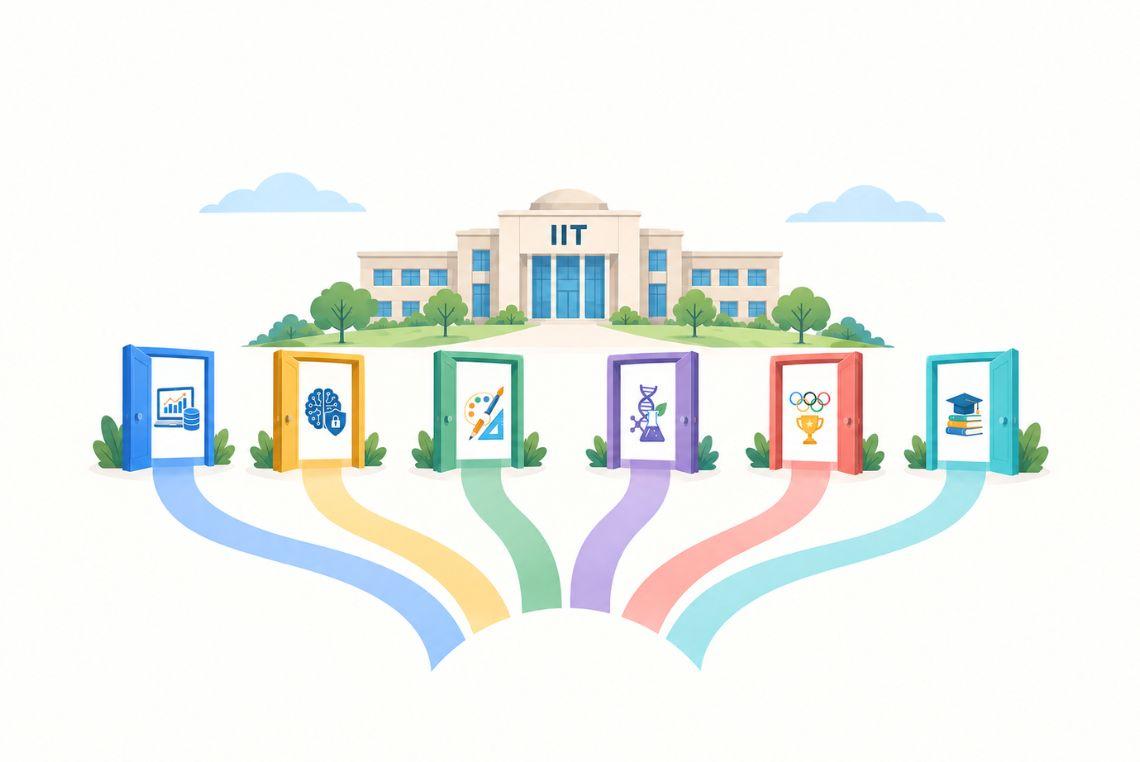
6 Secret Doors to IITs Beyond JEE: Alternative Admission Routes

Dr. Karan Gupta is a Harvard Business School alumnus and career counsellor with 27+ years of experience and 160,000+ students guided. His insights on Career Guidance come from decades of hands-on experience helping students achieve their goals.
For most Indian students, getting into an IIT means JEE Main, JEE Advanced and a BTech.
That remains the principal route to a traditional, residential IIT BTech. But it is not the only way to study at an IIT.
Today, IITs offer undergraduate and postgraduate programmes through online and hybrid degrees, UCEED, the IISER Aptitude Test, Olympiad-based admissions, GATE and JAM.
These are not simply easier alternatives to JEE. They lead to different programmes, have different eligibility rules and, in some cases, offer a very different student experience.
Free Tool
University Predictor
Find out which universities you can realistically get into.
Try it free →Here are six routes students and parents should know about.
1. IIT Madras BS in Data Science
The Indian Institute of Technology Madras offers a BS in Data Science and Applications without requiring JEE Advanced.
Students who have passed Class 12 or an equivalent examination can apply regardless of age or academic background. Students appearing for their Class 11 final examination can also apply and join after completing Class 12.
The programme expects Mathematics and English at the Class 10 level. Admission involves a qualifier process rather than JEE Advanced.
For the September 2026 qualifier, applications are open until September 27, 2026.
There is, however, an important distinction. This is not a conventional residential IIT programme. Teaching is primarily online, while quizzes and examinations include in-person components at designated centres.
For a student interested in data science who needs a flexible format, this is a very different proposition from a four-year residential BTech.
2. IIT Degrees in Data Science, AI and Cybersecurity
IITs have also introduced undergraduate programmes in areas such as Data Science, Artificial Intelligence and Cybersecurity through routes other than JEE Advanced.
IIT Guwahati offers a BSc (Hons.) in Data Science and Artificial Intelligence through an online format. For the January 2027 cohort, applications run until September 30, 2026, with classes beginning January 4, 2027. Eligibility requires Class XII or equivalent with at least 60% aggregate, followed by an admission process that includes a basic Mathematics course and qualifier assessment.
IIT Jodhpur offers undergraduate study in Applied AI and Data Science, with eligibility based on Class XII performance and Mathematics at the 10+2 level.
IIT Patna offers programmes including Computer Science and Data Analytics and Artificial Intelligence and Cyber Security. Its current framework requires Class XII Science with at least 60% cumulative marks and provides several recognised entrance routes, including IITP-SAT followed by a virtual interview.
The important point is that these should not be treated as one generic category of “IIT online degrees.” Their eligibility, admission process, degree structure and campus exposure vary.
Students should evaluate the specific programme, not just the IIT name attached to it.
3. Design Through UCEED
IITs are not only about engineering.
The Undergraduate Common Entrance Examination for Design (UCEED) provides another route into IIT undergraduate education.
UCEED is used for BDes admissions at participating institutes including IIT Bombay, IIT Delhi, IIT Guwahati, IIT Hyderabad, IIT Indore, IIT Roorkee and IIITDM Jabalpur.
Students from Science, Commerce and Arts & Humanities streams can appear for UCEED, although the BDes eligibility rules differ by institute.
Students with PCM can apply to all seven participating institutes. Students from other streams have fewer options because some institutes require specific science subjects.
For UCEED 2026, the examination was held on January 18, with the BDes application window running from March 14 to April 10.
Unlike the online programmes above, these are campus-based undergraduate programmes.
For a student whose strength is design rather than conventional engineering, UCEED can therefore open an entirely different path into the IIT system.
4. IIT Madras Through the IISER Aptitude Test
IIT Madras also admits students to certain undergraduate science programmes through the IISER Aptitude Test (IAT).
The programmes include:
- BS in Medical Sciences & Engineering
- BS in Chemistry
Students entering these programmes do not use JEE Advanced for admission.
The IAT is a science-focused examination, so students must check the relevant Class 12 subject requirements carefully.
For the 2026 cycle, the general IAT application window ran from March 5 to April 13. IIT Madras then conducted its programme-specific admission process.
These are on-campus IIT Madras programmes, making them quite different from the online BS programmes discussed earlier.
The lesson is simple: even within IIT Madras, different programmes can have completely different admission routes.
5. Olympiads Can Open a Specialised IIT Route
For students who reach the highest levels of recognised academic Olympiad pathways, IITs can offer specialised admission opportunities.
One example is SCOPE — Special Opportunities for Olympiad Excellence, involving IIT Kharagpur, IIT Madras and IIT Mandi.
The 2026 framework covered specified national or international Olympiad training pathways in areas including:
- Mathematics
- Physics
- Chemistry
- Biology
- Informatics
The 2026 SCOPE application window ran from May 6 to June 8 after an extension.
This is not an easier version of JEE. It is a highly specialised route for students who have already demonstrated exceptional achievement through recognised Olympiad systems.
6. You Can Reach an IIT After Your Bachelor's Degree
There is another route many school students overlook: you do not have to enter an IIT at 17 or 18.
A student can complete a bachelor's degree elsewhere and later apply to IIT postgraduate programmes.
GATE
The Graduate Aptitude Test in Engineering (GATE) is used for admission to postgraduate programmes at IITs and other institutions, depending on individual programme requirements.
GATE 2026 was held in February, with results announced on March 19.
JAM
The Joint Admission Test for Masters (JAM) provides another postgraduate route, particularly for students from science backgrounds.
JAM 2026 was held on February 15, with results announced on March 20 and the admission application process following later that month.
The exact eligibility requirements vary by IIT and programme, so students should always check the individual course requirements.
The broader point is important: your undergraduate college does not have to be an IIT for IIT education to become part of your academic journey.
IIT Name vs IIT Experience
One of the most important distinctions in this entire discussion is the difference between an IIT degree and the traditional IIT campus experience.
A residential programme generally includes campus classes, hostel life, physical laboratories, clubs and regular interaction with faculty and peers.
Online and hybrid programmes can provide greater flexibility, but teaching, assessments, campus access and student interaction may work very differently.
So don't ask only:
“Is this an IIT programme?”
Ask:
“What programme is it, what degree is awarded, how is it delivered, and what student experience does it provide?”
That distinction matters when comparing programmes.
What Students Should Do
JEE remains central if the goal is a traditional residential IIT BTech.
But IIT admissions are broader than JEE alone.
A student interested in data science may explore an online BS. A design-focused student may consider UCEED. A science student may look at the IAT route. An Olympiad-level student may qualify for a specialised pathway. And someone who completes a bachelor's degree elsewhere can later pursue an IIT postgraduate programme through GATE or JAM.
These are not six versions of the same admission process.
The better approach is to start with the academic goal, then identify the appropriate programme, eligibility criteria, admission route, deadlines and learning format.
An IIT name matters. But understanding exactly what programme you are entering matters just as much.
Disclaimer
Admission rules, eligibility criteria, participating institutes, programme structures, fees and deadlines can change between admission cycles. This article reflects official information available for the 2026 admission cycle and current 2026–27 intakes where specified. Students should verify the latest notification and programme brochure on the relevant IIT or examination authority's official website before applying.
Explore Related Resources & Tools
Free tools and expert services from Karan Gupta Consulting
Frequently Asked Questions
Is JEE Advanced the only way to get into an IIT?
Can Commerce or Arts students study at an IIT?
Are online IIT degrees the same as IIT campus degrees?
Can I get into IIT Madras without JEE Advanced?
Can I join an IIT after completing my bachelor's degree elsewhere?
Why Choose Karan Gupta Consulting?
- 27+ years of expertise in overseas education consulting
- 160,000+ students successfully counselled
- Personal guidance from Dr. Karan Gupta, Harvard Business School alumnus
- Licensed MBTI® and Strong® career assessment practitioner
- End-to-end support from career clarity to visa approval
SHARE THIS ARTICLE

Dr. Karan Gupta
Founder & Chief Education Consultant
Harvard Business School alumnus and India's leading career counsellor with 27+ years guiding 160,000+ students to top universities worldwide. Licensed MBTI® practitioner. Managing Director of IE University (India & South Asia).