IMO Olympiad Explained: The Official Pathway in India


Dr. Karan Gupta is a Harvard Business School alumnus and career counsellor with 27+ years of experience and 160,000+ students guided. His insights on Undergraduate come from decades of hands-on experience helping students achieve their goals.
Two exams in India are commonly called IMO.
One is the International Mathematical Olympiad — the official international mathematics competition for which India selects a six-student team.
The other is a private mathematics Olympiad, such as the International Mathematics Olympiad conducted by the Science Olympiad Foundation (SOF).
They share three letters but serve different purposes, use different selection processes, and have different admissions relevance.
Free Tool
University Predictor
Find out which universities you can realistically get into.
Try it free →The official mathematics Olympiad system leads to India's IMO team. Private Olympiads are separate academic competitions.
What Is the Official IMO Pathway in India?
The Homi Bhabha Centre for Science Education (HBCSE) coordinates India's official mathematics Olympiad programme under the National Board for Higher Mathematics (NBHM).
Importantly, the process runs across two calendar years.
The pathway:
1. IOQM — Indian Olympiad Qualifier in Mathematics
The first-stage examination. Students meeting the applicable criteria progress to RMO.
2. RMO — Regional Mathematical Olympiad
A proof-based examination focused on mathematical reasoning and problem-solving.
For the 2026–27 cycle, RMO is scheduled for 15 November 2026.
3. INMO — Indian National Mathematical Olympiad
The national-level mathematics Olympiad examination.
For the 2026–27 cycle, INMO is scheduled for 17 January 2027.
4. IMOTC — International Mathematical Olympiad Training Camp
Selected INMO students attend the training camp, where they receive advanced training and take further selection tests. The camp is generally held around April–May.
5. IMO — International Mathematical Olympiad
Six students are ultimately selected to represent India at the International Mathematical Olympiad later in the year.
The timeline
IOQM → RMO (Nov 2026) → INMO (Jan 2027) → IMOTC (Apr–May 2027) → IMO (later in 2027)
So, qualifying for IOQM, RMO, or INMO does not mean a student has qualified for the IMO itself. The six-member Indian team is selected only after the training-camp stage.
The Subject-Wise Olympiad Map
The same principle applies across subjects. The important question is not simply whether an exam uses the word Olympiad, but who conducts it, how students are selected and where the pathway leads.
- Mathematics: IOQM → RMO → INMO → IMOTC → IMO
- Physics: NSEP → INPhO → OCSC → IPhO
- Chemistry: NSEC → INChO → OCSC → IChO
- Biology: NSEB → INBO → OCSC → IBO
- Astronomy: NSEA → INAO → OCSC → IOAA
- Junior Science: NSEJS → INJSO → OCSC → IJSO
- Informatics: ZIO/ZCO → INOI → IOITC → IOI
In the science subjects, OCSC stands for Orientation-cum-Selection Camp. Informatics follows a separate pathway administered by IARCS.
The international competitions are IMO, IPhO, IChO, IBO, IOAA, IJSO and IOI, respectively.
The organiser, selection process and destination matter more than the word “Olympiad”.
What Is the Other “IMO”?
The other commonly encountered IMO in India is the International Mathematics Olympiad conducted by SOF.
SOF describes it as an annual competition for students in Classes 1–12 and offers certificates, medals, scholarships and other awards.
It can provide practice and competitive exposure.
However, a SOF IMO medal is not a qualification for INMO, IMOTC or India's IMO team.
The Quick Test
Before entering an Olympiad, ask:
- Who conducts it?
- Where does qualification lead?
- Is it part of an official national-team selection pathway?
These three questions usually tell you what an Olympiad achievement actually represents.
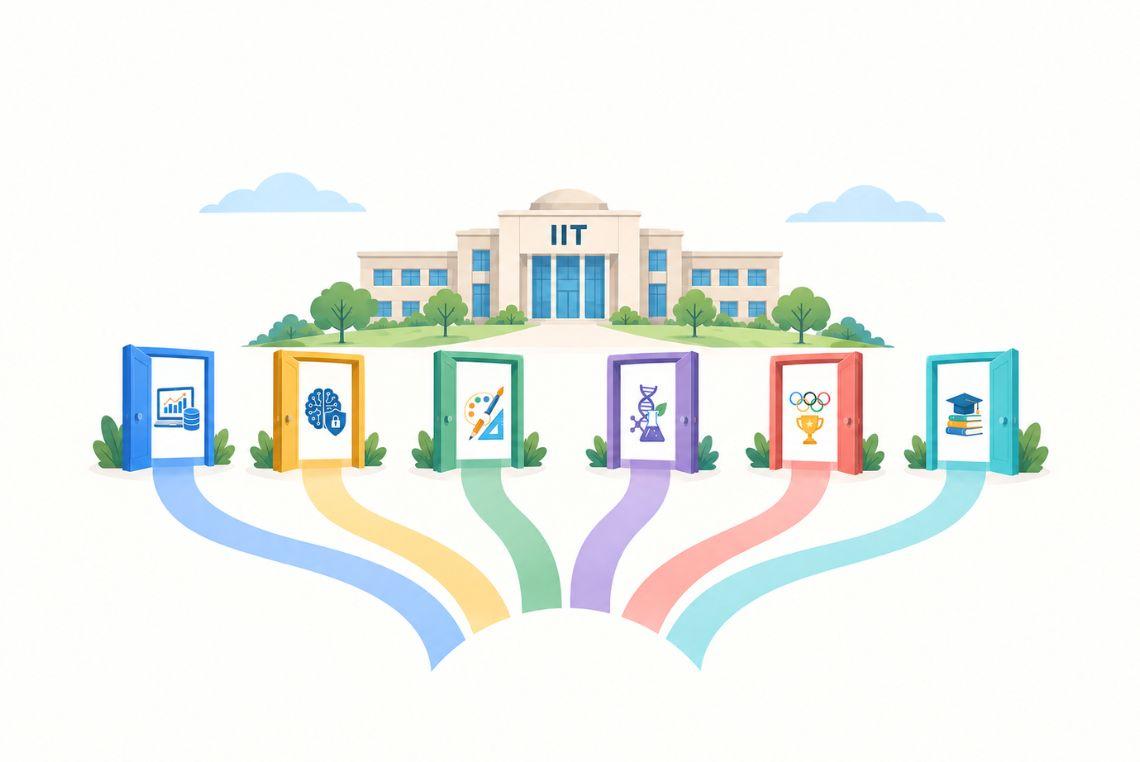
Can Olympiads Help a Student Get Into IIT?
Some IITs have Olympiad-based admission routes for specific undergraduate programmes. These are separate from the standard JEE route, and eligibility varies by institute and programme.
For example, IIT Bombay's B.S. Mathematics programme has an admission route for students on the INMO Qualified List, followed by an institute-level selection process.
IIT Madras also has an Olympiad Admission Mode for its B.S. Mathematics programme.
However, not every Olympiad qualifies, and an Olympiad achievement does not automatically result in an IIT admission. Students should check the current admission notification for the specific IIT and programme.
What about MIT?
MIT Admissions identifies international mathematics and science Olympiads among major academic competitions.
A strong official IMO record can therefore be an important part of a student's academic profile.
But there is no direct IMO-to-MIT admission route. An Olympiad achievement can contribute to an application, but it does not guarantee admission.
Don't Confuse Medals With Selection Credentials
These are different achievements:
- A medal from a private Olympiad
- IOQM qualification
- INMO qualification
- IMOTC selection
- Selection to India's IMO team
The name printed on a certificate does not tell you its full significance.
Look at the organiser, selection stage and destination.
The Bottom Line
Private Olympiads can be useful for practice and academic enrichment. The key is not to confuse them with India's official national-team selection system.
For any Olympiad, verify three things:
Who conducts it? How are students selected? Where does it lead?
That distinction can help parents understand whether an achievement represents participation in an academic competition or progression through an official national or international selection pathway.
Disclaimer
Olympiad structures, eligibility rules, selection criteria and IIT admission policies can change. Always check the current year's official HBCSE, IARCS and IIT notifications before making academic or admission decisions.
Explore Related Resources & Tools
Free tools and expert services from Karan Gupta Consulting
Frequently Asked Questions
What is the official IMO Olympiad in India?
Is SOF IMO the same as the International Mathematical Olympiad?
Can an Olympiad help a student get into IIT without JEE Advanced?
Does winning the IMO guarantee admission to MIT?
What are the official Olympiad pathways in India?
Why Choose Karan Gupta Consulting?
- 27+ years of expertise in overseas education consulting
- 160,000+ students successfully counselled
- Personal guidance from Dr. Karan Gupta, Harvard Business School alumnus
- Licensed MBTI® and Strong® career assessment practitioner
- End-to-end support from career clarity to visa approval
SHARE THIS ARTICLE

Dr. Karan Gupta
Founder & Chief Education Consultant
Harvard Business School alumnus and India's leading career counsellor with 27+ years guiding 160,000+ students to top universities worldwide. Licensed MBTI® practitioner. Managing Director of IE University (India & South Asia).