Breakthrough Junior Challenge: How Students Can Win $250,000

Dr. Karan Gupta is a Harvard Business School alumnus and career counsellor with 27+ years of experience and 160,000+ students guided. His insights on Scholarships & Finance come from decades of hands-on experience helping students achieve their goals.
What if a two-minute video could help you win a $250,000 scholarship for higher education?
The Breakthrough Junior Challenge is a global science communication competition for students aged 13 to 18. Participants create an original video explaining a complex concept in physics, mathematics or life sciences.
The winning student receives a $250,000 college scholarship. Their chosen teacher receives a $50,000 award, and their school may receive science-lab renovations valued at up to $100,000. Together, these awards represent a potential educational prize package of up to $400,000—not a $400,000 cash prize for the student.
Eligible students from India can participate. Those interested in entering can start preparing by researching a scientific concept and developing an original explanation.
Free Tool
Scholarship Finder
Find scholarships you actually qualify for, by country, level and profile.
Try it free →What Is the Breakthrough Junior Challenge?
Founded by Julia and Yuri Milner in 2015, the Breakthrough Junior Challenge encourages students to make complex scientific ideas accessible to a general audience.
Participants create a video explaining a concept, theory or principle from one of three fields:
- Physics: Relativity, quantum mechanics or the fundamental nature of matter.
- Life sciences: Genetics, cellular biology or neuroscience.
- Mathematics: Mathematical theories, patterns or principles.
Videos must be original and no longer than two minutes. Students can use animation, illustrations, simulations, demonstrations or storytelling to communicate their ideas.
The goal is to make a challenging scientific concept understandable without compromising accuracy.
What Does the Winner Receive?
The winning student receives a $250,000 college scholarship to support eligible undergraduate education expenses, subject to the programme's terms and conditions. The scholarship is not unrestricted cash; it is administered according to the competition's rules.
The student's chosen teacher receives a $50,000 award, while their school may receive science-lab renovations valued at up to $100,000.
Winning does not guarantee university admission. Students must still meet their chosen institution's admission requirements.
Who Can Apply?
The competition is open to eligible students aged 13 to 18 worldwide, including students from India. Applicants must meet the age requirements and qualifying dates specified for their chosen edition.
Key requirements include:
- Original work: The entry must be the student's own creation.
- Individual entry: Each submission must be created by one student. Group entries are not accepted.
- English-language submission: The video and application must be in English.
- Parental or guardian permission: Minors must provide the required consent.
- Eligible subject: The video must explain a concept in physics, mathematics or life sciences.
- Previous winners: Previous winners of the Challenge, as well as winners of certain similar competitions sponsored by the organisers, are ineligible.
The published entry criteria do not specify an SAT score or minimum school-examination percentage. Check the official rules for the relevant edition before applying.
How Are Entries Judged?
Entries are evaluated on four criteria: engagement, illumination, creativity and difficulty.
- Engagement: Capture attention with a surprising question, relatable example or counterintuitive fact.
- Illumination: Explain the concept clearly and accurately so viewers understand it.
- Creativity: Use original visuals, analogies or demonstrations to make the explanation memorable.
- Difficulty: Explore a sufficiently challenging concept without making the explanation unnecessarily complicated.
A strong entry balances all four. An advanced topic alone will not make a video stand out if the explanation is confusing or inaccurate.
How to Prepare a Strong Two-Minute Video
A compelling submission combines scientific understanding, a focused script and purposeful visuals. Follow these six steps.
Step 1: Choose One Specific Concept
Avoid broad subjects such as physics or evolution. Choose a focused question that can be explained meaningfully in two minutes.
Potential starting points include:
- Physics: Why does time behave differently at high speeds? What is quantum tunnelling?
- Life sciences: How do cells switch genes on and off? How do circadian rhythms regulate biological processes?
- Mathematics: How can probability produce counterintuitive results? What explains a surprising mathematical pattern?
These are starting points, not guaranteed winning topics. Choose a concept that genuinely interests you and offers scope for a clear visual explanation.
Step 2: Research the Science
Use reliable sources such as university publications, scientific institutions, textbooks and relevant research papers.
Identify the central question, the mechanism behind the concept and the evidence supporting it. Explain the idea in plain language rather than copying existing scripts or videos.
Ask a teacher to challenge your explanation and identify gaps in your understanding before filming.
Step 3: Write a Focused Script
Every sentence should contribute to the explanation. A possible two-minute structure is:
- 0–15 seconds: Introduce a surprising question.
- 15–40 seconds: Establish the concept.
- 40–95 seconds: Explain the mechanism using examples or visuals.
- 95–110 seconds: Show why the concept matters.
- 110–120 seconds: Resolve the opening question.
This is a suggested framework, not an official judging formula. Adapt it to your topic and leave enough time for the main explanation.
Read the script aloud and time it. Remove unnecessary definitions, repeated points and long transitions. The finished video must not exceed two minutes.
Step 4: Make the Explanation Visual
Use animation, diagrams, demonstrations or simulations to explain relationships that narration alone may struggle to convey.
For example, a video about cellular biology could animate how a signal triggers a change inside a cell. A mathematics video could build a pattern step by step until the underlying rule becomes clear.
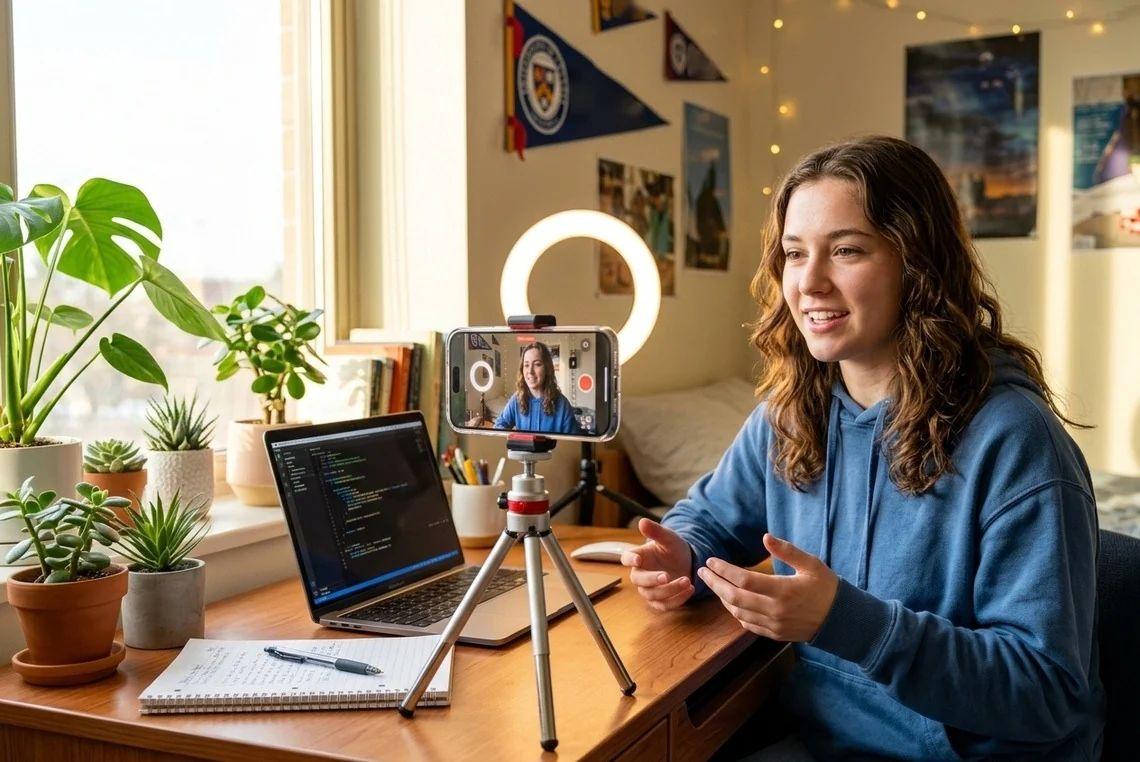
Keep labels readable and visuals scientifically accurate. A smartphone and basic editing software can be sufficient; clear communication matters more than expensive production.
Step 5: Test and Improve the Video
Show your draft to someone unfamiliar with the subject and ask:
- What did you understand?
- Which part was confusing?
- Can you explain the main idea back to me?
Use the feedback to improve unclear sections. Verify scientific claims and ensure any music or third-party material complies with the competition rules.
Before submitting, confirm that the video is original, the link is accessible, and the duration meets the requirements.
Step 6: Complete the Application Requirements
Read the official rules carefully and note every requirement, including registration, submission format, consent and peer review.
The rules require participants to review at least five other submissions. Check the relevant edition's instructions and deadlines so you complete every application requirement.
What Can Indian Students Learn From Past Winners?
Past winners demonstrate how different scientific concepts can become compelling videos.
- 2023 — Sia Godika, India: Explained Yamanaka factors, which are involved in cellular reprogramming.
- 2024 — Jasmine Eyal, Czech Republic/Singapore: Presented a video about mechanogenetic cellular engineering.
- 2025 — Matea Cañizares, Ecuador: Explained quark-gluon plasma, an extreme state of matter associated with the early universe.
These examples span biology and physics. Students do not need to discover a new theory; they need to communicate an existing concept with originality and insight.
Watch previous winning submissions to study how they introduce concepts, use visuals and build understanding. Develop your own script and creative approach rather than copying another student's work.
Official Entry Link
Official Breakthrough Junior Challenge entry page:https://breakthroughjuniorchallenge.org/enter
The 2026 submission period has closed. Students interested in participating in a future edition should check the official website for the next application dates, eligibility requirements and submission instructions.
Disclaimer
Eligibility, deadlines, judging procedures and scholarship terms may change each year. Always verify the latest requirements with the competition organisers. Participation does not guarantee a prize or university admission.
Explore Related Resources & Tools
Free tools and expert services from Karan Gupta Consulting
Frequently Asked Questions
Can Indian students apply for the Breakthrough Junior Challenge?
Is the Breakthrough Junior Challenge free to enter?
What is the age limit?
Are SAT scores or minimum board marks required?
When can students apply for the next edition?
Why Choose Karan Gupta Consulting?
- 27+ years of expertise in overseas education consulting
- 160,000+ students successfully counselled
- Personal guidance from Dr. Karan Gupta, Harvard Business School alumnus
- Licensed MBTI® and Strong® career assessment practitioner
- End-to-end support from career clarity to visa approval
SHARE THIS ARTICLE

Dr. Karan Gupta
Founder & Chief Education Consultant
Harvard Business School alumnus and India's leading career counsellor with 27+ years guiding 160,000+ students to top universities worldwide. Licensed MBTI® practitioner. Managing Director of IE University (India & South Asia).