WU Vienna
Vienna, Austria
WU — the Vienna University of Economics and Business — is Europe's largest specialist business and economics university and one of its most decorated: triple-crown accredited (a distinction held by under 1% of business schools) with its English-taught Master in International Management/CEMS ranked #18 in the world by the Financial Times (2025). The twist that stuns families: WU is a public Austrian university, so tuition for non-EU students is measured in hundreds of euros per semester, not tens of thousands per year — in Vienna, perennial winner of the world's most-liveable-city rankings.
#18
FT Int'l Mgmt (CEMS) 2025
1898
Founded
21,000+
Students
Triple Crown
AACSB · EQUIS · AMBA
WU at a Glance
EUR ~750-2,900
Tuition/Semester (verify)
#18
FT Int'l Management 2025
12 mo
Austrian Job-Seeker Visa
#1
Most Liveable City (Vienna)

Dr. Karan Gupta's Strategic View
Why WU Is a Strong Choice
The Ranking That Should Not Be Possible
The Financial Times' 2025 Masters in Management ranking places WU's International Management/CEMS programme #18 worldwide — Austria's only entrant, sitting among schools whose tuition runs €50,000-70,000. WU holds the triple crown of accreditations (AACSB, EQUIS, AMBA), shared by fewer than 1% of business schools globally.
WU can price this quality at public rates because Austria funds its universities as public goods: non-EU tuition is set by regulation at a few hundred to a few thousand euros per semester, not by market pricing.
The strategic conclusion for Indian families: WU seats are scarce precisely because the value is extreme. Treat admission like a competitive scholarship — because economically, that is what it is.
Vienna: The Capital That Works for Students
Vienna has topped the Economist's and Mercer's global liveability rankings repeatedly — and unusually for a 'best city' winner, it is affordable: subsidised student housing, student transit passes costing roughly a euro a day, and overall living costs of €1,000-1,400 per month, below Munich, Paris, Amsterdam or Dublin.
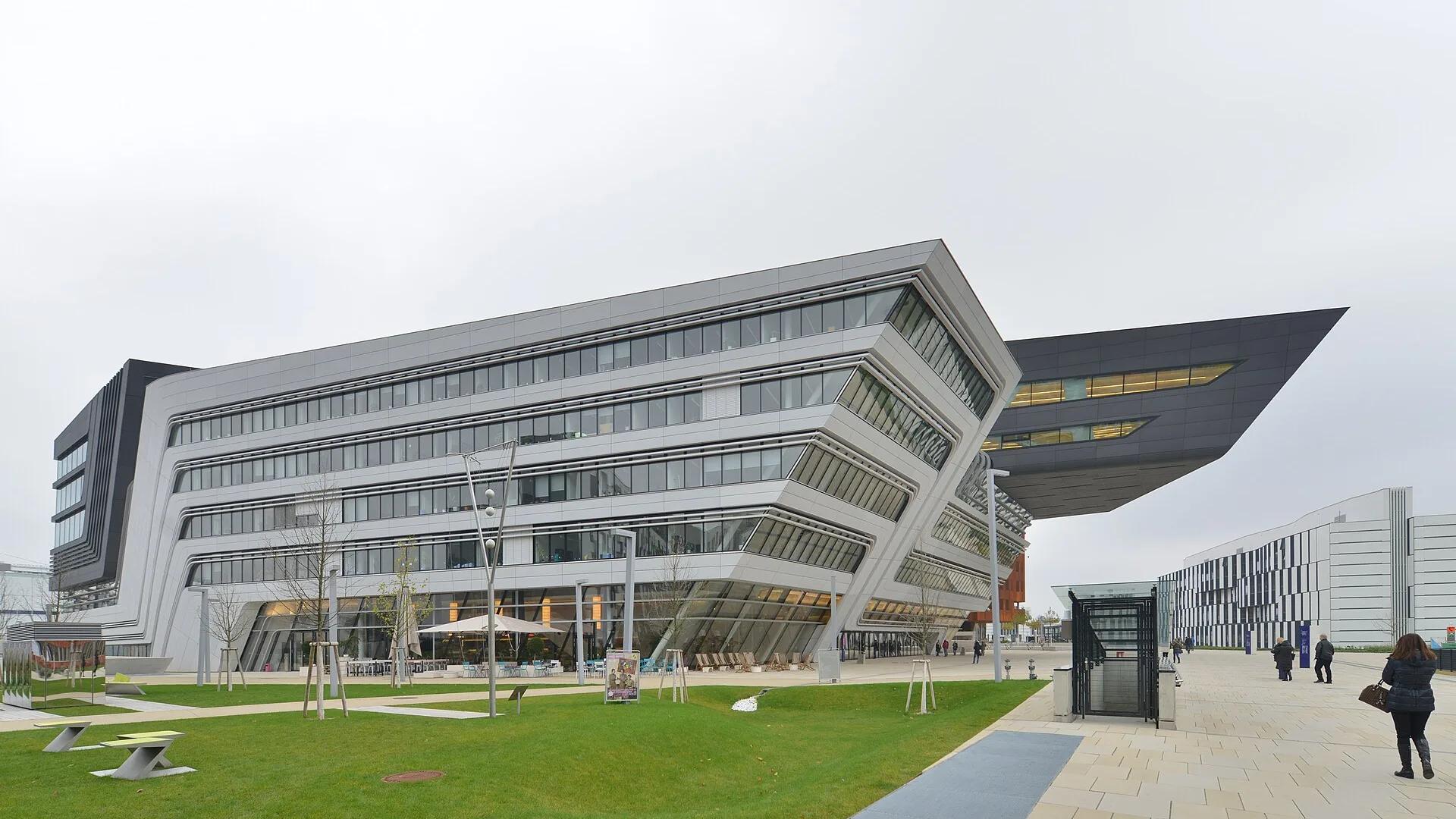
WU's campus matches the city's standard: a purpose-built architectural showcase (Zaha Hadid designed its library) beside the Prater park, ten minutes from the centre by U-Bahn.
For Indian students, Vienna adds a distinctive career geography: the city hosts UN agencies, OPEC and the OSCE alongside hundreds of multinationals' Central & Eastern Europe headquarters — a professional market wider than Austria's size suggests.
After Graduation: The Austrian Pathway, Honestly
Austria grants graduates a 12-month job-seeker residence permit; landing a qualifying role converts it to the Red-White-Red card (Austria's skilled-work permit), with permanent residency on a predictable clock thereafter. No lottery, no sponsorship roulette — but also no three-year open visa like New Zealand's: you are expected to find a professional role within the year.
WU's placement machinery — CEMS corporate partners, the CEE-headquarters economy, Vienna's consulting and banking offices — makes that year very workable for engaged students. English-only roles exist in consulting, international organisations and regional HQs; German (B1-B2) roughly doubles the market and is near-mandatory for the domestic corporate ladder.
Families should model both scenarios honestly: a Vienna career at excellent salaries and low taxes-to-services ratio, or returning home with an FT-top-20 credential bought at public prices. Both are strong outcomes; the second one costs less than an Indian MBA.
Campus & Student Life
A purpose-built modern campus beside the Prater park — including the Zaha Hadid-designed Library & Learning Center — connected to central Vienna in minutes by U-Bahn.
Zaha Hadid library
One of Europe's most architecturally celebrated university buildings
Prater at the door
Vienna's great park — and the Riesenrad — as the campus backyard
A student's Vienna
Subsidised housing, ~€1/day transit, the world's most liveable city
Programs at WU
MSc International Management / CEMS
The flagship: FT-ranked #18 in the world (2025), and WU is Austria's member of the CEMS alliance — the global consortium of one elite business school per country. CEMS students study across member schools worldwide with corporate-partner internships built in. At public-university fees, this may be the single best ranking-per-euro degree in Europe.
MSc Quantitative Finance / Finance & Accounting
Rigorous, research-backed finance programmes feeding Vienna's banking sector (Erste, Raiffeisen, UniCredit's CEE hub) and the region's role as financial gateway to Central and Eastern Europe.
MSc Business Analytics / Digital Economy
English-taught quantitative programmes aligned with European demand for analytics-plus-business profiles, taught on one of Europe's most modern campuses.
MSc Supply Chain Management
A recognised European strength — Austria's position at the continent's logistics crossroads and WU's research depth make this one of the region's best supply-chain credentials.
MSc Strategy, Innovation & Management Control (and other English tracks)
WU runs a broad portfolio of English-taught master's; competition varies by programme, and several offer realistic entry for strong Indian profiles who apply early.
Master's are typically 2 years (120 ECTS), September intake, with applications generally October-March. Several programmes (International Management/CEMS, Quantitative Finance) are highly selective; others are more accessible — portfolio strategy matters.
Admission Requirements
WU's selective English master's admit on academics, GMAT/GRE (programme-dependent), essays and sometimes interviews. As a public university its process is more form-driven than boutique business schools — follow the checklist exactly, and apply early: seats for non-EU applicants are capped in the popular programmes.
WU is a public Austrian university: non-EU tuition is a few hundred to a few thousand euros per SEMESTER (roughly €750-2,900 depending on programme and current fee rules) — not per month, not per course. Verify the exact current figure for your programme on WU's official fee page, and treat any agent quoting five-figure WU 'fees' with suspicion.
English-Taught Master's
- MSc International Management / CEMS
- MSc Quantitative Finance
- MSc Finance & Accounting
- MSc Business Analytics
- MSc Supply Chain Management
- MSc Economics
MBA (Executive Academy)
- Global Executive MBA
- Professional MBA (various tracks)
What Type of Student Gets In?
Academically strong with solid quantitative record
Self-directed — thrives without boutique-school babysitting
Internationally ambitious with a Europe/CEE thesis
Patient with paperwork, strategic about applications
Two opposite errors: families dismiss WU because 'cheap must mean weak' — while the FT ranks its flagship above schools charging twenty times more; or applicants aim only at the CEMS/QFin flagships with no backup track and miss WU entirely. Respect the selectivity, build a two-programme strategy, and verify fees only from WU's own pages — agents routinely misquote Austrian tuition.
Costs & ROI
Vienna is the affordability anomaly among great European capitals: subsidised student housing, a €1 daily-commute transit pass for students, and living costs below Munich, Paris or Amsterdam — in the city that keeps winning global liveability rankings. Total cost of a full WU master's (tuition + living) can undercut ONE YEAR of a UK MiM. Verify current tuition rules on WU's page — Austrian fee regulations changed recently and agents frequently quote them wrong.
| Level | Tuition |
|---|---|
| Tuition (non-EU, per semester) | EUR ~750 - 2,900 (verify current) |
| Full 2-year master's (tuition total) | EUR ~3,000 - 11,600 |
| Living Costs (Vienna) | EUR 1,000 - 1,400/month |
Salary Ranges
Career & Industry
CEMS corporate partners
As Austria's CEMS school, WU plugs students into the alliance's global corporate partners — multinationals that co-teach, host mandatory internships and recruit across the CEMS network.
Vienna's CEE headquarters economy
Hundreds of multinationals run their Central & Eastern Europe operations from Vienna; WU is their default local talent pool for finance, management and supply-chain roles.
Application Timeline
12-15 Months Before
- Map programme selectivity honestly (CEMS/QFin vs broader tracks)
- Check ECTS prerequisite mapping against your transcript
- Plan GMAT if targeting the selective tracks
9-12 Months Before
- Take GMAT/GRE and IELTS/TOEFL
- Prepare essays; line up documents with apostilles where required
8-11 Months Before (Oct-Mar)
- Submit application in WU's window — early matters for non-EU visa timelines
4-7 Months Before
- Accept offer
- Apply for the Austrian student residence permit — start immediately; Austrian processing is slow (proof of funds ~EUR 12,000/year)
1-3 Months Before
- Arrange housing — OeAD student housing or WGs; Vienna is affordable for a capital
- Begin German basics — Vienna lives comfortably in English, careers grow with German
Arrival
- Meldezettel (address registration) within days
- Orientation and CEMS/corporate-partner events start early — engage from week one
WU vs Peers
WU Vienna vs University of St. Gallen
WU: Comparable FT MiM tier at a twentieth of the cost, larger programme portfolio, Vienna's liveability and CEE job market
Other: St. Gallen's #1 FT MiM rank and Swiss salary market, tighter elite alumni network
Compare →WU Vienna vs ESMT Berlin
WU: Public fees (vs €29,500), CEMS alliance seat, bigger university breadth, Vienna's liveability
Other: ESMT's German corporate founder network, higher FT MiM rank (#22 vs WU's programme at #18 — comparable tier), Berlin's startup scene
Compare →WU Is Right For...
- High-ambition, budget-rational MIM/finance aspirants with GMAT firepower
- Students targeting Europe's CEE corporate and banking hub
- CEMS aspirants — WU is Austria's alliance seat
- Those who value quality of life alongside credentials
- Students willing to navigate public-university bureaucracy for the payoff
WU Is Not Right For...
- Applicants needing hand-holding admissions service (this is a public university)
- Those set on London/Paris banking brands specifically
- Students who will not engage with German for the long-term Austrian ladder
- Late planners — Austrian permit timelines punish them

Dr. Karan Gupta's Advice
FAQs: WU for Indian Students
Is WU Vienna good for Indian students?
For business, finance and economics students who can win a seat — exceptional. FT ranks WU's International Management #18 worldwide; the school holds triple-crown accreditation; and public-university tuition means the entire master's can cost less than one year elsewhere. The trade: selective flagship admissions, Austrian bureaucracy, and better career outcomes for those who learn German.
What does WU Vienna really cost?
Non-EU tuition is set by Austrian public-university regulation — roughly €750-2,900 per semester depending on programme and current rules, i.e. about €3,000-11,600 for a full two-year master's. Vienna living costs run €1,000-1,400/month. Verify the current figure on WU's official tuition page; agents frequently misquote Austrian fees.
How selective is WU's International Management/CEMS programme?
Very — it is Austria's CEMS seat and FT #18 in the world, with limited places and strong GMAT expectations. Treat it like a top-school application: strong academics, GMAT, sharp essays, interview preparation. Build a backup track among WU's broader English master's, which are meaningfully more accessible.
Can I work in Austria after WU?
Yes — graduates receive a 12-month job-seeker residence permit, converting to the Red-White-Red skilled-work card upon landing a qualifying role. Vienna's consulting firms, banks, international organisations and CEE regional headquarters hire WU graduates routinely; English-only roles exist, and German (B1-B2) roughly doubles your market.
Related Articles
How to Prepare for the SAT: 3 Free Tools and a 12-Week Plan
Prepare for the SAT with three free tools and a practical 12-week study plan to strengthen your skills without expensive coaching.
Is a Foreign Degree Still Worth It? What I Told Raj Shamani
Every year Indian families spend crores on a foreign degree. In two hours with Raj Shamani on Figuring Out I answered one question honestly: in 2026, is it still worth it? Here is the fifteen-minute version, with the six student profiles, the Five Removals test, the ROI formula and the funding routes most families never use.
The ₹0 List: Free Opportunities That Actually Strengthen a Student’s Profile
The best summer opportunities are not always expensive. Discover selective ₹0 programs that can demonstrate genuine student achievement.
Related Guides & Resources
Want to Study at WU?
Get expert guidance from Dr. Karan Gupta: Harvard alumnus, 27+ years of global admissions experience guiding 160,000+ students worldwide.