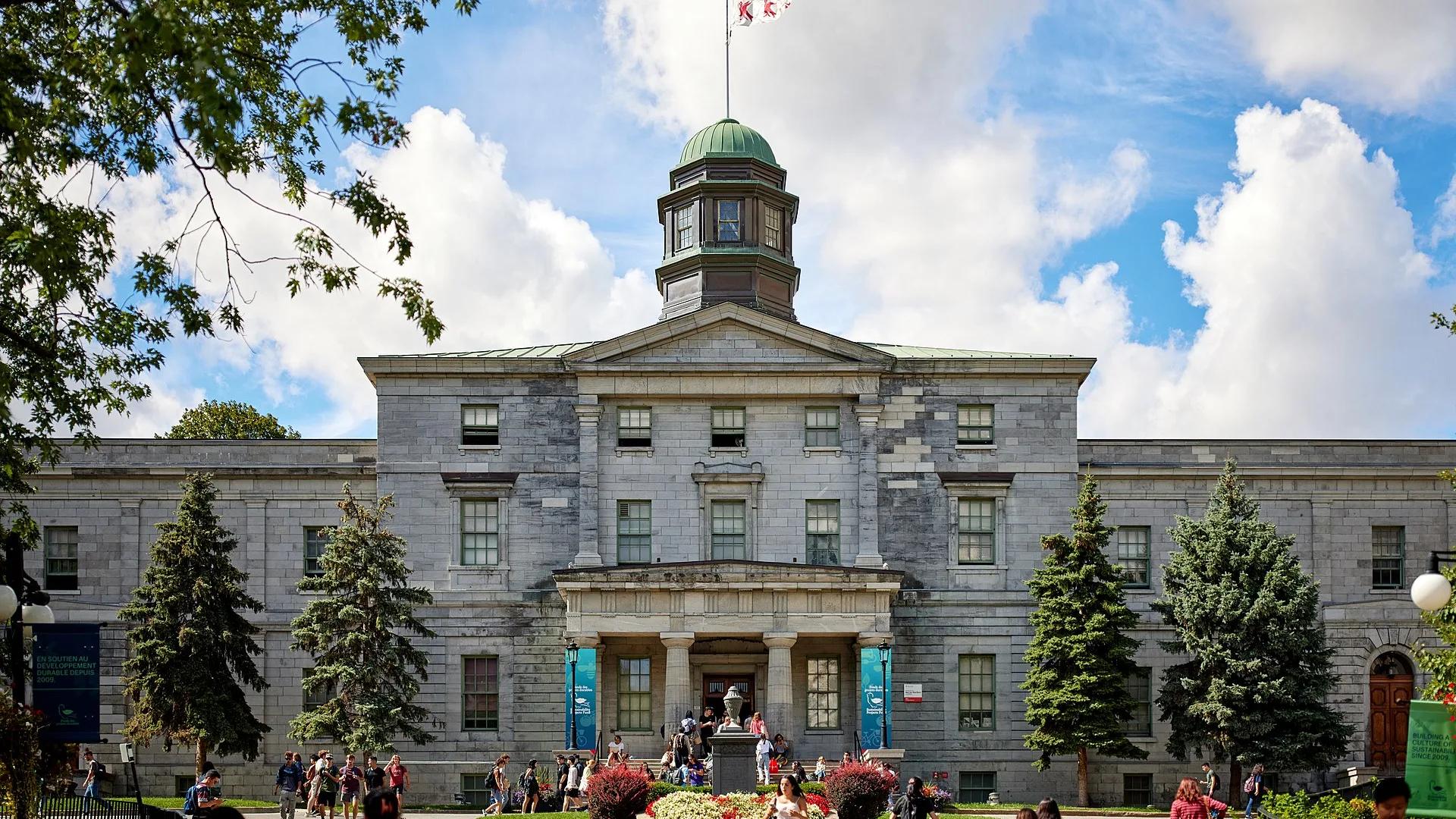
McGill University
Montreal, Quebec
Often called the “Harvard of Canada” — the phrase is exaggerated but not random. McGill is academic-first: historically prestigious, research-driven, and globally alumni-connected. Unlike Waterloo (career-first), McGill is intellectual tradition.
#29
QS World Ranking
~40%
Acceptance Rate
300+
Programs Offered
25+
Students Guided
McGill University at a Glance
Public Research
Type
Montreal, QC
Location
Top 30
Global Rank
~40,000
Students
30%+
Intl Students
English
Language

Dr. Karan Gupta's Strategic View
Why McGill University Is a Strong Choice
Canada's Most International University
McGill attracts students from over 150 countries and operates primarily in English in the heart of French-speaking Montreal. This bilingual, multicultural environment creates a uniquely global academic experience unmatched by other Canadian universities.
Research Excellence at Canadian Costs
McGill is consistently ranked among the top 30 universities globally, with particular strength in medicine, neuroscience, and natural sciences. International students benefit from Canadian tuition rates that are significantly lower than comparable US institutions.
Montreal's Quality of Life
Montreal offers one of the best student cities in the world—affordable housing, vibrant culture, excellent food, and a thriving tech and AI ecosystem. The city's low cost of living compared to Toronto or Vancouver makes graduate study more financially accessible.
Downtown Montreal Campus
McGill's 80-acre downtown campus sits at the foot of Mount Royal in the heart of Montreal, blending historic stone buildings with modern research facilities in one of the world's best student cities.
Heart of Montreal
Downtown campus with walkable access to Montreal's cultural districts, restaurants, and the tech corridor.
Bilingual Advantage
English instruction in a French-speaking city creates unique bilingual opportunities for career and cultural development.
Affordable Student City
Montreal offers significantly lower living costs than Toronto or Vancouver, stretching graduate funding further.
Programs at McGill University
Medicine & Biomedical Sciences
Faculty of Medicine & Health Sciences
Globally respected. Neuroscience, public health, clinical sciences. Extremely competitive.
Neuroscience
Faculty of Science / Medicine
World-class. Montreal Neurological Institute is pioneering. Research-intensive.
Law (BCL/JD)
Faculty of Law
Unique dual common + civil law exposure. International commercial law careers.
Computer Science
Faculty of Science
Strong, especially for AI. Montreal is a global AI research hub (Mila, Yoshua Bengio).
Economics
Faculty of Arts
Quantitative and rigorous. Strong for graduate school pathway.
Engineering
Faculty of Engineering
Strong in biomedical, mechanical, civil. More research-focused than Waterloo's industry model.
Political Science / International Relations
Faculty of Arts
Strong humanities tradition. Global affairs and policy focus.
Management (Desautels)
Desautels Faculty of Management
International business, finance, analytics. Respected but not Rotman/Ivey dominant.
MBA (Desautels)
Desautels Faculty of Management
~CAD 100K total. Strong regionally. Better for Canadian corporate roles.
Physics & Mathematics
Faculty of Science
Strong fundamental sciences. Research-intensive with good PhD pipeline.
McGill is particularly distinguished in medicine, neuroscience, mining engineering, music, and law—programs that benefit from Montreal's healthcare infrastructure, cultural richness, and growing AI/tech scene.
Admission Requirements
McGill graduate admissions emphasize academic excellence and research potential. Most programs require a minimum GPA equivalent to McGill's 3.0/4.0 scale, with competitive programs expecting significantly higher.
Many McGill thesis-based programs require a supervisor commitment before admission. Contact potential supervisors early and demonstrate specific alignment with their research interests.
Interview Preparation
What to expect and how to prepare for your McGill University interview
Format
One-on-one — non-blind (interviewer has full application)
Duration
25-40 minutes
Interviewers
Admissions panel member via Skype or in-person
Interview Style
Conversational and substantive — application follow-ups
What McGill University Looks For
Sample Interview Questions
Something you do outside work?
Well-rounded candidates.
Walk through work experience.
Add depth beyond written.
Why McGill and why MBA?
Montreal, bilingual environment.
Mid-term and long-term goals?
Realistic progression.
Challenges overcome?
Resilience and learning.
Contribute to Desautels?
Specific programmes.
Preparation Tips
- Reread application before interview
- Research Montreal ecosystem, bilingual environment
- Discuss personal interests
- Show realistic goals
- Interview is holistic
Common Mistakes
- Not preparing for application-specific follow-ups
- Unrealistic career goals
- Not researching Montreal ecosystem
- Being too brief
- Forgetting interviewer has read everything

Dr. Karan Gupta's Interview Advice
Dr. Karan's Take: McGill's non-blind interview means your interviewer has read everything.
What Type of Student Gets In?
Academically strong candidates with research experience relevant to McGill faculty
Internationally-minded students who value bilingual and multicultural environments
Researchers attracted to Montreal's AI ecosystem or McGill's medical research infrastructure
International students sometimes overlook the Quebec-specific visa requirements (CAQ) in addition to the federal study permit. Also, for thesis programs, not contacting potential supervisors before applying is the most common avoidable mistake.
Costs & ROI
McGill offers excellent value with Canadian tuition. International graduate tuition ranges from $20,000-$45,000 CAD annually. Most PhD students receive funding through TA/RA positions and fellowships.
| Level | Tuition | Living | Total |
|---|---|---|---|
| Undergraduate (International) | CAD 45,000-60,000/yr (~$33-45K USD) | CAD 15,000-22,000/yr | CAD 60,000-80,000/yr (~$45-60K USD) |
| Master's (Research) | CAD 20,000-35,000/yr | CAD 15,000-22,000/yr | CAD 35,000-55,000/yr (funding possible) |
| MBA (Desautels) | CAD 100,000 total | CAD 30,000-44,000 total | ~CAD 130,000-145,000 total |
Salary Ranges
Career & Industry
AI & Technology
MILA (Montreal AI Institute), Google DeepMind Montreal, and Microsoft Research partner with McGill on cutting-edge AI and machine learning research.
Healthcare & Pharma
McGill University Health Centre, Montreal's research hospitals, and pharma companies provide extensive clinical research opportunities.
Natural Resources
Mining and natural resource companies headquartered in Montreal maintain strong partnerships with McGill's engineering programs.
McGill graduates benefit from Montreal's growing AI ecosystem, Canada's immigration pathways, and the university's strong international reputation—particularly in medicine and research.
Application Timeline
12-18 Months Before
- Research McGill programs and identify potential supervisors
- Take required standardized tests if applicable
- Contact potential supervisors for thesis-based programs
8-12 Months Before
- Draft statement of purpose or research proposal
- Request recommendation letters
- Research McGill funding options and external scholarships
4-8 Months Before
- Submit applications (most deadlines December-January)
- Apply for FRQNT, NSERC, and departmental funding
- Prepare Quebec Acceptance Certificate (CAQ) documentation
0-4 Months Before
- Accept offer and submit enrollment deposit
- Apply for CAQ and Canadian study permit
- Explore Montreal neighborhoods for affordable housing
McGill University vs Peers
{comp.vs}
McGill University: McGill: {comp.self}
Other:
McGill University Is Right For...
- Want global academic credibility at lower cost
- Want medicine or life sciences
- Want Canada PR pathway
- Value intellectual culture over corporate polish
- Want strong international recognition
McGill University Is Not Right For...
- Want global academic credibility at lower cost
- Want medicine or life sciences
- Want Canada PR pathway
- Value intellectual culture over corporate polish
- Want strong international recognition
Our Students at McGill University
Simran Kaur
McGill University
“KGC helped me navigate Canadian university applications.”
Read full storyWatch: Study Abroad Insights
KGC Student Testimonials
Dr. Karan Gupta

Dr. Karan Gupta's Advice
McGill is Canada's most internationally recognizable traditional university. Academic seriousness, lower cost vs U.S. private, global alumni network, and medicine & life sciences dominance.
But it does not engineer employment the way Waterloo does. Do you want structured industry pipeline? Or traditional academic prestige? That decision defines whether McGill is powerful — or misaligned.
FAQs: McGill University for Indian Students
Is McGill really the 'Harvard of Canada'?
Do I need to speak French to study at McGill?
Is McGill medicine competitive for international students?
What makes McGill Law unique?
Is McGill affordable?
Can I get PR in Canada after McGill?
McGill vs University of Toronto — which is better?
Related Articles
The ₹0 List: Free Opportunities That Actually Strengthen a Student’s Profile
The best summer opportunities are not always expensive. Discover selective ₹0 programs that can demonstrate genuine student achievement.
Demonstrated Interest in US College Admissions: What Students Need to Know
Demonstrated interest can strengthen US college applications, but only when students know which universities value it and engage genuinely.
IMO Olympiad Explained: The Official Pathway in India
Two exams in India are called IMO. Only one is the official pathway to India's International Mathematical Olympiad team.
Related Guides & Resources
Want to Study at McGill University?
Get expert guidance from Dr. Karan Gupta: Harvard alumnus, 27+ years of global admissions experience guiding 160,000+ students worldwide.