University College Cork
Cork, Ireland
UCC climbed to #220 in the QS World University Rankings 2027 — up 26 places — and sits in a city with an industrial base most capitals would envy: Apple's European headquarters employs thousands in Cork, and the surrounding region hosts one of the world's densest pharmaceutical clusters, with Pfizer, Johnson & Johnson, Eli Lilly and dozens more operating major sites. For Indian students, UCC pairs a fast-rising research university with direct access to these employers — and Ireland's 2-year post-study stay-back visa to convert the degree into a European career.
#220
QS World Ranking 2027
1845
Founded
24,000+
Students
2 yrs
Ireland Stay-Back Visa
UCC at a Glance
#220
QS World Ranking 2027
EUR 19-28K
Non-EU Tuition/Year
2 yrs
Post-Study Stay-Back
Top 10
Food Science Globally (QS)

Dr. Karan Gupta's Strategic View
Why UCC Is a Strong Choice
A City Whose Employers Match the University
Cork's industrial story is remarkable for a city of its size. Apple chose Cork for its European headquarters in 1980 and now employs around 6,000 people there. The surrounding region hosts one of the world's densest pharmaceutical manufacturing clusters — Pfizer, Johnson & Johnson, Eli Lilly, Merck, GSK, Novartis and dozens of biologics and medical-device operations.
UCC's academic strengths line up with this base almost exactly: pharmacy and pharmaceutical sciences, process engineering, computing, data science and food science. Placements, final-year projects and graduate recruitment flow through these pipelines continuously.
For Indian students, that alignment is the whole strategy: you study a subject the local economy is built on, and Ireland's 2-year stay-back visa gives you the runway to convert it into a European career.
Momentum: UCC's Ranking Trajectory
UCC rose 26 places to #220 in the QS World University Rankings 2027 — among the strongest improvements of any Irish university — and holds a genuine global flagship in food science, where it ranks with the world's best.
Research infrastructure supports the trajectory: the Tyndall National Institute at UCC is one of Europe's premier ICT research centres, and the university's APC Microbiome Institute is a world reference point in gut-health research — a field with growing pharmaceutical significance.
A rising university means your credential appreciates after you graduate; UCC's direction of travel has been consistently upward.
Cork Life: Ireland's Second City
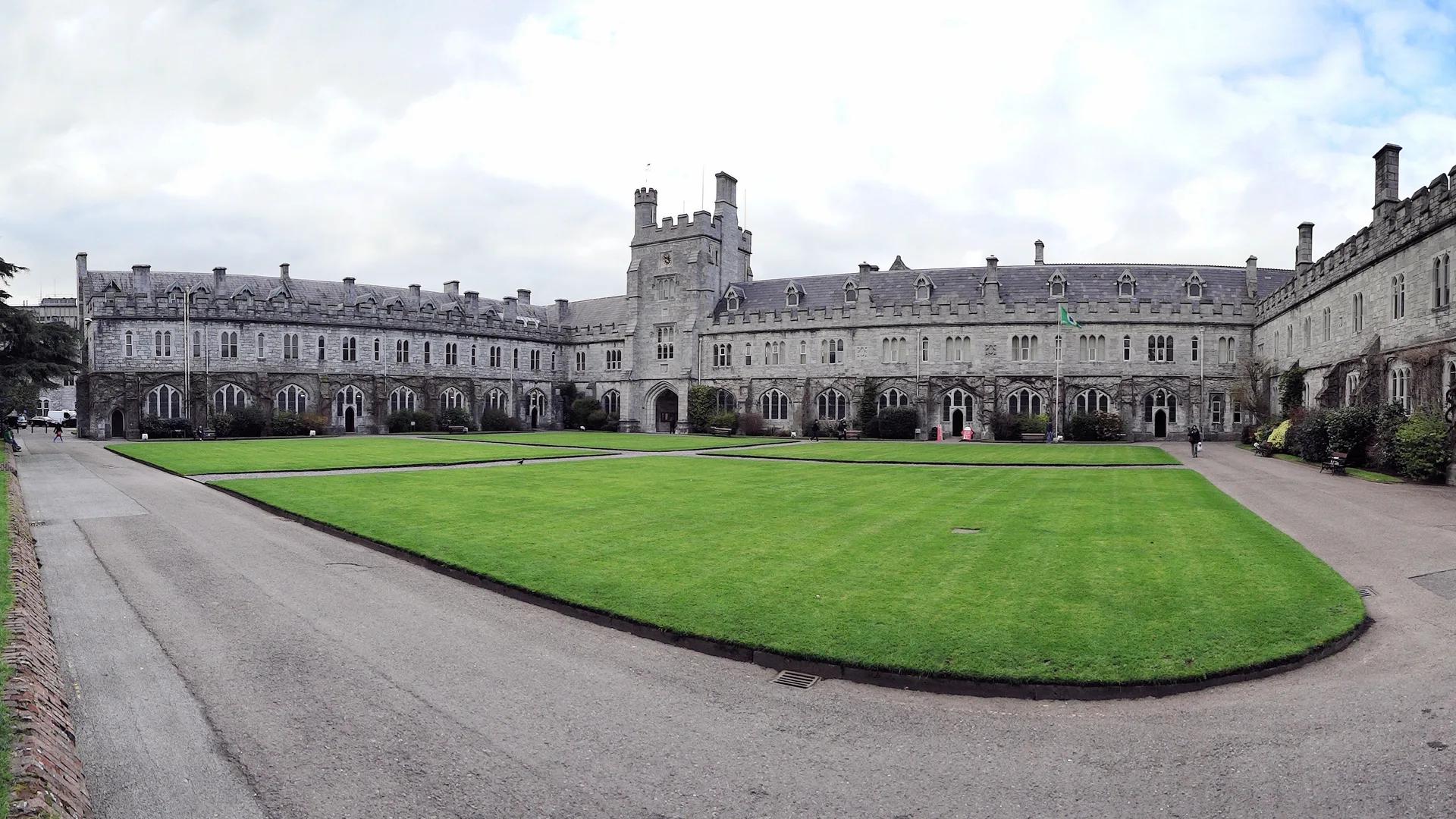
Cork calls itself Ireland's 'real capital' with a wink — it is a compact, walkable city of about 220,000 with a famous food scene (the English Market), live music culture, and a student population large enough to shape the city's rhythm. UCC's riverside campus, with its Victorian quadrangle, is routinely listed among Ireland's most beautiful.
Living costs run meaningfully below Dublin — typically €900-1,400 per month all-in — and the city's scale means no long commutes eating your day.
For students, Cork offers the classic Irish trade: less anonymity and nightlife-scale than a capital, more community, lower costs and — in UCC's fields — employers who actually know the university's graduates by department.
Campus & Student Life
A riverside Victorian campus ten minutes' walk from Cork's centre — the stone quadrangle is one of Ireland's most photographed university settings, ringed by modern science and business buildings.
The Quad
UCC's Victorian quadrangle — Ireland's classic campus image
100+ clubs & societies
One of Ireland's most active student scenes, with a growing Indian society
Tyndall Institute
Europe-leading ICT research on the university's doorstep
Programs at UCC
MSc Computer Science / Data Science & Analytics
Cork's technology base — anchored by Apple's European headquarters with 6,000 employees, plus significant operations of major tech and cybersecurity firms — gives UCC computing graduates a local employer market unusual for a city its size. Conversion MSc options exist for non-computing graduates.
Pharmacy, Pharmaceutical Sciences & Biotechnology
The Cork region is one of the world's great pharma manufacturing hubs — Pfizer, Johnson & Johnson, Eli Lilly, Merck, GSK and dozens of others run major plants and R&D here. UCC's pharmacy and pharmaceutical science programmes feed this cluster directly, with placements and graduate recruitment on the doorstep.
Food Science & Nutritional Sciences
UCC ranks among the world's very best universities for food science — a genuine global flagship built on Ireland's agri-food industry and the university's long research heritage in dairy and nutrition science.
Engineering (Electrical, Process, Civil)
Process and pharmaceutical engineering are natural strengths given the surrounding industry; UCC's Tyndall National Institute — one of Europe's leading ICT research centres — anchors microelectronics and photonics research and industry partnerships.
Cork University Business School (MSc Finance, Business Analytics, Management)
Ireland's largest business school by student numbers, with practical master's programmes and growing placement into Cork and Dublin's multinational base.
Most taught master's are 1 year full-time from September. Applications open in autumn and are rolling — popular programmes (CS conversion, data science, pharma) fill early; Indian applicants should apply by January-March for the following September.
Admission Requirements
UCC is accessible for well-prepared Indian students: transparent criteria, no entrance exams for most programmes, and an active recruitment presence in India. Competitive science programmes expect a relevant degree with strong grades.
Ireland's Third Level Graduate Programme gives master's graduates a 2-year stay-back visa with full work rights — and Cork's employer base (Apple, the pharma cluster, cybersecurity firms) hires from exactly the programmes UCC is strong in. The degree-to-job geography here is unusually tight.
Master's Programs
- MSc Data Science & Analytics
- MSc Computer Science (conversion)
- MSc Pharmaceutical Technology & Quality Systems
- MSc Food Science
- MSc Finance
- MEngSc programmes
What Type of Student Gets In?
Science- or tech-oriented with a clear industry goal
Practical about careers — values employer access over brand polish
Comfortable in a mid-size, sociable city
Planning to use Ireland's stay-back visa deliberately
Indian families treat Ireland as 'Dublin or nothing', pay Dublin rents, and compete in Dublin's crowded graduate market — while Cork's pharma and tech employers recruit steadily from UCC with far less applicant competition. If your field matches Cork's industry, the 'smaller' city is the bigger opportunity.
Costs & ROI
Verify your specific programme's fee on UCC's official fee schedule. Cork living costs run 15-25% below Dublin, which matters over a full degree. Part-time work rights (20 hours in term) and the 2-year stay-back visa complete a strong value equation.
| Level | Tuition |
|---|---|
| Master's (non-EU) | EUR 19,000 - 28,000/year |
| Undergraduate (non-EU) | EUR 18,000 - 25,000/year |
| Living Costs (Cork) | EUR 900 - 1,400/month |
Salary Ranges
Career & Industry
The Cork pharma cluster
Pfizer, Johnson & Johnson, Eli Lilly, Merck and dozens of pharmaceutical and biologics plants operate in the Cork region — UCC's pharmacy, science and process-engineering programmes maintain placement and recruitment pipelines into this cluster.
Apple and Cork's tech base
Apple's European headquarters has been in Cork since 1980. Together with cybersecurity and software employers, it anchors a technology job market that UCC computing graduates access directly.
Tyndall National Institute
One of Europe's leading ICT research centres, headquartered at UCC — photonics, microelectronics and semiconductor research with deep industry programmes.
Application Timeline
12-18 Months Before
- Shortlist programmes and check prerequisites
- Research Cork's employer base in your field
- Check UCC and Government of Ireland scholarships
9-12 Months Before
- Take IELTS
- Prepare personal statement and references
6-9 Months Before
- Apply — rolling admissions, but popular programmes fill by spring
- Apply for scholarships
3-6 Months Before
- Accept offer and pay deposit
- Apply for the Irish student visa with proof of funds
1-3 Months Before
- Arrange accommodation — apply early for UCC residences; Cork rents are below Dublin but rising
- Arrange mandatory health insurance
Arrival
- Attend international orientation
- Register with immigration (IRP)
- Join societies — UCC's student life is among Ireland's most active
UCC vs Peers
UCC vs Trinity College Dublin
UCC: Cork's pharma/Apple employer fit, 15-25% lower living costs, rising ranking momentum, less graduate-market competition
Other: Trinity's global brand, Dublin's larger and broader job market, historic prestige
Compare →UCC vs University of Galway
UCC: Higher QS ranking, bigger city with Apple + pharma cluster, stronger food science
Other: Galway's medtech cluster (Medtronic, Boston Scientific), even lower costs, famous student-city culture
Compare →UCC Is Right For...
- Pharma, biotech and process-engineering aspirants — the cluster is the career
- Computing students who want a real local tech market beyond Dublin
- Food science students — a genuine world-leading department
- Value-focused families comparing against Dublin costs
- Students who like a friendly, compact student city
UCC Is Not Right For...
- Students who need a capital-city experience and market breadth
- Brand-maximisers set on Trinity/UCD prestige
- Fields outside UCC's strengths — check the specific department first
- Those unwilling to engage with industry placements — that is the whole point here

Dr. Karan Gupta's Advice
FAQs: UCC for Indian Students
Is UCC good for Indian students?
Yes — particularly for pharmaceutical sciences, computing, food science, and process engineering, where UCC's programmes feed Cork's Apple and pharma employer base directly. Add the QS #220 ranking (up 26 places), Ireland's 2-year stay-back visa, and living costs 15-25% below Dublin, and UCC is one of Ireland's strongest value propositions.
UCC vs Trinity vs UCD — how should I choose?
Trinity and UCD carry bigger global brands and Dublin's larger job market; choose them if brand and breadth are your priorities and budget allows. UCC wins on industry fit for pharma/tech/food science, on cost of living, and on ranking momentum. For a career-specific decision in UCC's strong fields, the Cork cluster often outweighs the Dublin brand.
What are UCC's fees for Indian students?
Non-EU master's fees typically range €19,000-28,000 per year depending on programme (science and business at the upper end); undergraduate fees run €18,000-25,000. Verify your exact programme fee on UCC's official schedule. Cork living costs of €900-1,400/month are notably below Dublin.
Can I work in Ireland after UCC?
Yes — Ireland's Third Level Graduate Programme grants master's graduates a 2-year stay-back visa with full work rights, no sponsorship required. Cork's multinational base recruits UCC graduates steadily, and many convert to Critical Skills Employment Permits for the long term.
Related Articles
IMO Olympiad Explained: The Official Pathway in India
Two exams in India are called IMO. Only one is the official pathway to India's International Mathematical Olympiad team.
5 Ways to Get Into an IIM Without CAT
CAT is not the only way into an IIM. Discover five non-CAT routes, from IPMAT and JIPMAT to IIMB's BBA and GMAT/GRE-based MBAs.
The U.S. Government Website Every College Applicant Should Know
College Scorecard is the free U.S. government tool that lets students research college costs, earnings, completion, debt and more.
Related Guides & Resources
Want to Study at UCC?
Get expert guidance from Dr. Karan Gupta: Harvard alumnus, 27+ years of global admissions experience guiding 160,000+ students worldwide.