Singapore Management University
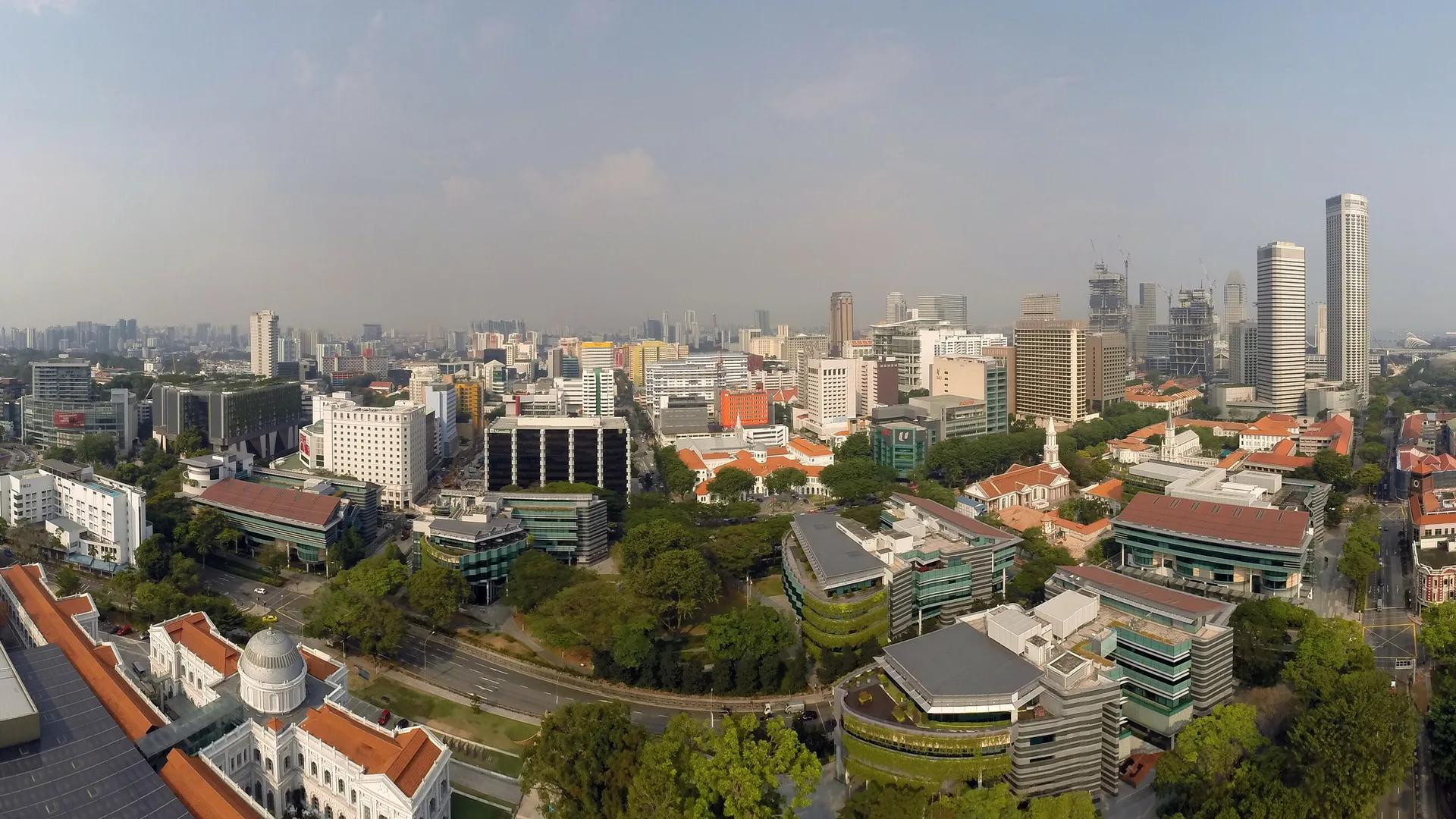
Singapore (City Centre)
SMU is Singapore's specialist university for business, economics, law, accountancy and computing — modelled on the American seminar style, with small interactive classes rather than lecture halls. Its campus is not near Singapore's business district; it is inside it. QS ranks SMU #39 in the world for Business & Management and top-50 for Accounting & Finance (2026 subject rankings), and the university was the world's most-improved in the latest QS subject cycle. For Indian students targeting Asian finance, consulting and tech careers, SMU is the focused alternative to NUS and NTU.
#39
QS Business & Mgmt (2026)
#50
QS Accounting & Finance
2000
Founded
13,000+
Students
SMU at a Glance
#39
QS Business & Mgmt (2026)
#411
QS Overall 2027 (rising fast)
SGD 35-70K
Master's Tuition (total, varies)
CBD
Campus in the Business District

Dr. Karan Gupta's Strategic View
Why SMU Is a Strong Choice
A Specialist That Beats Generalists in Its Lane
SMU was founded in 2000, modelled on the Wharton seminar tradition, to be Singapore's specialist in management, economics and law. Twenty-five years later the bet has paid off: QS ranks SMU #39 globally in Business & Management and top-50 in Accounting & Finance (2026 subject rankings), and it was the world's most-improved university among institutions with ten or more ranked subjects.
Its Lee Kong Chian School of Business holds the triple crown of accreditations (AACSB, EQUIS, AMBA) — a distinction shared by fewer than 1% of business schools worldwide.
The lesson for applicants: rankings are tools, and the right tool here is the subject table. On the table that matters for a business career in Asia, SMU sits alongside schools whose overall brands dwarf it.
The CBD Campus Advantage
SMU's campus is built along Victoria Street and Bras Basah in central Singapore — the financial district, government quarter and legal precinct are a walk away. This is not a marketing line; it changes student behaviour.
Internships during term are logistically trivial. Networking events, industry talks and client meetings happen around lectures, not instead of them. By graduation, SMU students typically have multiple internships and a working professional network inside Singapore's employer base.
For Indian students, this compresses the career timeline: in a 12-18 month master's, every week counts, and SMU's geography means none are wasted commuting to opportunity.
Singapore Careers: Honest Mechanics
Singapore offers no automatic multi-year post-study visa. Graduates typically get a short-term pass to seek work, and then need an employer-sponsored Employment Pass that carries salary thresholds. This filters outcomes toward genuinely hireable graduates — which is precisely the game SMU trains you for.
The demand side is strong: Singapore hosts the regional headquarters of thousands of multinationals, Asia's fastest-growing wealth management industry, and major consulting and technology hubs. SMU's placement outcomes in business, finance and computing are consistently among Singapore's best.
Families should model the honest scenario: strong performance at SMU converts to a Singapore career at excellent salaries with low taxes; mediocre engagement converts to returning home with a still-respected Asian credential. Both outcomes are acceptable — but the first one is earned, not given.
Campus & Student Life
A vertical city campus across central Singapore — connected undergrounds, modern seminar rooms, and the museums, cafés and business towers of the CBD as your quad.
True city campus
Victoria Street/Bras Basah — the business district is the campus
Seminar rooms, not lecture halls
Classes of 40-50 with graded participation
100+ student clubs
Strong international community; active Indian student network
Programs at SMU
MSc in Wealth Management / Applied Finance
SMU's finance master's programmes are embedded in the world's fastest-growing wealth management hub. Singapore's private banking sector — UBS, DBS, Standard Chartered, family offices — recruits directly from SMU's specialised finance cohorts, and several of these programmes carry top global rankings in their category.
MSc in Management / MBA
Seminar-style, career-services-intensive programmes with strong Asia-Pacific placement. The Lee Kong Chian School of Business holds the triple crown of international accreditations (AACSB, EQUIS, AMBA) — held by fewer than 1% of business schools worldwide.
MSc in Computing / IT in Business (MITB)
SMU's computing programmes are business-flavoured by design — analytics, AI applications, fintech systems — feeding Singapore's bank-technology and consulting employers rather than pure engineering roles. The MITB is one of the most placement-effective tech master's in Singapore.
Bachelor of Business Management / Economics
SMU's undergraduate programmes are known for interactive seminar teaching, mandatory internships, and global exposure terms. Graduate employment outcomes for business and economics consistently rank among Singapore's best.
Juris Doctor / Master of Laws
SMU's Yong Pung How School of Law is one of Asia's most modern law schools, with strengths in commercial and technology law aligned to Singapore's role as Asia's arbitration and legal hub.
Master's programmes are typically 12-18 months, full-time, with January and August intakes depending on programme. SMU's academic culture is participation-heavy — class contribution is graded, and cohorts are deliberately small.
Admission Requirements
SMU admissions are competitive and interview-driven: the university explicitly selects for articulate, participative students who fit seminar teaching. Strong academics are the entry ticket; the interview and profile determine the outcome.
Singapore work visas are employer-sponsored (Employment Pass) with salary thresholds — there is no automatic multi-year post-study visa like Australia or the UK. SMU's placement machinery largely solves this for strong graduates, but go in with open eyes: your job outcome depends on performing in a competitive market, not on a visa entitlement.
Master's Programs
- MSc Applied Finance
- MSc Wealth Management
- MSc Management
- MSc IT in Business (Analytics/FinTech/AI)
- MSc Economics
- LLM
MBA Program
- SMU MBA (12-15 months, city-centre)
- EMBA
What Type of Student Gets In?
Confident communicator — thrives in graded class participation
Ambitious about Asian finance, consulting or corporate careers
Professional polish — comfortable networking early and often
Values career services engagement, not just classroom learning
Families judge SMU by its overall QS rank (#411) and rule it out, while Singapore's employers judge it by Business & Management #39 and hire accordingly. The reverse mistake also happens: students who hate public speaking enrol and struggle — SMU's participation-graded seminars are non-negotiable. Match the model to the child, and judge the school by the subject rankings employers use.
Costs & ROI
SMU master's fees vary significantly by programme — verify the exact current fee on the programme page before budgeting. Singapore living costs are high (housing is the driver), but degrees are short (12-18 months) and starting salaries in finance/tech/consulting are strong, so total-cost-to-first-salary compares well against 2-year US options.
| Level | Tuition |
|---|---|
| Master's (total programme, varies widely) | SGD 35,000 - 70,000 |
| MBA (total) | SGD ~70,000+ |
| Living Costs (Singapore) | SGD 1,500 - 2,500/month |
Salary Ranges
Career & Industry
Singapore's financial sector
SMU's location and specialised finance programmes create direct pipelines into the banks, asset managers and family offices concentrated within walking distance of campus.
Consulting and corporate Singapore
The seminar model produces presentation-ready graduates — a fit consulting firms and regional HQs actively recruit for through SMU's career services.
Application Timeline
12-15 Months Before
- Shortlist SMU programmes vs NUS/NTU equivalents
- Understand Employment Pass salary thresholds and hiring landscape
- Plan GMAT/GRE
9-12 Months Before
- Take GMAT/GRE and IELTS/TOEFL
- Draft Asia-focused essays
- Line up recommenders
6-9 Months Before
- Submit applications (rounds from ~October for August intake)
- Prepare thoroughly for the interview — it is decisive at SMU
3-6 Months Before
- Accept offer, pay deposit
- Apply for Student's Pass (straightforward once admitted)
1-3 Months Before
- Arrange housing — Singapore rents are high; budget realistically
- Plan finances: SGD living costs of 1,500-2,500/month
Arrival
- Orientation and networking events start immediately — engage from day one
- Register with career services in week one; recruiting cycles start early
SMU vs Peers
SMU vs NUS
SMU: Seminar teaching with small classes, CBD campus, comparable business subject rankings, more career-intensive culture
Other: World top-10 overall ranking, stronger global brand, engineering/science breadth, larger alumni network
Compare →SMU vs NTU Singapore
SMU: Stronger specialist business/law identity, central location (NTU is far west), participation-based teaching
Other: World top-tier overall ranking, engineering powerhouse, larger campus and research budget
Compare →SMU Is Right For...
- Business, finance, economics and law aspirants targeting Asian careers
- Articulate students who thrive on participation and small classes
- Those wanting internships during term in a walkable business district
- Students choosing between SMU and overseas business schools — compare subject ranks, not overall
SMU Is Not Right For...
- Engineering and pure-science students — that is NUS/NTU territory
- Students who prefer anonymous lecture-hall learning
- Those expecting an automatic post-study work visa (Singapore is employer-sponsored)
- Budget-constrained students without a financing plan for Singapore costs

Dr. Karan Gupta's Advice
FAQs: SMU for Indian Students
Is SMU good for Indian students?
Yes — for business, finance, economics, law and business-tech students targeting Asian careers, SMU is genuinely world-class (QS #39 Business & Management). Its CBD campus, seminar teaching and career services produce strong Singapore placement. It is not the right choice for engineering or pure sciences — that is NUS/NTU territory.
SMU vs NUS vs NTU — how do I choose?
NUS and NTU are large, world-top-tier comprehensive universities — stronger for engineering, science and overall brand. SMU is the specialist: for business, accounting, finance and law, its subject rankings and seminar model compete directly, with a more career-intensive culture and a CBD location. If your child is business-focused and articulate, SMU belongs on the same shortlist — not as a backup.
Can I work in Singapore after SMU?
Singapore has no automatic multi-year post-study visa. Graduates use a short-term pass to seek employment, then need an employer-sponsored Employment Pass (with qualifying salary thresholds). SMU's placement outcomes are strong, and Singapore actively retains skilled graduates — but the job must be earned. Factor this into planning versus Australia's or the UK's entitlement-based schemes.
What does an SMU master's cost?
Total programme fees vary widely — roughly SGD 35,000-70,000 depending on the programme (MBA higher). Living costs run SGD 1,500-2,500/month, with housing the biggest driver. Verify exact current fees on the specific programme page. The short 12-18 month duration keeps total cost competitive with 2-year alternatives elsewhere.
Related Articles
IMO Olympiad Explained: The Official Pathway in India
Two exams in India are called IMO. Only one is the official pathway to India's International Mathematical Olympiad team.
5 Ways to Get Into an IIM Without CAT
CAT is not the only way into an IIM. Discover five non-CAT routes, from IPMAT and JIPMAT to IIMB's BBA and GMAT/GRE-based MBAs.
The U.S. Government Website Every College Applicant Should Know
College Scorecard is the free U.S. government tool that lets students research college costs, earnings, completion, debt and more.
Want to Study at SMU?
Get expert guidance from Dr. Karan Gupta: Harvard alumnus, 27+ years of global admissions experience guiding 160,000+ students worldwide.