Dr. Karan Gupta is quoted in this article which talks about the permanent dropping of SAT Subject tests and SAT Essay
 Dr. Karan Gupta
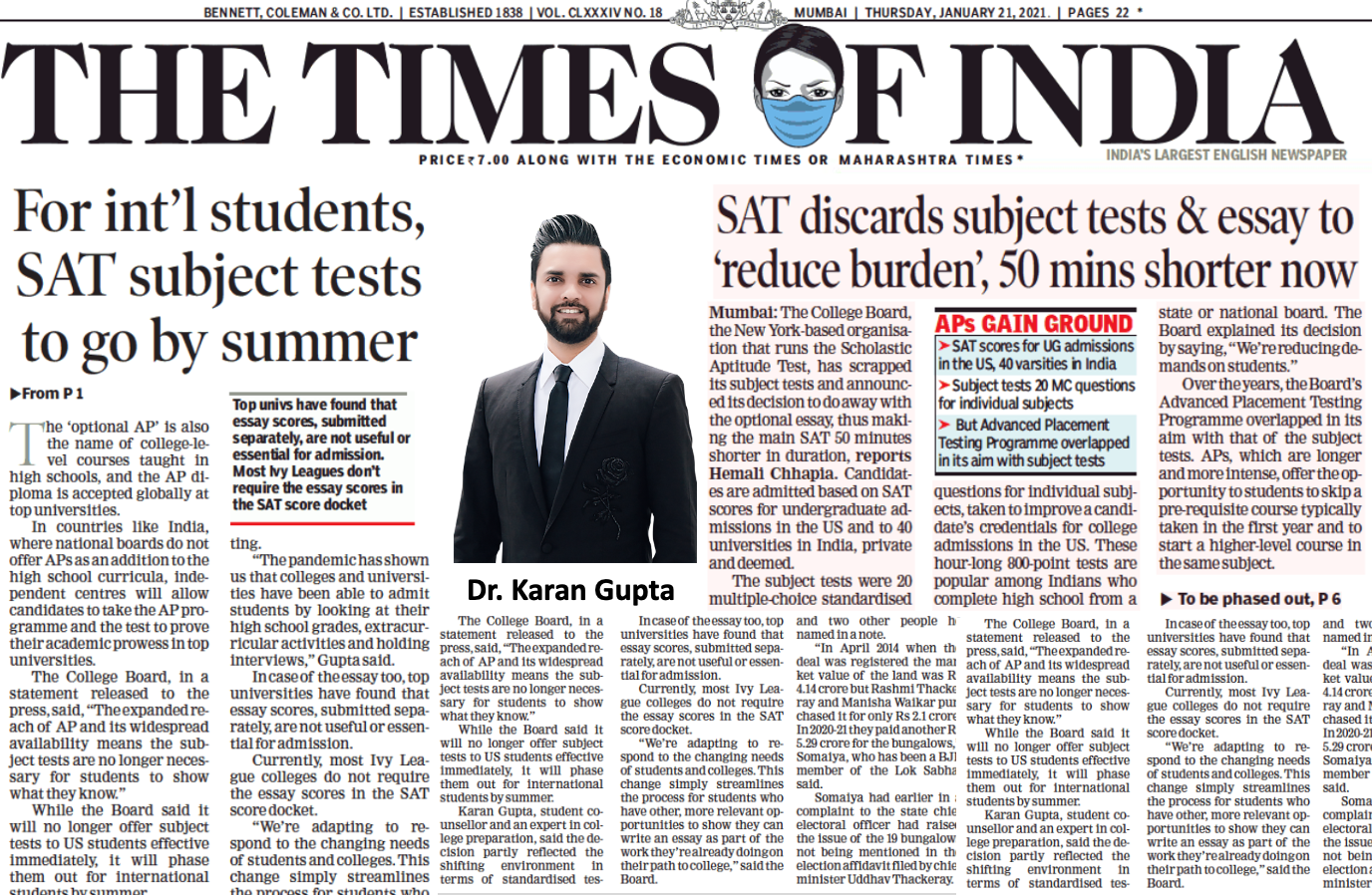
Dr. Karan Gupta is quoted in this article which talks about the permanent dropping of SAT Subject tests and SAT Essay

Dr. Karan Gupta's Perspective
Harvard Alumnus · 27 Years · 160,000+ Students
The announcement about the permanent elimination of SAT Subject Tests and the SAT Essay made headlines across global media, including the Times of India where I found myself quoted. This development marks a significant shift in the landscape of college admissions, one that students and parents keenly observe. As I ponder over this news, it becomes apparent how this change aligns with broader trends I've witnessed over the past 27 years in the sphere of overseas education.
Throughout my career, I've seen an increasing push towards holistic assessments by universities. The most prestigious institutions, once heavily reliant on standardized testing, now advocate for a more comprehensive view of a student’s abilities and potential. The permanent removal of these additional SAT tests underscores a movement towards educational paradigms that place less emphasis on rote memorization and more on broader capabilities—critical thinking, problem-solving, and adaptability. These are qualities that I discuss frequently with my students and their parents.
Last year, I encountered a student, Anika, who was a stellar performer in her high school. She possessed impressive SAT Subject Test scores, which she believed were vital for her admission prospects. Despite her achievements, she often felt constrained by the weight placed on these scores. Anika's true strengths lay beyond the narrow confines of textbooks and standardized papers—her passion for environmental advocacy and her leadership in local community projects were equally, if not more, compelling narratives about her readiness for college life.
Anika's experience epitomizes a common pattern I have observed: many students feel burdened by the necessity of excelling in numerous tests, each measuring limited facets of their abilities. The elimination of SAT Subject Tests and the SAT Essay, therefore, should not be seen merely as a reduction of checkboxes for applications but as an expansion of opportunities to present oneself. Students can now focus more intently on showcasing their intrinsic qualities and involvements that truly signify their potential to contribute meaningfully to their chosen fields.
For parents increasingly baffled by the shifting criteria of college admissions, this change should be perceived as a step towards normalizing the teaching of self-driven motivation and authentic engagement. My advice to parents is simple: cultivate an environment where children pursue and delve into activities that genuinely excite them. Encourage them to take ownership of their projects, whether that be through leading a club, volunteering, or starting a small business. These experiences shape character and feed an admissions officer's desire to understand who an applicant is, beyond numbers and statistics.
Conversely, this change also heralds a possible increase in competition as students showcase diverse accomplishments, not merely standardized scores. Parents and students need to recognize that while entrance testing criteria may appear relaxed, the demand for distinctive, vibrant applications remains unaltered. Staying complacent won't suffice. Instead, approach this new admissions landscape with a strategy influenced by introspection and an understanding of unique personal attributes. Embrace the articulation of authentic stories and experiences.
I recall another curious case involving Rohan, who applied to multiple Ivy League colleges. Besides his strong academic background, Rohan excelled in art, something he assumed would be peripheral to his application due to the STEM focus of his preferred majors. When the importance of SAT Subject Tests diminished, we used the opportunity to posit Rohan’s artistic ventures as central elements of his application, illustrating how his creativity sparked his interest in innovative design technologies. Rohan's success story serves as a reminder to students and parents that non-traditional accomplishments can not only distinguish an applicant but also reflect the multifaceted nature admissions committees now seek.
For students presently navigating these changes, here's a directive to guide you. Begin with self-reflection: identify your innate interests and areas where you possess an undeniable fervor. Translate these passions into action, be it through community endeavors, independent projects, or collaborative enterprises. Moreover, bolster these experiences by building a portfolio that vividly records your journey and growth.
While applications without SAT Subject Tests may seem less daunting, remember to maintain a sustained commitment to academic excellence. Your school transcript and overall GPA still serve as crucial indicators of your academic preparedness. Leverage teacher recommendations and personal essays to convey stories that grades alone cannot. Admissions committees cherish narratives that resonate with authenticity; your task is to ensure that your application sings of your sincere passions and capabilities.
Reflecting on the permanent shift away from SAT Subject Tests and the SAT Essay, one sees change evident not only in the mechanics of applications but also in the educational philosophies shaping future generations. By focusing more on intrinsic qualities, leadership, and resilience, students can learn to not only thrive in academic settings but also lead purposeful careers.
In this evolving educational environment, remember that the pathway to success is often non-linear but inherently yours to craft. Be dynamic, be authentic, and most importantly, remain true to the quests that inspire you. As admissions processes evolve, the need for students who possess both academic prowess and individual distinctiveness becomes ever more apparent. This is your time to leverage the flexibility this change offers and step forth into a future that values the full spectrum of human potential.
As we look ahead, I encourage students and parents to engage in this dialogue, sharing experiences and insights, to further demystify the admissions journey for all. By adopting a strategy grounded in authenticity and a commitment to lifelong learning, we equip our future generations with the tools to navigate a world that is diverse and filled with limitless possibilities.
Need Personalized Guidance?
Dr. Karan Gupta has been featured in leading media outlets for his expertise. Book a consultation to get the same trusted advice for your education journey.