American Career Fair Networking: The Pitch That Helps Students Stand Out

Dr. Karan Gupta is a Harvard Business School alumnus and career counsellor with 27+ years of experience and 160,000+ students guided. His insights on Study Abroad come from decades of hands-on experience helping students achieve their goals.
You can spend four years earning an excellent degree, building an impressive resume, and maintaining a high GPA. But if you don't know how to start a conversation with a recruiter, you could still walk away from a career fair without a single opportunity.
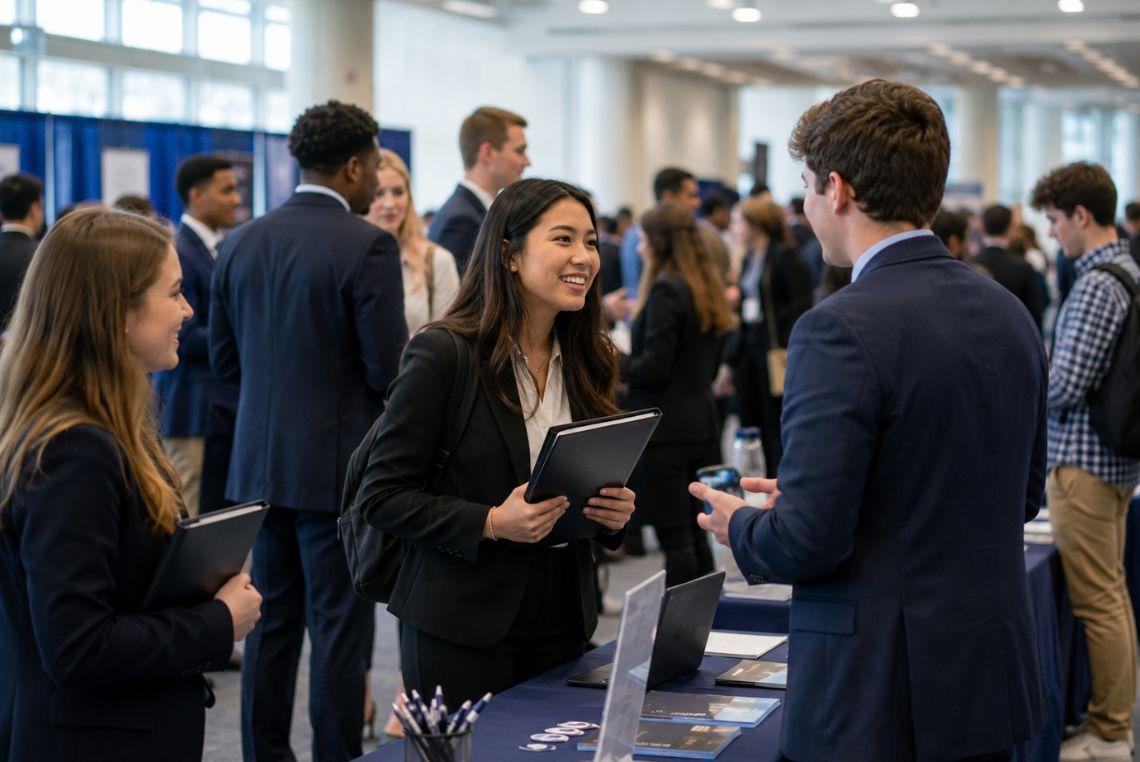
I recently spent an hour observing a career fair in New York, and what I witnessed explained why so many students struggle to get noticed.
There were two distinct lines.
The first was filled with students waiting patiently to hand over their resumes. Many stood quietly, hoping their qualifications would speak for themselves. They had invested years in their education and believed their resume was enough to make an impression.
Free Tool
Free Profile Evaluation
Get an honest AI assessment of your study-abroad profile in 2 minutes.
Try it free →The second line looked very different.
These students weren't holding out resumes the moment they reached the recruiter. Instead, they started conversations.
They asked thoughtful questions like:
"What's the biggest challenge your team is solving right now?"
"What kind of projects do your interns usually work on?"
"If I wanted to contribute from day one, what skills should I focus on developing before joining your team?"
Within a few minutes, those conversations became far more valuable than a resume exchange. Students walked away with LinkedIn connections, business cards, follow-up emails, and in some cases, invitations to apply for specific roles.
The students in the resume queue often walked away with little more than a polite "Thank you."
The difference wasn't intelligence.
It wasn't academic performance.
It wasn't even the university they attended.
The difference was communication.
This is one of the biggest lessons students and parents often overlook when preparing for higher education in the United States.
In America, hiring is a conversation—not an application.
Your resume may open the door, but your ability to communicate, ask thoughtful questions, and build professional relationships is what creates opportunities.
Whether you're an undergraduate looking for your first internship, a master's student preparing for full-time recruitment, or a parent helping your child plan for an international career, understanding how networking works at American career fairs can make a significant difference.
In this guide, you'll learn:
- Why most students fail to make an impression at career fairs.
- How recruiters actually evaluate candidates.
- A proven 30-second career fair pitch template.
- Questions that create meaningful conversations.
- Common networking mistakes to avoid.
- How to follow up after the event and build lasting professional relationships.
Because at an American career fair, your goal isn't simply to submit a resume.
Your goal is to become someone the recruiter remembers.
Why Most Students Don't Stand Out at American Career Fairs
For many students, attending a career fair feels like another stage of the application process.
They print multiple copies of their resume, dress professionally, stand in long queues, and hope that speaking to a recruiter for a minute or two will lead to an internship or job interview.
Unfortunately, that's not how most American career fairs work.
Many students have spent years preparing academically but very little time preparing professionally.
Schools teach subjects.
Universities teach technical knowledge.
Parents encourage students to achieve higher grades and secure admission to reputed institutions.
All of these are important.
But very few students are taught how to introduce themselves confidently, build rapport with professionals, ask insightful questions, or continue a conversation naturally.
As a result, many career fair interactions follow the same predictable pattern.
The student approaches the recruiter, says hello, hands over a resume, briefly mentions their degree, and asks,
"Are you hiring?"
The recruiter thanks them, accepts the resume, and encourages them to apply online.
The interaction lasts less than a minute.
Nothing memorable happens.
Now compare that with a student who begins differently.
Instead of immediately offering a resume, they introduce themselves, explain what genuinely interests them, reference something specific about the company, and ask a thoughtful question.
Suddenly, the conversation becomes personal rather than transactional.
The recruiter is no longer reading another resume.
They're speaking with a potential future colleague.
That shift changes everything.
Students often believe networking is about promoting themselves.
In reality, networking is about creating genuine conversations built on curiosity, professionalism, and mutual respect.
The students who stand out aren't always the ones with the highest GPA.
They're often the ones who know how to connect with people.
How Career Fairs Work in the United States
One of the biggest misconceptions among international students is that career fairs are mini job interviews.
They're not.
Career fairs are networking events designed to help students and employers connect before the formal hiring process begins.
Recruiters attend these events for several reasons.
They want to introduce students to their organisation, identify promising candidates, answer questions about internships and graduate programmes, and encourage talented students to apply.
Think of a career fair as your opportunity to make a strong first impression—not to secure a job offer on the spot.
This is why communication skills matter so much.
Recruiters often meet hundreds of students in a single day. Most resumes begin to look similar after a while, especially when students have comparable academic backgrounds.
What recruiters remember is how someone made them feel during the conversation.
Did the student appear genuinely interested?
Did they communicate confidently?
Did they ask thoughtful questions?
Could they explain their experiences clearly?
Would they fit well within the team?
These are the qualities that often distinguish one candidate from another.
This isn't just an opinion.
According to the National Association of Colleges and Employers (NACE), employers consistently rank communication, teamwork, problem-solving, professionalism, and critical thinking among the most important career readiness competencies they seek in graduates.
Technical knowledge may help you qualify for a role.
Professional communication often determines whether you progress to the interview stage.
Understanding this changes how you should approach every career fair.
Instead of thinking,
"How many recruiters can I give my resume to?"
Ask yourself,
"How many meaningful conversations can I have today?"
That simple change in mindset can transform your entire experience.
Prepare Before You Walk Into the Career Fair
Successful networking doesn't begin when you reach the recruiter's table.
It begins days before the event.
Students who prepare well appear more confident because they already know what they want to say and whom they want to meet.
Here are some practical ways to prepare before attending an American career fair.
Research the Companies
Don't arrive without a plan.
Most universities publish a list of participating employers before the event.
Identify the companies that genuinely interest you and spend time learning about them.
Look at:
- Their products or services.
- Recent news or achievements.
- Internship and graduate opportunities.
- Company values and culture.
- Technologies or projects they are working on.
Mentioning something specific about the company immediately demonstrates initiative and genuine interest.
Prepare Questions in Advance
The best conversations begin with thoughtful questions.
Instead of asking,
"What does your company do?"
Consider asking:
- What projects are interns currently working on?
- What qualities help students succeed on your team?
- What advice would you give someone hoping to join your organisation next year?
Questions like these encourage meaningful discussions rather than one-word answers.
Update Your Resume and LinkedIn Profile
Your resume should be concise, error-free, and tailored to the type of opportunities you're seeking.
Your LinkedIn profile should also reflect your latest achievements, internships, certifications, projects, and leadership experiences.
Many recruiters will look at your LinkedIn profile shortly after speaking with you.
A strong online presence reinforces the impression you've made in person.
Practise Your Introduction
One of the biggest reasons students feel nervous is that they haven't practised speaking about themselves.
Your introduction doesn't need to sound rehearsed.
It simply needs to sound confident and natural.
Practise introducing yourself aloud with friends, mentors, or family members until it feels comfortable.
The more you practise, the more authentic you'll sound.
Dress Professionally
First impressions matter.
You don't need expensive clothing, but you should dress neatly and professionally.
Business formal or business casual attire is generally appropriate unless your university provides different guidance.
Professional appearance demonstrates respect for the opportunity and helps you feel more confident.
Bring More Than Just Your Resume
Carry multiple printed copies of your resume, but don't rely on them to create opportunities.
Bring a notebook for taking notes, keep your phone charged for exchanging LinkedIn details, and have a positive attitude.
Remember, the resume supports the conversation.
It should never replace it.
The 30-Second American Career Fair Pitch Template
Many students believe they need to memorise the perfect speech before attending a career fair.
They don't.
Recruiters can usually tell when a student is reciting a script. Instead of sounding confident, it often comes across as rehearsed and impersonal.
The purpose of a career fair pitch isn't to impress the recruiter with a flawless introduction.
It's to start a conversation.
Think of your pitch as an opening, not a performance.
A good pitch should answer four simple questions:
- Who are you?
- What are you studying?
- What interests you professionally?
- Why are you interested in speaking with this recruiter?
Once you've answered those questions, invite the recruiter into the conversation with a thoughtful question.
A simple structure like the one below works well for almost every industry.
Step 1: Introduce Yourself
Start with your name, degree, and university.
Hi, I'm [Your Name]. I'm currently studying [Degree] at [University].
Keep it simple and confident.
Step 2: Share Your Career Interest
Briefly explain what excites you about your field.
I'm particularly interested in cybersecurity because I enjoy solving complex security challenges and learning how organisations protect their systems.
Or:
I'm passionate about marketing because I enjoy understanding consumer behaviour and building campaigns that create measurable impact.
This gives recruiters insight into your motivation rather than simply your qualifications.
Step 3: Highlight One Relevant Experience
Choose one internship, research project, leadership role, competition, or academic project.
Don't list everything you've done.
Instead, mention one experience that demonstrates your skills.
For example:
Recently, I completed a data analytics project where I built a dashboard to identify sales trends using Power BI. It strengthened my analytical and problem-solving skills.
Or:
Last semester, I led a team during a university consulting competition, where we developed a market entry strategy for a startup.
One example is more memorable than five bullet points.
Step 4: Show You've Done Your Research
This is where many students separate themselves from the crowd.
Instead of saying,
"I want to work at your company."
Say something like:
I noticed your company has been expanding its AI initiatives, and I'd love to learn more about how students contribute to those projects.
Or:
I recently read about your sustainability initiatives, and they really align with my interests.
Specificity demonstrates genuine interest.
Step 5: End With a Thoughtful Question
This is the most important part.
Your question determines whether the conversation continues.
Instead of asking:
"Are you hiring?"
Try asking:
- What qualities make interns successful on your team?
- What projects do interns typically work on?
- What skills would you recommend students develop before applying?
- What's something new graduates often underestimate about working in your industry?
- What do you enjoy most about working at your company?
Good questions lead to meaningful conversations.
And meaningful conversations are what recruiters remember.
A Sample American Career Fair Pitch
Here's how everything comes together.
Hi, I'm Riya, and I'm currently pursuing my Master's in Business Analytics at New York University. I'm really interested in using data to solve business problems, and last semester, I worked on a predictive analytics project that helped improve sales forecasting for a retail case study. I noticed your company has been investing heavily in AI-driven analytics, and I'd love to learn more about how your interns contribute to those projects. What's one quality you think helps students succeed on your team?
Notice what this pitch does well.
It doesn't sound like a rehearsed speech.
It communicates confidence without sounding boastful.
It demonstrates preparation.
Most importantly, it invites the recruiter into a conversation.
That's exactly what you want.
What NOT to Say at an American Career Fair
Sometimes, knowing what to avoid is just as important as knowing what to say.
Here are a few common mistakes students make.
"Are you hiring?"
This is one of the most common questions recruiters hear all day.
Most participating companies are hiring in some capacity—that's why they're attending the event.
Instead, ask:
What qualities do you look for in successful interns or graduate hires?
"Can you sponsor my visa?"
While visa sponsorship is a valid concern for many international students, it shouldn't be the first topic of conversation.
Build rapport first.
Understand the company's hiring process.
If sponsorship policies aren't already available on the company's careers page, you can discuss them later in the conversation or during the recruitment process.
"Here's my resume."
Don't lead with your resume.
Lead by yourself.
Introduce yourself first, have a conversation, and then offer your resume when it feels natural.
Your resume should support your conversation—not replace it.
"I need an internship."
Recruiters already know why students attend career fairs.
Instead of focusing on what you need, focus on what you can contribute and what you'd like to learn.
For example:
I'm interested in learning how your team approaches product development because that's an area I'd like to build my career in.
That shifts the conversation from need to curiosity.
Talking Non-Stop
Some students become nervous and continue speaking without allowing recruiters to respond.
Remember, networking is a two-way conversation.
Pause.
Listen.
Respond naturally.
The best conversations feel balanced.
How to Turn Your Pitch Into a Real Conversation
This is where many students miss an opportunity.
A great pitch gets the conversation started.
A great conversation builds the relationship.
Once you've introduced yourself, your focus should shift from speaking to listening.
If the recruiter mentions a project, ask a follow-up question.
If they describe a challenge their team is working on, show genuine curiosity.
For example, if a recruiter says their company is investing heavily in artificial intelligence, don't immediately talk about your resume.
Instead, ask:
That's really interesting. How has AI changed the kind of skills you now look for in interns?
Or if they mention that interns often work with cross-functional teams, you could respond:
That sounds like a great learning opportunity. How do interns usually collaborate with different departments?
These questions demonstrate that you're engaged in the conversation rather than simply waiting for your turn to speak.
Another important skill is active listening.
Many students become so focused on remembering their next sentence that they stop listening to the recruiter.
Instead, pay attention to what they're saying.
Smile.
Maintain eye contact.
Respond thoughtfully.
Ask relevant follow-up questions.
Professional networking isn't about delivering the perfect speech.
It's about building genuine relationships.
Recruiters are far more likely to remember someone who was curious, confident, and pleasant to speak with than someone who simply recited an impressive list of achievements.
Before ending the conversation, thank the recruiter for their time and ask whether it's appropriate to stay connected.
You might say:
Thank you for sharing those insights. I've really enjoyed learning about your team. Would it be alright if I connected with you on LinkedIn?
Or:
Is there someone else on your team you'd recommend I speak with to learn more about this area?
These small steps often lead to valuable professional relationships that continue long after the career fair ends.
Remember, your objective isn't to collect as many business cards as possible.
It's to leave a lasting impression with a few meaningful conversations.
Questions That Impress Recruiters at Career Fairs
One of the easiest ways to stand out at a career fair is by asking better questions.
Recruiters speak with hundreds of students during these events. Many conversations begin and end with questions like, "Are you hiring?" or "Can I give you my resume?"
While these questions aren't necessarily wrong, they don't create memorable conversations.
Thoughtful questions demonstrate that you've done your research, are genuinely interested in the company, and are thinking beyond simply securing an internship.
Here are some questions that can help you leave a stronger impression.
Questions About the Role
- What kind of projects do interns or new graduates typically work on?
- What skills make someone successful in this role?
- How do interns contribute to the team from the beginning?
Questions About Growth
- What learning opportunities are available for interns?
- How do graduates usually progress within the organisation?
- What advice would you give students preparing for careers in this industry?
Questions About the Company
- What's one challenge your team is currently working on?
- What excites you most about the company's future?
- Has the role changed significantly over the last few years?
- What qualities distinguish candidates who stand out during the recruitment process?
Remember, your objective isn't to ask as many questions as possible. Ask one or two meaningful questions, listen carefully to the answers, and build the conversation naturally.
Quality always matters more than quantity.
Common Networking Mistakes Students Make
Even well-qualified students can unintentionally weaken their chances by making a few avoidable mistakes.
Being aware of these pitfalls can help you approach career fairs with greater confidence.
Focusing Only on the Resume
Your resume is important, but it's only one part of your professional profile.
Recruiters are also evaluating how you communicate, how curious you are, and whether you'd fit into their team.
Don't let your resume do all the talking.
Speaking Without Listening
Networking isn't a presentation.
If you're doing all the talking, you're missing valuable opportunities to learn from the recruiter.
Listen actively and respond to what they're saying rather than moving straight to your next prepared point.
Asking Questions You Could Easily Find Online
Questions like "What does your company do?" suggest that you haven't prepared.
Spend a few minutes researching the organisation before the event so you can ask more thoughtful questions.
Trying to Visit Every Booth
Students often believe that speaking with as many recruiters as possible increases their chances of success.
In reality, it's usually better to have five meaningful conversations than twenty rushed ones.
Prioritise quality over quantity.
Ignoring Smaller Companies
Many students head straight to the biggest global brands.
However, smaller organisations often offer excellent internships, greater responsibilities, and faster learning opportunities.
Keep an open mind.
Forgetting to Follow Up
Some students have excellent conversations but never reconnect with the recruiter afterwards.
Without a follow-up, even a great interaction can quickly be forgotten.
Networking doesn't end when the career fair ends.
What to Do After the Career Fair
Many students assume the event is over once they leave the venue.
In reality, some of the most important networking happens afterwards.
Following up professionally demonstrates initiative and helps the recruiter remember you.
Here are a few simple steps to take after the event.
Connect on LinkedIn
Within 24 to 48 hours, send a personalised LinkedIn connection request.
Instead of using the default message, mention something specific from your conversation.
For example:
Hello Sarah, it was great speaking with you at yesterday's career fair. I really enjoyed learning about your team's work in data analytics. Thank you for sharing your insights—I look forward to staying connected.
A personalised message is far more memorable than a generic connection request.
Send a Thank-You Email (If Appropriate)
If the recruiter shared their email address, send a brief thank-you message.
Express appreciation for their time and mention one key takeaway from your discussion.
Keep it concise and professional.
Apply Promptly
If the recruiter encouraged you to apply for a particular internship or graduate programme, don't delay.
Submit your application while your conversation is still fresh in their memory.
Reflect on Your Experience
Every career fair is a learning opportunity.
Ask yourself:
- Which conversations went well?
- Which questions received the best responses?
- Where could I improve my introduction?
The more events you attend, the more confident you'll become.
Advice for International Students
For many international students, attending an American career fair can feel intimidating.
You may worry about your accent, your confidence, cultural differences, or saying the wrong thing.
These concerns are completely normal.
The good news is that recruiters aren't expecting perfection.
They're looking for students who are prepared, curious, professional, and eager to learn.
Don't let the fear of making mistakes prevent you from starting conversations.
Most recruiters appreciate authenticity far more than perfectly rehearsed answers.
Remember that communication is a skill.
Like interviewing, public speaking, or presenting, it improves with practice.
The first conversation may feel uncomfortable.
The fifth will feel easier.
By the tenth, you'll probably wonder why you were nervous in the first place.
Confidence isn't something you're born with.
It's something you build through experience.
And every networking conversation helps you develop it.
Career Fair Networking Checklist
Before attending your next career fair, use this quick checklist to make sure you're prepared.
✔ Research the companies you'll be speaking with.
✔ Update your resume and LinkedIn profile.
✔ Prepare your 30-second career fair pitch.
✔ Practise introducing yourself aloud.
✔ Prepare two or three thoughtful questions.
✔ Dress professionally.
✔ Carry multiple copies of your resume.
✔ Listen more than you speak.
✔ Connect with recruiters on LinkedIn after the event.
✔ Follow up within 24 to 48 hours.
Small steps like these can make a significant difference to the quality of your networking conversations.
Conclusion
Let's go back to the career fair in New York.
Two lines.
One line of students is quietly waiting to hand over their resumes.
Another line of students is asking thoughtful questions, building genuine conversations, and leaving with professional connections.
The difference wasn't intelligence.
It wasn't grades.
It wasn't the university name on their resume.
It was their ability to communicate.
That's one of the biggest lessons students need to understand before entering the American job market.
A degree may get you into the room.
A strong resume may help you earn attention.
But meaningful conversations build careers.
The students who succeed at American career fairs aren't necessarily the ones with the highest GPAs. They're the ones who show curiosity, communicate confidently, and leave recruiters remembering them long after the event ends.
If you're planning to study in the United States, your preparation shouldn't stop once you've secured admission. Choose a university that offers strong career services, networking opportunities, internships, and industry connections. Just as importantly, invest in developing the communication and professional skills that employers value.
Because in the end, your education doesn't just prepare you for exams.
It prepares you for the conversations that shape your future.
Explore Related Resources & Tools
Free tools and expert services from Karan Gupta Consulting
Frequently Asked Questions
What is an American career fair pitch?
How long should a career fair pitch be?
What questions should I ask recruiters at a career fair?
Should I hand over my resume immediately?
Why is networking important at American career fairs?
Why Choose Karan Gupta Consulting?
- 27+ years of expertise in overseas education consulting
- 160,000+ students successfully counselled
- Personal guidance from Dr. Karan Gupta, Harvard Business School alumnus
- Licensed MBTI® and Strong® career assessment practitioner
- End-to-end support from career clarity to visa approval
SHARE THIS ARTICLE

Dr. Karan Gupta
Founder & Chief Education Consultant
Harvard Business School alumnus and India's leading career counsellor with 27+ years guiding 160,000+ students to top universities worldwide. Licensed MBTI® practitioner. Managing Director of IE University (India & South Asia).