MS in Environmental Engineering Abroad for Indian Students: Programs, STEM-OPT, and Careers

Dr. Karan Gupta is a Harvard Business School alumnus and career counsellor with 27+ years of experience and 160,000+ students guided. His insights on Postgraduate come from decades of hands-on experience helping students achieve their goals.
Why Indian Students Should Consider an MS in Environmental Engineering Abroad
Every headline about India's future eventually circles back to the same set of problems: cities running out of groundwater, rivers carrying more effluent than they can dilute, winter air that shuts down schools in Delhi, mountains of unsegregated waste, and a coastline bracing for sea-level rise. These are not abstract environmental worries. They are engineering problems — of moving, treating, storing, and cleaning water; of capturing and scrubbing pollutants; of designing landfills, sewers, and treatment plants that work at the scale a country of 1.4 billion people demands. Environmental engineering is the discipline that builds the physical systems standing between a growing population and the natural resources it depends on, and demand for people who can design those systems is only accelerating.
For an Indian student weighing a master's abroad, environmental engineering sits at an unusually favourable intersection. It is a rigorous, quantitative engineering degree that qualifies as a STEM field in the United States — which matters enormously for post-study work rights, as we will get into. It draws on the global push toward decarbonisation and climate adaptation, so employers in consulting, utilities, government, and increasingly the private ESG world are hiring. And it plays to a strength many Indian applicants already have: strong foundations in mathematics, chemistry, fluid mechanics, and civil or chemical engineering fundamentals. An MS abroad adds the specialist depth and international exposure that turn a capable graduate into someone a global firm wants to hire.
There is also a quieter, strategic reason: environmental regulation worldwide is tightening, not loosening, and green infrastructure spending — on water reuse, clean air, climate-resilient construction, and industrial decarbonisation — survives economic cycles because it is driven by law, health, and physical necessity rather than fashion. A degree tied to that kind of durable demand is a sensible long-term bet.
Environmental Engineering vs Environmental Science vs Civil (Environmental) vs Energy/Sustainability
This is the decision that trips up more applicants than any other, and getting it wrong can cost you two years and a lot of money in a field that does not lead where you thought it would. These four labels overlap in brochures but point at genuinely different careers, so it is worth being precise.
Environmental engineering is about designing and building systems. You are the person who sizes a wastewater treatment plant, models how a plume of contaminated groundwater will move, designs an air-pollution control system for a factory stack, or specifies a stormwater network for a new district. The work is quantitative — heavy on chemistry, fluid mechanics, reaction kinetics, and mass balances — and closely tied to professional licensure and codes, because what you design has to be safe and hold up in the real world. If you like the idea of your name being on the drawings for infrastructure that treats real water or cleans real air, this is your field.
Environmental science, by contrast, is about understanding and measuring the environment rather than building interventions for it. Environmental scientists study ecosystems, monitor pollution, model climate, assess impacts, and inform policy — more research- and analysis-oriented work, often rooted in biology, ecology, chemistry, or earth science, leading toward research institutions, government agencies, NGOs, and policy-side consultancies. If you are drawn to fieldwork, data, and the "why and how much" questions rather than "how do we build the fix," environmental science may suit you better — and we have a separate guide on that path.
Civil engineering with an environmental focus is a close cousin — at many universities the two share a "Civil and Environmental Engineering" department and courses. The distinction is breadth: a civil engineer specialising in environmental or water resources still carries the broader structural, geotechnical, and transportation grounding of civil engineering and often works within large infrastructure projects, whereas a dedicated environmental engineering MS goes deeper into treatment, remediation, and pollution control.
Finally, energy and sustainability programmes tilt toward a different set of problems: renewable energy systems, energy efficiency, carbon markets, corporate sustainability strategy, and the business and policy of decarbonisation — some highly technical, many interdisciplinary and management-oriented. The honest test is simple: do you want to design the physical systems that treat water, clean air, and manage waste? If yes, environmental engineering is the right label. If you want to research the environment, choose science; for the broadest infrastructure career, civil; for the energy transition and sustainability strategy, energy/sustainability.
Top Programs to Consider
Environmental engineering is offered at a deep bench of well-regarded universities across several countries with different cost and work-visa profiles. What follows is a representative set rather than a ranking; the right choice depends on your budget, research interests, and where you want to work afterward. Verify current details on each department's own website before applying, since curricula and admission policies change.
United States
The United States has the widest and deepest set of environmental engineering programmes, and — crucially — the degree is STEM-designated there. Stanford University and UC Berkeley both run their environmental engineering work through combined Civil and Environmental Engineering departments and are consistently among the most respected in the field, with research spanning water quality, environmental biotechnology, fluid mechanics, and climate. The Georgia Institute of Technology has a large, highly regarded School of Civil and Environmental Engineering with dedicated MS tracks and strong industry ties. The University of Michigan and the University of Illinois Urbana-Champaign (UIUC) offer well-established programmes across water, air, and sustainable infrastructure, while the University of Texas at Austin is strong in water resources engineering. Carnegie Mellon University brings an analytical, systems-and-policy flavour for students who like modelling, and Johns Hopkins University rounds out the list with its Environmental Health and Engineering department, notable for the intersection of environmental engineering and public health. Because all fall under the engineering CIP family, these US degrees are STEM-eligible — which, as the next section explains, has a direct effect on your ability to work in the US after graduation.
United Kingdom and Europe
Outside the US, several European institutions are world-class and often shorter or cheaper. Imperial College London offers respected master's programmes in environmental engineering and related water fields, with the advantage of a one-year UK master's structure. In continental Europe, ETH Zurich in Switzerland is an elite technical university with strong, research-led environmental engineering, and the Delft University of Technology (TU Delft) in the Netherlands is particularly renowned for water management and environmental engineering — unsurprising for a country that has engineered its own relationship with water for centuries — with English-taught programmes at costs generally well below US private universities. European programmes do not carry the US STEM-OPT benefit, but they offer their own post-study routes (such as the UK Graduate Route and the Netherlands' orientation year), often at lower tuition, so they deserve serious consideration depending on where you want to build your career.
What You Will Study: Curriculum
An MS in environmental engineering is built on a core of applied chemistry and physics, then layered with specialist modules that map onto the field's main problem areas. The structure varies, but most programmes share a recognisable spine.
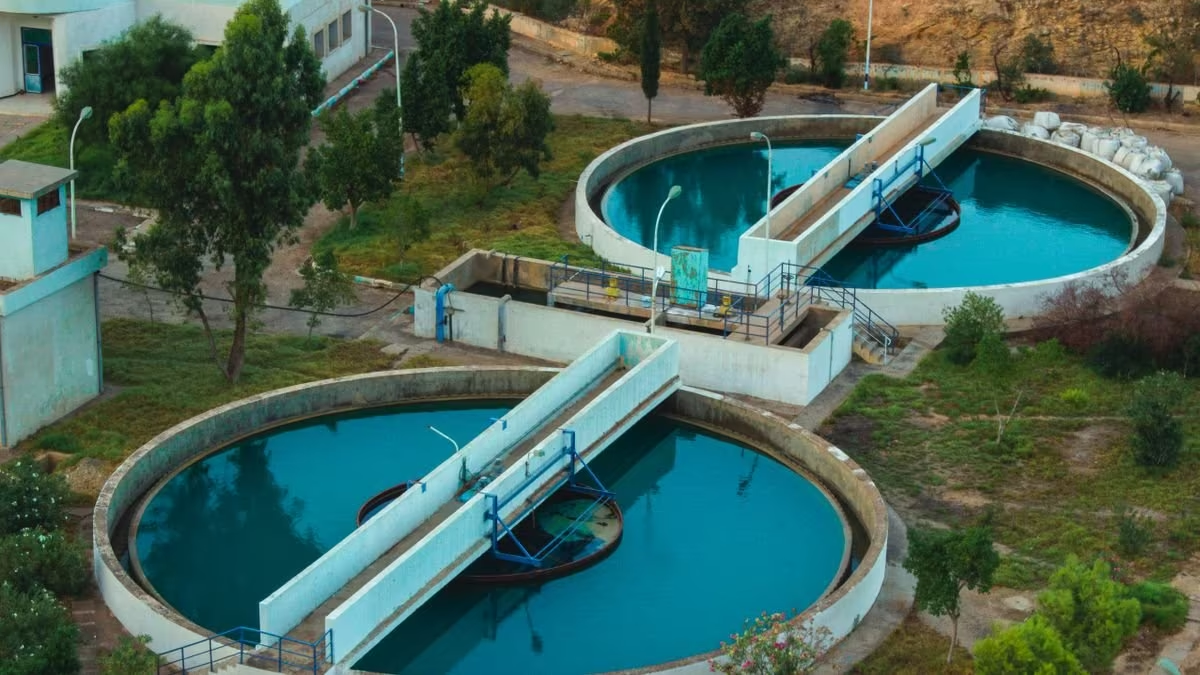
At the centre sits water and wastewater treatment — the design of the physical, chemical, and biological processes that make water safe to drink and effluent safe to discharge or reuse. Often the flagship of the discipline, it draws heavily on environmental chemistry (how contaminants behave and transform) and environmental microbiology (the biological processes that break down pollutants). Alongside it sit air quality engineering — the measurement, modelling, and control of atmospheric pollutants and emissions — and solid and hazardous waste management, covering landfill design, waste treatment, and remediation of contaminated sites.
Underpinning all of this is a strong quantitative toolkit. Hydrology and water resources teach how water moves through catchments, aquifers, and infrastructure, while environmental (or contaminant) transport modelling predicts how pollutants spread through air, water, and soil using fluid mechanics and reaction kinetics — increasingly through computational simulation. A growing share of programmes now include climate and greenhouse-gas engineering — carbon accounting, GHG inventories, and low-emission systems — and many weave in sustainability and life-cycle analysis. Most MS students round out the degree with a thesis, capstone design project, or independent research — where the coursework becomes a portfolio piece you can show an employer.
Career Paths and Salaries
The most common destination is the role the degree is named for: the environmental engineer, designing and overseeing treatment plants, pollution-control systems, remediation projects, and compliance work. From that base, careers branch into specialisms. Water resources engineers focus on supply, distribution, treatment, and reuse; air quality engineers work on emissions control, permitting, and dispersion modelling. A fast-growing lane is climate and ESG, where engineers move into carbon accounting, sustainability reporting, climate-risk assessment, and decarbonisation projects, often bridging the technical and corporate worlds. Others go into environmental consulting, advising companies and governments on compliance, impact assessments, and remediation, or into the public sector, working for environmental agencies, water utilities, and municipal bodies.
Employers span engineering and environmental consultancies (firms such as AECOM, Jacobs, Arcadis, Stantec, and WSP are typical), water and utility companies, government environmental and public-health agencies, and — increasingly — the sustainability and ESG functions of large corporations.
On compensation, the most reliable US benchmark is the Bureau of Labor Statistics, which reported a median annual wage for environmental engineers of about US$104,000 (May 2024 data), with the lower tenth earning under roughly US$65,000 and the top tenth above roughly US$162,000. Entry-level salaries for a master's graduate typically start below the median and rise with experience, licensure, and specialisation. Treat these as broad reference ranges rather than promises — actual pay varies by city, sector, employer, and immigration status. The BLS also projects employment of environmental engineers to grow around 4% through 2034, roughly in line with the overall labour market. In the Indian context, salaries are considerably lower in absolute terms and vary widely, but a strong international master's, relevant project experience, and roles with multinational consultancies or in the growing ESG and water-infrastructure space can command a meaningful premium over a purely domestic profile.
STEM Designation, Work Visas, and ROI
For students targeting the United States, this is the section that matters most financially. Environmental engineering is classified as a STEM field on the US government's designated-degree list, under the environmental/environmental-health engineering CIP code. A graduate on an F-1 visa is therefore eligible not only for the standard 12 months of Optional Practical Training (OPT), but also for the STEM OPT extension of an additional 24 months — up to three years of authorised work before needing to move to a longer-term visa such as the H-1B. Three years is a materially better runway than the single year available to non-STEM graduates: more time to gain experience, more paycheques to repay your investment, and up to three chances at the H-1B lottery rather than one. Confirm that your specific programme carries the STEM CIP designation, since the extension is tied to the exact classification of the degree you enrol in.
That extended work window is central to the return-on-investment case. A US master's is a significant outlay — often tens of thousands of dollars in tuition plus living costs — but three years of post-study earnings at the salary levels above can go a long way toward recouping it, especially with assistantship funding. European programmes trade the STEM-OPT advantage for lower upfront cost and their own post-study routes; a one-year UK master's or a lower-tuition programme at TU Delft can produce a stronger ROI for a student who does not need the US pathway. Run the numbers honestly for your own situation — tuition, funding odds, expected starting salary, and where you actually want to work — rather than assuming any single destination is best.
Admissions: Backgrounds, Tests, and Prerequisites
Environmental engineering master's programmes draw from a broad set of undergraduate backgrounds. The most direct feeders are bachelor's degrees in civil, environmental, or chemical engineering, but applicants also come from mechanical engineering, biotechnology, agricultural engineering, and even the physical sciences — provided they can show adequate grounding in mathematics, chemistry, and fluid mechanics. If your degree is further afield, some programmes will admit you with prerequisite coursework to fill the gaps, so read each department's prerequisites carefully rather than assuming eligibility either way.
On testing, the landscape has shifted noticeably. Many strong programmes have moved away from the GRE: UC Berkeley's Civil and Environmental Engineering department, for instance, no longer requires or even accepts it, and a number of others have made it optional in recent cycles, while some still require or recommend it. Check each programme's current policy individually rather than relying on old advice — and where the GRE is optional, a strong score can still strengthen a borderline application, while a weak one is best left off. English-language proficiency is near-universal: expect TOEFL or IELTS, with typical minimums around IELTS 6.5 or TOEFL in the mid-80s to 100, and higher at the most competitive programmes.
Beyond scores, committees weigh your academic record, letters of recommendation, and — critically — a statement of purpose showing genuine, specific interest rather than a generic "I want to save the planet." The strongest applications connect a clear technical interest (water reuse, air-quality modelling, contaminated-site remediation) to relevant experience and to specific faculty or research groups. Given how much environmental engineering research is funded and lab-based, demonstrating fit with a department's actual work is often what separates an admit from a rejection.
Funding: Assistantships, Scholarships, and Loans
As a research-intensive engineering field, environmental engineering offers more funding avenues than many taught master's programmes. The most valuable are assistantships — research assistantships (RAs) on a faculty member's funded project, and teaching assistantships (TAs) supporting undergraduate courses. A full assistantship typically covers a tuition waiver plus a living stipend, which can transform the economics of a US degree; these are competitive and often tied to research fit, another reason to engage with departments directly during the application. Fellowships and scholarships — from universities, external and government bodies, and India-specific study-abroad awards — provide partial to full support and are worth researching well ahead of deadlines. Finally, education loans remain the backbone of financing for most Indian students, and the STEM-OPT window (for US degrees) is precisely what makes the repayment maths workable, since it front-loads several years of earning. Apply early, target programmes where your research interests align with funded work, and treat funding as part of the application effort rather than an afterthought.
Why Work With a Counsellor for Environmental Engineering Applications
Environmental engineering rewards precision at every step — choosing the right sub-field, matching your background to programmes that will actually admit and fund you, and telling a coherent story that connects your experience to a department's research. That is exactly the kind of decision where experienced, honest guidance pays for itself. With over 27+ years of experience and having guided more than 160,000+ students, Dr. Karan Gupta Consulting helps you weigh environmental engineering against neighbouring fields, shortlist programmes that fit your profile and budget, position your application for funding, and navigate the STEM-OPT and post-study landscape realistically — so a focused conversation early can save you from an expensive wrong turn.
Related programmes and guides
Still comparing your options? Explore our related guides to the MS in Construction Management, MS in Industrial Engineering, and MS in Engineering Management. You can also gauge your chances with the free Masters Admit Predictor, search funding through the Scholarship Finder, or browse the complete Masters Study Abroad Guide.
Explore Related Resources & Tools
Free tools and expert services from Karan Gupta Consulting
TAGS
Why Choose Karan Gupta Consulting?
- 27+ years of expertise in overseas education consulting
- 160,000+ students successfully counselled
- Personal guidance from Dr. Karan Gupta, Harvard Business School alumnus
- Licensed MBTI® and Strong® career assessment practitioner
- End-to-end support from career clarity to visa approval
SHARE THIS ARTICLE

Dr. Karan Gupta
Founder & Chief Education Consultant
Harvard Business School alumnus and India's leading career counsellor with 27+ years guiding 160,000+ students to top universities worldwide. Licensed MBTI® practitioner. Managing Director of IE University (India & South Asia).