Subject Choices: How Family Decisions Shape University Options for Students


Dr. Karan Gupta is a Harvard Business School alumnus and career counsellor with 27+ years of experience and 160,000+ students guided. His insights on Undergraduate come from decades of hands-on experience helping students achieve their goals.
Choosing subjects in school often feels like a simple academic decision. In reality, it is rarely just that. For many students, subject choices become a family conversation — sometimes even a family conflict.
Parents want security. Students want freedom. Schools talk about flexibility. Universities talk about eligibility. Somewhere in the middle sits a 15–17-year-old trying to decide what subjects to study.
Free Tool
University Predictor
Find out which universities you can realistically get into.
Try it free →This is where the real debate begins.
Almost every family discussion around subject choices eventually turns into the same question:
“Should we keep options open, or should we choose a direction early?”
To understand this better, let’s look at two very common student stories.
Two Students. Two Subject Choice Strategies.
Student A: The “Keep All Options Open” Strategy
Student A says:
“I chose subjects that are popular and my family felt were safer.
They kept me eligible for more universities and more courses.
But I still don't know what I want to do.”
This is the most common strategy families choose.
Typical combinations might include:
- Physics, Chemistry, Maths
- Economics, Maths, Business
- Biology, Chemistry, Maths
The logic is simple:
- These subject choices keep more university options open
- They allow applications to multiple fields
- They feel like the “safe” academic route
Parents often encourage this path because it feels like insurance.
But the reality is more complicated.
Student B: The “Clear Direction” Strategy
Student B says:
“I chose subjects based on one clear direction early on.
It limited some options,
But everything I’ve done since then points to the same field.”
This student usually has a strong early interest.
Examples include:
- Psychology + Biology + Statistics
- Economics + Maths + Politics
- Design + Art + Media
Instead of maximising eligibility, this student focuses on depth and direction.
Every decision starts reinforcing the same academic path.
Why Families Disagree About Subject Choices
When families argue about subject choices, they are rarely arguing about subjects themselves.
They are arguing about risk.
Parents usually think in terms of:
- Stability
- Future job security
- University acceptance chances
- Keeping multiple pathways open
Students often think about:
- Interest
- Curiosity
- Identity
- Passion for a particular field
Both sides are trying to protect the future — just in different ways.
The “Safety Myth” Behind Subject Choices
Many families believe that certain subjects are automatically safer.
Typical examples include:
- Maths
- Science streams
- Economics
These subjects are often considered safe because they appear to keep doors open.
However, data from global university admissions tells a more nuanced story.
Many top universities now evaluate students based on:
- Academic alignment
- Depth of engagement in a field
- Evidence of intellectual curiosity
- Projects, internships, or research in a subject area
In other words:
Universities increasingly prefer coherent academic stories over scattered possibilities.
A student who demonstrates sustained interest in a field often stands out more clearly.
How Universities Actually Evaluate Subject Choices
Most universities do not reward students simply for taking the most difficult or “prestigious” subjects.
Instead, admissions teams look for alignment between three things:
- Subject choices
- Extracurricular activities
- Intended university course
For example:
A student applying for Economics might show:
- Maths and Economics subjects
- Data analysis projects
- Research papers
- Economics competitions
- Internships in finance or policy
This creates a consistent narrative.
Admissions teams can immediately understand the student’s direction.
By contrast, students who choose subjects purely for flexibility sometimes struggle to explain their academic focus later.
The Hidden Cost of Keeping All Options Open
At first glance, keeping options open sounds like the smartest strategy.
But it comes with hidden trade-offs.
1. Lack of Academic Direction
Students who keep everything open sometimes reach Grade 11 or Grade 12 still unsure about what they want to pursue.
This can create pressure when university applications approach.
2. Weak Academic Narrative
Without a clear theme, students may find it harder to build a strong story around their interests.
Universities increasingly value purposeful learning.
3. Burnout From Difficult Combinations
Some students take very demanding subject combinations simply because they seem “safe”.
But if the student does not genuinely enjoy those subjects, academic performance can suffer.
The Advantage of Early Direction
Students who choose subjects with a clear direction often experience several advantages.
Stronger University Profiles
When students pursue a focused path, their activities, projects, and academic work naturally reinforce each other.
This makes their university applications more compelling.
Deeper Learning
Instead of spreading attention across multiple fields, students can go deeper in one.
This often leads to:
- Research projects
- Competitions
- Internships
- Mentorship opportunities
Greater Confidence
Students who understand their direction earlier tend to feel more confident about their academic journey.
That clarity reduces the stress many families feel during university application season.
But What If Students Change Their Minds?
This is the question most families worry about.
What if a student commits to a direction and later decides to change?
The good news is that education systems today are more flexible than before.
Many universities allow students to:
- Change majors
- Combine subjects
- Move between related fields
- Explore interdisciplinary programmes
For example, a student interested in technology and business may later study:
- Data science
- Digital economics
- Technology management
- AI and business analytics
The modern university ecosystem encourages flexibility.
Early direction does not mean permanent limitation.
The Real Question Families Should Ask
Instead of asking:
“Which subjects keep the most options open?”
Families should ask a more powerful question:
“Which subject choices allow this student to explore something deeply?”
Depth often leads to:
- Better academic performance
- Stronger university applications
- Greater intellectual curiosity
- Clearer career direction
Breadth without direction often leads to confusion.
The Role of Families in Subject Choices
Families play a crucial role in shaping student decisions.
But the goal should not be control — it should be guidance.
The most successful families do three things well.
1. Encourage Exploration Early
Students should explore interests in middle school and early high school.
Exposure matters.
Clubs, reading, competitions, internships, and projects all help students understand what they enjoy.
2. Focus on Strengths
Not every student thrives in the same academic structure.
Subject choices should reflect strengths and curiosity, not just reputation.
3. Understand University Requirements
Many subject combinations are chosen based on outdated assumptions.
Families should understand what universities actually require today.
Often, the requirements are more flexible than expected.
A Simple Framework for Making Subject Choices
Students and families can use a simple three-question framework.
Question 1: What subjects genuinely interest the student?
Interest matters because students spend hundreds of hours studying these subjects.
Enjoyment often leads to better performance.
Question 2: What subjects align with potential university paths?
Even if the final career is uncertain, students usually have broad areas of interest.
Examples:
- Business and economics
- Science and medicine
- Social sciences
- Technology
- Creative fields
Subject choices should align with these broad directions.
Question 3: Does this combination allow depth?
A good subject combination allows students to go beyond the classroom.
Research, internships, projects, and competitions all strengthen a student’s profile.
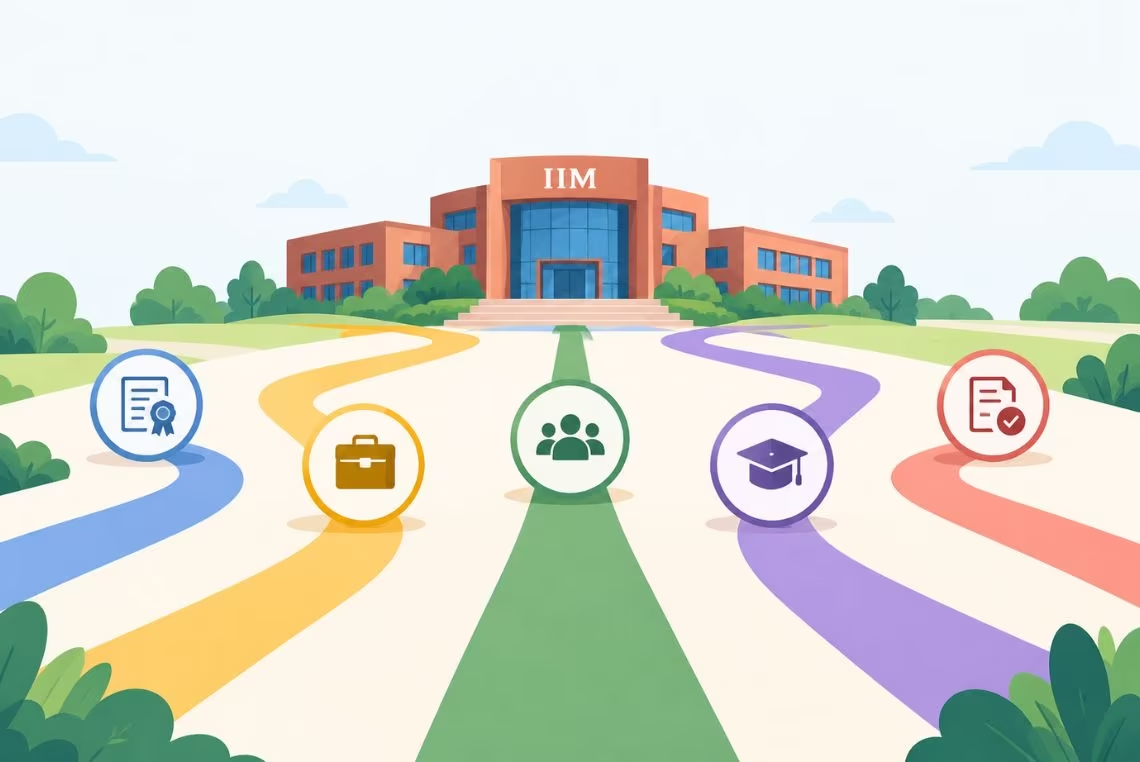
The Subject Choice Map
Many families think subject choices are about locking or unlocking doors.
In reality, subject choices work more like a map.
Some roads lead directly to certain destinations.
Others lead to intersections where students can change direction.
The goal is not to keep every road open.
The goal is to choose roads that lead somewhere meaningful.
Final Thought: The Family Conversation That Matters
Most families approach subject choices as a technical decision.
But it is actually a strategic one.
Student A keeps options open but lacks direction.
Student B limits options but builds a strong path.
The real answer is not about choosing one extreme or the other.
The real answer is finding the balance between curiosity and clarity.
When students choose subjects that genuinely align with their interests and potential university goals, the conversation becomes less about conflict — and more about direction.
Explore Related Resources & Tools
Free tools and expert services from Karan Gupta Consulting
Frequently Asked Questions
Do universities prefer certain subject combinations?
Should students choose subjects based on family expectations?
Is it risky to specialise early?
What if a student is unsure about their future career?
Do subject choices determine career success?
Why Choose Karan Gupta Consulting?
- 27+ years of expertise in overseas education consulting
- 160,000+ students successfully counselled
- Personal guidance from Dr. Karan Gupta, Harvard Business School alumnus
- Licensed MBTI® and Strong® career assessment practitioner
- End-to-end support from career clarity to visa approval
SHARE THIS ARTICLE

Dr. Karan Gupta
Founder & Chief Education Consultant
Harvard Business School alumnus and India's leading career counsellor with 27+ years guiding 160,000+ students to top universities worldwide. Licensed MBTI® practitioner. Managing Director of IE University (India & South Asia).