Stanford University
Stanford, California
Stanford is not just an elite university — it is the epicenter of innovation. Located in Silicon Valley, Stanford combines academic excellence with entrepreneurship, venture capital access, and real-world execution. For Indian students aiming at technology, startups, research, or global leadership, Stanford represents one of the most powerful ecosystems in the world.
~4%
Acceptance Rate
Top 5
QS World Ranking
~7,500
Undergraduates
75+
Students Guided
Tuition & Costs
- Undergraduate: ~$67,731/year
- Master's: ~$57,000–$67,000/year (school-dependent)
- MBA: ~$140,000+ total (GSB, 2-year)
- Living costs: ~$2,200–$2,800/month | ~$26,000–$33,000/year
- Total estimated annual budget: ~$90,000–$100,000/year
- Note: Income <$75K: tuition free | <$150K: tuition + board free
- Approximate for recent intake cycles — Study in USA | Cost Calculator
Key Deadlines
Silicon Valley Pipeline
- Direct access to Google, Apple, Meta, NVIDIA
- Leading AI research labs
- Venture capital ecosystem on campus
- Stanford founders: Google, LinkedIn, Netflix, Snapchat

Dr. Karan Gupta's Strategic View
Why Stanford University Is a Strong Choice
Silicon Valley Advantage
No other university has the same direct pipeline to Google, Apple, Meta, NVIDIA, leading AI labs, and venture capital firms. Stanford isn't just academically strong — it's geographically powerful. Internships, startup mentoring, and investor meetings happen during your studies, not after.
Culture of Innovation
Stanford encourages students to build, test, fail, and rebuild. Many founders started their first companies while still students — Google, LinkedIn, Snapchat, Instagram, and Netflix all have Stanford DNA. The Stanford Technology Ventures Program and StartX accelerator provide support that no classroom can match.
Research Depth
Stanford leads globally in Artificial Intelligence, Machine Learning, Bioengineering, Neuroscience, Climate Science, and Entrepreneurship. The Stanford AI Lab (SAIL) has shaped modern AI — from ImageNet to transformers. If your ambition is impact at scale, Stanford aligns well.
Stanford Campus in Palo Alto
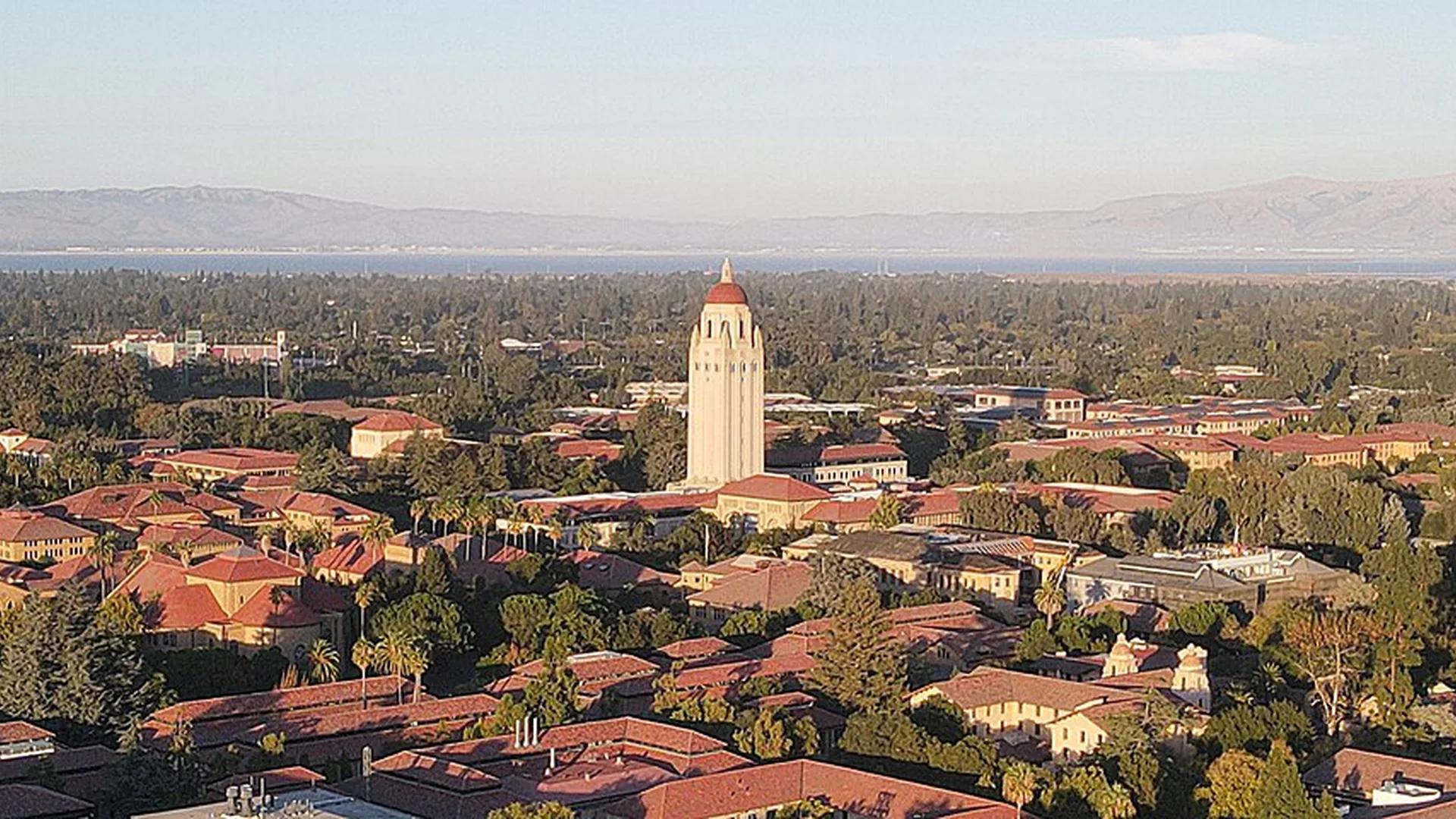
Stanford's stunning 8,180-acre campus is one of the largest in the US, featuring Spanish colonial revival architecture, palm-lined walkways, and the iconic Hoover Tower. Located in Palo Alto at the heart of Silicon Valley, students are surrounded by the world's densest concentration of tech companies, startups, and venture capital firms.
Main Quad & Memorial Church
Stanford's iconic Romanesque architecture at the heart of campus
Stanford Research Park
700-acre research park where university meets industry innovation
Silicon Valley Location
Walking distance to Sand Hill Road VCs and major tech company headquarters
Residential Life
All undergrads guaranteed 4 years of housing in diverse residential communities
Athletics & Outdoors
36 varsity sports teams and year-round outdoor activities in California sunshine
Programs at Stanford University
Computer Science
Arguably the strongest CS ecosystem in the world. Close integration with Silicon Valley. Stanford CS graduates are recruited by every major tech company and startup.
Engineering
Electrical, mechanical, bioengineering, and systems engineering are globally respected. Stanford Engineering is deeply connected to industry and venture capital.
AI & Data Science
Stanford AI Lab (SAIL) is globally influential — birthplace of ImageNet and key transformer research. The HAI institute leads AI policy discussions.
Economics
Strong theoretical and applied economics program with tech integration. Many graduates move into fintech, consulting, and policy.
Pre-Med / Biosciences
Strong pipeline into medical research and innovation. Stanford Medical School is among the top 5 in the world.
Stanford GSB (MBA)
One of the most selective MBA programs globally (~6% acceptance). Known for entrepreneurship, leadership, and tech-industry connections.
Stanford comprises 7 schools: Humanities & Sciences, Engineering, Business, Law, Medicine, Education, and Earth/Climate/Society. Undergraduates choose from 65+ majors and can easily take courses across schools. Stanford's quarter system allows students to explore more courses than semester-based universities.
Admission Requirements
Stanford's acceptance rate is approximately 3.6%, making it one of the most selective universities in the world. The holistic admissions process emphasizes intellectual vitality, demonstrated impact, and personal character. Stanford is one of few schools that is need-blind for all applicants including international students.
Stanford's application asks 'What matters to you, and why?' — and they mean it. The best applications show genuine intellectual passion and a track record of initiative, not just a list of accomplishments. Be authentic rather than trying to fit a mold.
Master's Requirements
- Undergraduate GPA + research experience
- Program fit (Stanford values applicants whose research interests align with faculty)
- Statement of Purpose
- 2-3 strong recommendations (research supervisors preferred)
MBA Requirements
- Leadership trajectory and career progression
- Stanford GSB's famous essay: “What matters most to you, and why?”
- Entrepreneurial thinking (GSB produces more startup founders than any other MBA)
- Strong recommendations from managers/mentors
Interview Preparation
What to expect and how to prepare for your Stanford University interview
Format
Behavioral Interview (Blind Resume-Based)
Duration
45-60 minutes
Interviewers
Trained alumni volunteers (not staff)
Interview Style
Structured behavioral, blind (resume only)
What Stanford University Looks For
Sample Interview Questions
Walk me through your resume. What is the story you are telling with your career?
You will almost certainly get this. Do not just list jobs. Explain the logic of your transitions, what you learned at each step, and how each role prepared you for the next. Show a coherent narrative.
Tell me about a time you led a team. What was the situation, and what was the outcome?
Give a specific example with clear context. What was your role? What challenge did the team face? What did you say or do? What was the result? Did you learn something about your leadership style?
Describe a time you had to influence someone who disagreed with you or was resistant to your idea.
Show a real conflict, not a fake one. How did you understand their perspective? What arguments did you use? What compromise or outcome did you reach? Did you learn about communication or empathy?
Tell me about a time you failed or made a significant mistake. How did you handle it?
Do not give a humble-brag or a tiny mistake that you spun into a success. Give a real failure. Show vulnerability. Most importantly, what did you learn? How did you change?
Give an example of a time you worked on a team where you did not hold the leadership role.
Show that you can contribute meaningfully without being in charge. What value did you add? How did you support the leader? Were there any tensions or conflicts you helped resolve?
Tell me about a time you had to work with someone very different from you. How did you navigate that?
Different could mean different background, different function, different personality, or different view. Show that you can value differences and create something meaningful together.
Describe a time you had to adapt or pivot. What triggered the change, and what did you learn?
Show flexibility and growth mindset. Were you forced to adapt, or did you recognize the need? How did you handle the ambiguity? What did this teach you?
Tell me about a time you saw an opportunity that others missed. What did you do with it?
This is about seeing patterns, anticipating trends, or recognizing gaps. Show foresight and initiative. What analysis did you do? Did it pan out? What did you learn?
Give an example of when you had to make a tough decision with incomplete information.
Show your decision-making process. What did you know? What did you not know? How did you handle the uncertainty? What was the outcome?
Tell me about a time you had to give someone difficult feedback. How did you approach it?
Show empathy and directness. How did you prepare? What did you say? How did the person respond? Did your feedback lead to change or growth?
Describe a situation where you had to balance competing priorities or stakeholders.
Show judgment and compromise. Explain the competing needs. How did you find balance? Who did you disappoint, and how did you manage that?
Tell me about a project or initiative you are proud of. What was your role?
Pick something with measurable impact. Be clear about your specific contribution. Do not oversell, but do not undersell either. What would not have happened without you?
Why do you want an MBA? What are your goals?
Be specific. What do you want to do after Stanford? What skills or networks do you need? How will an MBA help?
Why Stanford specifically? What attracted you to our program?
Do your homework. Reference specific programs, clubs, professors, or resources. Show that Stanford is a top choice for a reason.
What else would you like me to know about you that we have not discussed?
This is your chance to add something important that you want to make sure comes across. Do not repeat; add new information or insight.
Preparation Tips
- Develop 8-10 specific, detailed STAR stories before your interview. Practice them until they feel natural.
- Remember: your interviewer has ONLY your resume. You cannot assume they know anything about you beyond what you have listed.
- When telling a story, include specific details: what you said, what happened, what the outcome was, what you learned.
- Use numbers and metrics when possible. 'We increased efficiency by 25%' is more credible than 'We improved efficiency.'
- Show reflection and learning in every story. Stanford values growth mindset.
- Practice your resume walkthrough out loud. You should be able to deliver a crisp 2-3 minute overview of your career.
- Prepare a detailed 'why Stanford' answer that references specific programs, faculty, clubs, or resources.
- Be ready for the question 'What else would you like me to know?' This is your chance to add something important.
- Smile and make eye contact (if in-person). Show genuine interest in the conversation.
- Ask thoughtful questions about Stanford, the MBA experience, or the interviewer's path. Show curiosity.
Common Mistakes
- Over-polishing stories until they sound fake. Authenticity beats perfection.
- Giving generic answers. 'I led a team' is vague. Give specific details.
- Not showing what you learned. Stories need reflection, not just accomplishment.
- Rushing through the outcome or impact. Slow down and articulate the result.
- Forgetting that the interviewer has only your resume. You must paint the full picture.
- Not preparing a strong 'why Stanford' answer. Research specific programs and clubs.
- Defensive reactions to follow-up questions. Treat them as invitations to go deeper.
- Talking too much or not giving the interviewer time to ask follow-ups.

Dr. Karan Gupta's Interview Advice
Dr. Karan's Perspective on Stanford GSB Interviews
Stanford's blind behavioral interview is one of the most effective interview formats in MBA admissions. By giving interviewers only your resume, Stanford forces you to tell your story authentically. You cannot hide behind a polished essay or a strong recommender. It is just you, your experiences, and your ability to communicate them compellingly.
The candidates who succeed at Stanford are those who can give specific, detailed examples with genuine reflection. When I say 'specific,' I mean you should be able to answer: What exactly did you say? What was the reaction? What was the measurable outcome? Stanford's behavioral questions are designed to separate the candidates who have actually had leadership experiences from those who have observed them or read about them.
One more thing: authenticity is the secret weapon. Candidates who try to be perfect, who polish their stories until they sound like case studies, tend to fall flat. The interviewers are looking for real people who have real experiences and have learned from them. If you failed, own it. If you made a mistake, acknowledge it. Stanford respects vulnerability paired with growth.
What Type of Student Gets In?
National or international competition performance — Olympiads, science fairs, debate championships
Research exposure — published papers, lab work, independent projects with real results
Startup or entrepreneurial initiative — even small-scale, self-driven ventures that show execution
Deep focus in one or two domains — not 15 clubs, but 2-3 activities pursued with genuine depth
Strong essays reflecting authenticity — Stanford officers are trained to identify rehearsed narratives
Evidence of lifting others — community impact, mentoring, collaborative leadership
Reality check: Students who present “perfect resumes” without genuine depth rarely succeed at Stanford. They want interesting people, not polished people. Start building your authentic profile early with KGC's profile building.
Costs & ROI
Stanford meets 100% of demonstrated financial need for admitted students, including international students. Families earning under $100,000/year with typical assets pay zero tuition. Over 70% of students receive some form of financial aid. All PhD students are fully funded.
| Level | Tuition |
|---|---|
| Undergraduate | ~$67,731/year |
| Master's | ~$57,000–$67,000/year (school-dependent) |
| MBA | ~$140,000+ total (GSB, 2-year) |
| Living costs | ~$2,200–$2,800/month | ~$26,000–$33,000/year |
Salary Ranges
Career & Industry
Google / Alphabet
Founded by Stanford PhD students; remains one of the top recruiters of Stanford graduates.
Apple
Major recruiter from Stanford's engineering and design programs, located 15 minutes from campus.
Meta
Recruits heavily from Stanford CS and AI research programs.
Sequoia Capital
Iconic VC firm with deep Stanford ties, located on Sand Hill Road near campus.
Tesla
Recruits from Stanford engineering and energy programs; Elon Musk briefly attended Stanford.
The alumni network is highly active in entrepreneurship and venture capital. Stanford's proximity to investors and tech accelerators is unmatched. The USA's OPT/STEM OPT program gives graduates up to 3 years of post-study work authorization.
Application Timeline
Grade 9-10
- Explore deep interests — don't spread thin across 15 activities
- Start independent intellectual projects (research, coding, writing, building)
- Develop genuine curiosity in 1-2 areas
- Begin psychometric testing to identify natural strengths
Grade 11
- SAT or ACT — aim for 1500+/34+
- Research or leadership involvement with tangible outcomes
- Start profile building with strategic guidance
- Identify recommenders who know you deeply, not just senior faculty
November (Grade 12)
- Restrictive Early Action deadline — shows commitment but is NOT binding
- Stanford REA is strategic: you can still compare offers from other schools
- Essays must feel authentic, not engineered — Stanford officers are trained to spot rehearsed narratives
January (Grade 12)
- Regular Decision deadline: January 5
- If you didn't apply REA, this is your shot
- Results typically arrive late March/early April
Stanford University vs Peers
Stanford vs MIT
Stanford University: MIT is more technically focused and structured. Stanford blends technology with entrepreneurship and venture capital access. Choose MIT for deep technical research, Stanford for tech + startup ecosystems. Read more: Best Country for MS in CS .
Other:
Stanford vs Harvard
Stanford University: Harvard leans broader across disciplines — law, government, humanities. Stanford dominates in tech and startup ecosystems. If you want to be a tech founder, choose Stanford. If you want broader leadership across sectors, consider Harvard.
Other:
Stanford vs UC Berkeley
Stanford University: Both are strong in tech and located in the Bay Area. Stanford has a smaller student population, stronger private funding, and more venture capital access. Berkeley is a public university with lower costs and a larger research community. Read: UK vs USA comparison .
Other:
Stanford University Is Right For...
- Students with entrepreneurial ambitions who want to launch startups or innovate
- Those targeting careers in Silicon Valley tech, venture capital, or product management
- Students who want a balanced lifestyle with excellent weather and outdoor activities
- Interdisciplinary thinkers who want to combine engineering with business or humanities
- Those seeking need-blind admissions and exceptional financial aid
Stanford University Is Not Right For...
- Students who prefer an East Coast urban campus experience
- Those who want a tight-knit small college feel (Stanford has 17,000+ students)
- Students primarily interested in traditional finance or Wall Street (East Coast schools are stronger)
- Those who dislike suburban settings (Palo Alto is quiet compared to NYC or Boston)
- Students seeking a deep liberal arts core curriculum (Stanford is flexible, not structured)
Our Students at Stanford University
Bhavya Shah
Stanford University
“Karan was an absolute supporter, cheerleader, and mentor during my college application season. Personally, I think the process starts way before August of your senior year; considerable planning goes into scheduling, preparing for, and appearing for standardized tests.”
Deepan Gandhi
Stanford University
“Karan Gupta Consulting helped me to focus on relevant information when researching universities. Their guidance was invaluable throughout the entire application process.”
Rahil Kacheria
Stanford University
“KGC gave me the courage to apply to the top schools in the USA with their guidance and assistance. I couldn't have done it without Dr. Karan Gupta's strategic approach.”
Watch: Study Abroad Insights

Dr. Karan Gupta's Advice
After guiding 75+ students to Stanford:
Dr. Karan Gupta is a Harvard Business School alumnus with 27+ years of experience. Book a consultation to discuss your Stanford strategy.
- Do not apply with a generic “I love tech” narrative. Every second Indian applicant says this. Stanford wants specificity — what exactly have you built, researched, or created?
- Stanford wants creators, not spectators. Demonstrate initiative — startups, published research, open-source contributions, community projects with measurable impact.
- Essays must feel authentic, not engineered. Stanford admissions officers are highly trained at identifying rehearsed narratives. Write like you talk, not like you think they want you to sound.
- Restrictive Early Action is strategic. It shows genuine interest and is not binding — you can still compare offers. If Stanford is a top choice, REA gives you an advantage.
FAQs: Stanford University for Indian Students
Is Stanford harder to get into than Ivy League schools?
Does Stanford require SAT for Indian students?
Can Indian students get full financial aid at Stanford?
Is Stanford better than MIT?
What GPA is needed for Stanford?
What does Stanford look for in Indian applicants?
Related Articles
The ₹0 List: Free Opportunities That Actually Strengthen a Student’s Profile
The best summer opportunities are not always expensive. Discover selective ₹0 programs that can demonstrate genuine student achievement.
Demonstrated Interest in US College Admissions: What Students Need to Know
Demonstrated interest can strengthen US college applications, but only when students know which universities value it and engage genuinely.
IMO Olympiad Explained: The Official Pathway in India
Two exams in India are called IMO. Only one is the official pathway to India's International Mathematical Olympiad team.
Explore More
Related Guides & Resources
Want to Study at Stanford University?
Get expert guidance from Dr. Karan Gupta: Harvard alumnus, 27+ years of global admissions experience guiding 160,000+ students worldwide.