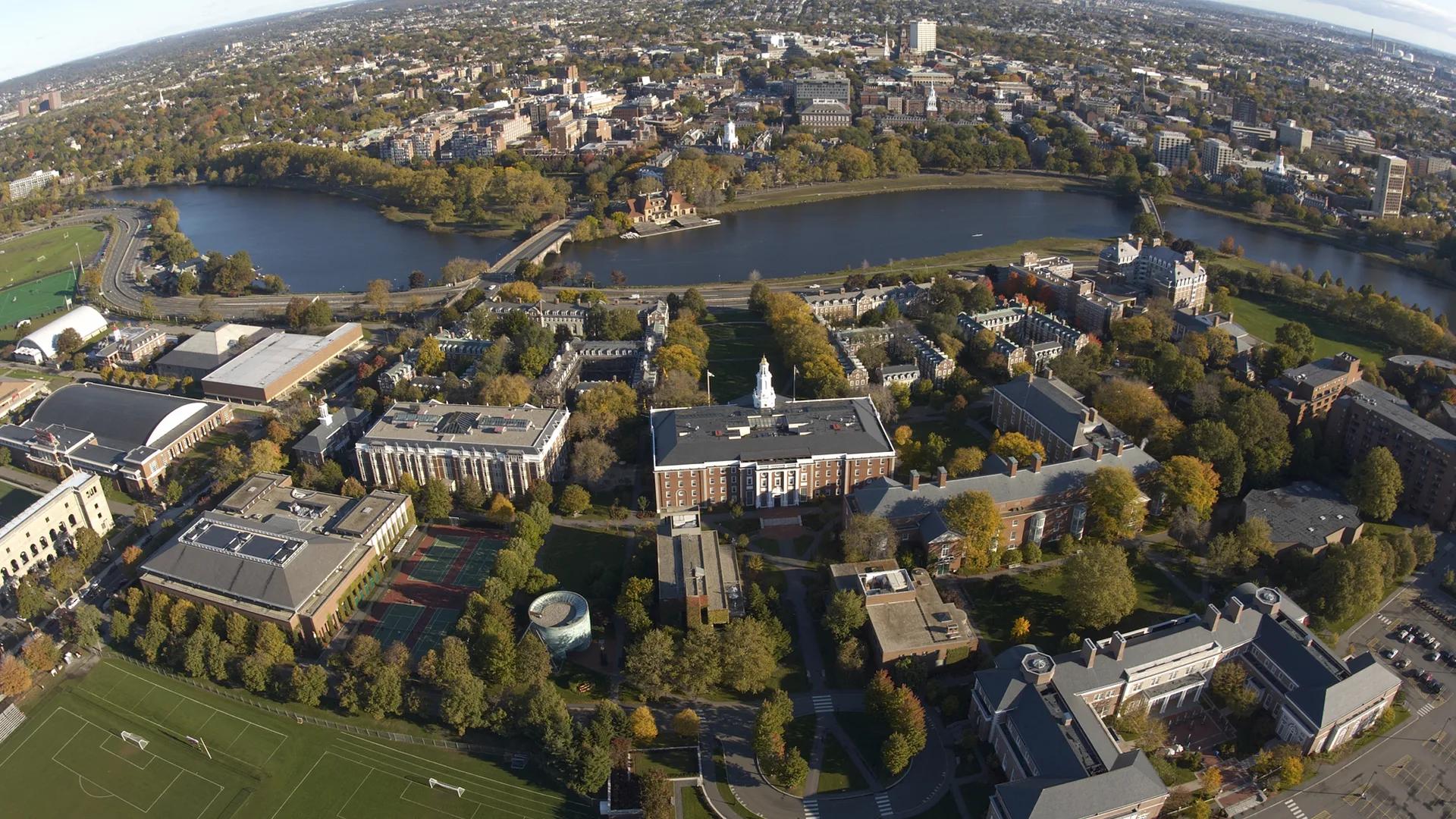
Harvard University
Cambridge, Massachusetts
Harvard is the world's most recognized university brand. ~3-4% acceptance rate. Need-based financial aid for families earning below $100,000. HBS MBA. What Harvard actually looks for from Indian students.
~3-4%
Acceptance Rate
#1
Global Brand
1636
Founded
Students Guided

Dr. Karan Gupta's Strategic View
Harvard is not just the hardest university to get into — it is the most misunderstood. Indian families often treat it as a pure academics race. It is not.
Why Harvard Is a Strong Choice
World-Class Academic Resources
Harvard's library system is the largest academic library in the world with over 17 million volumes. Students have access to 12 degree-granting schools, cross-registration at MIT, and research opportunities with Nobel laureate faculty. The General Education curriculum ensures breadth while concentration requirements build deep expertise.
Unmatched Career Network
Harvard's alumni network spans over 400,000 living graduates across 190+ countries, including heads of state, Fortune 500 CEOs, and leaders in every field imaginable. The Office of Career Services and Harvard alumni clubs worldwide provide lifelong professional support that opens doors no other network can.
Need-Blind Admissions & Generous Financial Aid
Harvard practices need-blind admissions for all applicants, including international students. Families earning under $100,000/year pay nothing, families under $200,000 pay no tuition (expanded for 2025-26), and 55% of students receive need-based scholarships. The average grant covers roughly 75% of tuition costs, making Harvard more affordable than many state universities for qualifying families.
Cambridge & Boston Ecosystem
Located in Cambridge, Massachusetts, Harvard sits at the heart of the world's densest concentration of universities, hospitals, biotech firms, and tech companies. Students benefit from proximity to MIT, Boston's thriving startup scene, world-renowned teaching hospitals, and a vibrant cultural landscape.
Harvard Yard & Cambridge Campus
Harvard's historic 209-acre campus in Cambridge, Massachusetts, blends centuries-old architecture with modern facilities. Harvard Yard is the iconic heart of campus life, surrounded by libraries, labs, residential houses, and green spaces along the Charles River.
Harvard Yard
Historic center with freshman dormitories and iconic Widener Library
Library System
Largest academic library in the world with 17+ million volumes
Residential Houses
12 undergraduate Houses each with unique traditions and communities
Science & Engineering Complex
State-of-the-art research facility in Harvard's expanding Allston campus
Athletic Facilities
Harvard Stadium and extensive sports facilities along the Charles River
Programs at Harvard
Computer Science
School of Engineering & Applied Sciences
AI, Systems, Theory
Economics
Faculty of Arts & Sciences
Development, Behavioral, Finance
MBA
Harvard Business School
General Management, Leadership
Juris Doctor (JD)
Harvard Law School
Constitutional, Corporate, International Law
Doctor of Medicine (MD)
Harvard Medical School
Research-Intensive, Clinical Training
Master in Public Policy (MPP)
Harvard Kennedy School
Government, Policy Analysis
Data Science
School of Engineering & Applied Sciences
Machine Learning, Statistical Methods
Biology & Biomedical Sciences
Faculty of Arts & Sciences
Genomics, Neuroscience, Molecular Biology
Applied Mathematics
Faculty of Arts & Sciences
Computational Science, Modeling
Government
Faculty of Arts & Sciences
Political Theory, International Relations
Harvard offers 50+ concentrations (majors) at the undergraduate level through Harvard College, plus professional and research degrees across 12 graduate schools including Business, Law, Medicine, Education, Engineering, and Public Health.
Admission Requirements
Harvard's acceptance rate is approximately 3.4%, making it one of the most selective universities globally. The holistic admissions process evaluates academic excellence, extracurricular impact, personal qualities, and potential contribution to the Harvard community.
Harvard meets 100% of demonstrated financial need. Families earning below $100,000 typically pay nothing. This makes Harvard more affordable than most Indian private universities for admitted students.
Master's Requirements
- Undergraduate GPA + transcripts
- Program fit (projects, research, internships)
- Statement of Purpose
- 2-3 letters of recommendation
- CV/Resume with research or professional experience
MBA Requirements
- Work experience quality and progression (typically 3-7 years)
- Leadership evidence (people, projects, impact)
- Clarity of goals (short-term + long-term)
- Strong recommendations (manager/client)
- Interview readiness (HBS interviews are famously rigorous)
Interview Preparation
What to expect and how to prepare for your Harvard interview
Format
Post-Interview Reflection + Live Interview
Duration
30 minutes live interview + 24-hour written reflection
Interviewers
MBA Admissions Board members (not blind)
Interview Style
Fast-paced, customized, application-aware
What Harvard Looks For
Sample Interview Questions
Walk me through your resume. Why did you make each transition?
This will almost certainly be asked. Do not simply list jobs; explain the 'why' behind each move. Show a logical career narrative, not random jumps. Highlight transitions that required growth or learning.
What are your short-term and long-term goals? How does an MBA fit into this plan?
Be specific. Short-term could be a role, industry, or function (not just 'get an MBA and see what happens'). Long-term should show ambition and impact. Connect HBS specifically—the networks, the case method, certain clubs or programs.
Why Harvard specifically? What is it about HBS that excites you?
Go beyond 'HBS is the best.' Reference the case method and how it matches your learning style. Mention specific programs like the Startup Garage, Baker Scholar, or clubs aligned with your interests. Show genuine research.
In your essay, you mentioned [specific detail]. Tell me more about that.
Your interviewer will reference specific sentences from your essays. Know your own narrative intimately. Be prepared to elaborate, clarify, or defend any claim you made. If you said you are a leader, have examples ready.
Tell me about a time you failed or made a significant mistake. What did you learn?
This is a character question. Do not give a fake 'failure' that is really a humble-brag ('I was promoted too quickly'). Share a real setback, own it, and explain what you learned. Show humility and growth mindset.
What is something you are deeply uncertain about or something you have changed your mind on?
HBS values intellectual honesty. Show that you are willing to question your assumptions and evolve your thinking. This could be a professional belief, a career assumption, or a personal value.
How do you define leadership? Give me an example of how you have demonstrated it.
Leadership at HBS does not just mean 'being in charge.' It means influencing others, making tough calls, and delivering results. Show a specific example where you led without formal authority, or made a difficult decision that benefited others.
Tell me about a time you had to work with someone very different from you. How did you navigate that?
HBS cares about collaboration and diversity of thought. Show that you can work across differences, listen to other perspectives, and create value through diverse teams. Avoid stereotyping.
What is one thing about your background or perspective that will add value to the HBS classroom?
Do not say 'my work experience' or 'my passion for learning.' Think about what is unique about you: your international background, your industry expertise, your lived experience, your perspective. What will you teach your classmates?
If your CEO asked you to do something you disagreed with, what would you do?
This probes your integrity and judgment. Show that you would speak up respectfully, that you care about doing the right thing, and that you can navigate complex organizational dynamics with honesty.
What is the most constructive feedback you have ever received? How did you respond to it?
Choose feedback that was genuinely hard to hear and that led to real change in your behavior. Show that you can be vulnerable and that you take feedback seriously.
Tell me about someone who has challenged your worldview or changed how you think.
This shows intellectual curiosity and openness. It could be a mentor, a colleague, a family member, or even a book. Show how the encounter changed you.
If you could only read one book for the rest of your life, what would it be and why?
This is not about the 'right' answer. Be authentic. Explain why the book matters to you. Show something about your values, curiosity, or sense of humor.
What do you want us to understand about you that is not already clear from your application?
This is your chance to add something important. Do not re-hash your essays. Introduce a new perspective, a motivation, a context that helps round out your profile.
Do you have any questions for me?
Always have 2-3 thoughtful questions ready. Ask about the student experience, the case method, the interviewer's favorite class, or the culture. Show genuine curiosity about the program.
Preparation Tips
- Re-read your entire application before the interview. Know every word you wrote.
- Prepare 6-8 core stories, each telling in 60-90 seconds. Be ready to reference them.
- Practice rapid-fire mock interviews. Thirty questions in 30 minutes is fast.
- Develop a specific, detailed 'why HBS' narrative. Reference programs, professors, or the case method.
- Listen carefully to each question and answer directly. Do not volunteer information not asked.
- Stay composed under pressure. Pausing to think is fine. Rambling is not.
- Ask thoughtful questions about the program, student life, or the interviewer's experience.
- In your post-interview reflection, show intellectual humility and genuine self-reflection. This is not a do-over.
- Do not try to be someone you are not. HBS values authenticity over polish.
- Practice thinking about curveballs. Harvard likes candidates who are comfortable with ambiguity.
Common Mistakes
- Over-explaining or rambling. Thirty minutes goes fast. Keep answers crisp.
- Generic 'why HBS' answers. The admissions board hears 'HBS is the best' 100 times.
- Defensive reactions to challenging follow-ups. Treat probes as invitations to show your thinking.
- Contradicting your essays. If you wrote something, be ready to own it or clearly explain your thinking.
- Lack of preparation. HBS interviewers can tell when a candidate has not re-read their own application.
- Not asking questions. The interview is a two-way conversation. Ask thoughtful questions.
- Overthinking curveball questions. 'What book would you bring to a desert island?' does not have a right answer. Be authentic.
- Forgetting the post-interview reflection deadline. Submit within 24 hours, not later.

Dr. Karan Gupta's Interview Advice
Dr. Karan's Insider Perspective on HBS Interviews
I have coached over 150 HBS candidates in my career. The ones who get in are not necessarily those with the flashiest accomplishments. They are the ones who show genuine self-knowledge, intellectual honesty, and the ability to think clearly under pressure.
HBS's 30-minute, 30-40-question format is designed to reveal character. You cannot hide behind polish or a script when you are fielding a new question every minute. The admissions board is looking for people who can think on their feet, who can handle being challenged, and who can articulate complex ideas simply.
The post-interview reflection is underestimated by many candidates. It is your chance to show humility and self-awareness. If you stumbled, do not try to spin it. Acknowledge it and explain what you learned. Harvard respects honesty more than perfection.
One last note: Your interviewer is not your enemy. They want you to succeed. If you do not understand a question, ask for clarification. If you need a moment to think, take it. Confidence paired with humility is the winning combination at HBS.
What Type of Student Gets In?
Genuine intellectual curiosity (not just grade-chasing)
Deep involvement in 2-3 areas with real impact
Leadership that shows initiative, not just positions held
Character and values evident in essays and recommendations
Something distinctive — what only YOU bring to campus
Strong enough academics to handle Harvard rigor
Common mistake: Treating Harvard like a numbers game. Students with perfect SATs and GPAs get rejected every year because their application lacks soul. Harvard wants to know who you are, not just what you've achieved.
Costs & ROI
Harvard meets 100% of demonstrated financial need for all admitted students, including international students. Over 55% of undergraduates receive need-based aid. PhD students across most programs receive full tuition waivers and living stipends. Costs shown are approximate for the 2025-26 academic year.
| Level | Tuition | Living | Total |
|---|---|---|---|
| Undergraduate (per year) | $57,261 | $21,130 | $78,391 |
| MBA (per year) | $74,910 | $25,000 | $99,910 |
| Law - JD (per year) | $72,150 | $24,000 | $96,150 |
| Master's Programs (per year) | $52,000 - $58,000 | $21,130 | $73,130 - $79,130 |
| PhD Programs | Fully funded | Stipend provided | Fully funded with stipend |
Salary Ranges
Career & Industry
McKinsey & Company
One of the top recruiters of Harvard graduates across MBA, undergraduate, and policy programs.
Goldman Sachs
Major recruiter for Harvard undergrads and MBA students in finance and investment banking.
Recruits heavily from Harvard's computer science and engineering programs.
Mass General Brigham
Harvard's primary teaching hospital system, closely integrated with the medical school.
Boston Consulting Group
Consistently among the top employers of Harvard Business School graduates.
Harvard graduates consistently rank among the highest earners globally. The mid-career median salary for Harvard alumni exceeds $130,000. Harvard Business School, Law School, and Medical School graduates command some of the highest starting salaries in their respective fields.
Application Timeline
12-18 Months Before
- Research Harvard's programs and concentration options
- Begin standardized test preparation (SAT/ACT, TOEFL/IELTS)
- Build meaningful extracurricular involvement and leadership
8-12 Months Before
- Take standardized tests and aim for 1550+ SAT or 34+ ACT
- Request recommendation letters from teachers who know you well
- Visit campus or attend virtual information sessions
4-8 Months Before
- Draft and refine Common Application essays and Harvard supplement
- Complete the Common Application and Harvard-specific questions
- Prepare for optional alumni interview
Application Deadlines
- Restrictive Early Action deadline: November 1
- Regular Decision deadline: January 1
- Financial aid application deadline: February 1 (CSS Profile + FAFSA)
After Submission
- Early Action decisions released: mid-December
- Regular Decision results released: late March
- Admitted students reply by May 1 (National Decision Day)
Pre-Departure
- Apply for F-1 student visa with I-20 from Harvard
- Complete housing preferences for freshman year
- Attend Harvard's First-Year Orientation in late August
Harvard vs Peers
MIT
Harvard: Broader liberal arts education, Larger alumni network across all industries, Need-blind for international students
Other: Stronger in pure STEM and engineering, More hands-on lab culture from day one, Higher starting salaries in tech roles
Compare →Stanford University
Harvard: Larger and more established alumni network, Stronger in law medicine and public policy, Located in academic hub with MIT nearby
Other: Silicon Valley location for tech startups, Stronger startup culture and entrepreneurship, More collaborative student culture
Compare →University of Oxford
Harvard: More generous financial aid for international students, Broader range of professional schools, Located in innovation ecosystem with Boston
Other: Tutorial system offers personalized teaching, 3-year undergrad programs save time and cost, Deeper academic specialization from year one
Compare →Yale University
Harvard: Stronger professional schools in Business Medicine Engineering, Larger research budget and more lab opportunities, Cambridge/Boston offers more career access
Other: Smaller class sizes and more intimate campus, Stronger in arts drama and creative writing, Residential college system praised for community
Compare →Harvard Is Right For...
- Students who thrive in intellectually intense, discussion-driven environments
- Ambitious learners who want access to the world's most powerful alumni network
- Those seeking generous need-based financial aid (no merit scholarships offered)
- Students interested in cross-disciplinary learning across Harvard's 12 schools
- Future leaders in law, medicine, business, government, or academia
Harvard Is Not Right For...
- Students who prefer small, intimate campus communities (Harvard has 22,000+ students total)
- Those seeking guaranteed merit-based scholarships (Harvard only offers need-based aid)
- Students who want a highly specialized technical curriculum from day one
- Those uncomfortable with intense academic competition and high-pressure environments
- Students looking for a warm-weather campus experience
Our Students at Harvard
Sumit Khatri
Harvard University
“The team at KGC went above and beyond to help me with my Harvard application. Their strategic approach and deep understanding of what Harvard looks for made all the difference.”
Shaurya Gupta
Harvard University
“Harvard Kennedy School was my goal and KGC got me there. Dr. Gupta's insights into Harvard's graduate admissions were invaluable.”
Saira Mehta
Harvard University
“Harvard Medical School — a dream achieved with KGC. The application strategy was meticulous and deeply personalized.”
Watch: Study Abroad Insights

Dr. Karan Gupta's Advice
FAQs: Harvard for Indian Students
Is Harvard the hardest university to get into?
Does Harvard accept CBSE or ISC students?
Can Indian students get full financial aid at Harvard?
Is Harvard better than Stanford?
What GMAT score is needed for Harvard MBA (HBS)?
Does Harvard require GRE for Masters programs?
Related Articles
The ₹0 List: Free Opportunities That Actually Strengthen a Student’s Profile
The best summer opportunities are not always expensive. Discover selective ₹0 programs that can demonstrate genuine student achievement.
Demonstrated Interest in US College Admissions: What Students Need to Know
Demonstrated interest can strengthen US college applications, but only when students know which universities value it and engage genuinely.
IMO Olympiad Explained: The Official Pathway in India
Two exams in India are called IMO. Only one is the official pathway to India's International Mathematical Olympiad team.
Explore More
Want to Study at Harvard?
Get expert guidance from Dr. Karan Gupta: Harvard alumnus, 27+ years of global admissions experience guiding 160,000+ students worldwide.