IIMs Have Already Moved On

Dr. Karan Gupta is a Harvard Business School alumnus and career counsellor with 27+ years of experience and 160,000+ students guided. His insights on Undergraduate come from decades of hands-on experience helping students achieve their goals.
Why New Undergraduate Programs in Economics, AI & Digital Sciences Matter
Here’s something most students and parents don’t fully realise:
Even the IIM system has moved beyond the idea that “management” alone is enough.
Free Tool
University Predictor
Find out which universities you can realistically get into.
Try it free →For decades, the Indian Institutes of Management were synonymous with one thing — the MBA. Clear pathway. Graduate degree. Corporate job. Growth.
But the world has changed.
Companies today are not hiring generic “management professionals” straight after Grade 12.
They are hiring problem-solvers with technical understanding. They are hiring analysts. They are hiring economists who understand data.
They are hiring people who can think across business, AI, digital sciences, and public policy.
And the IIMs have responded.
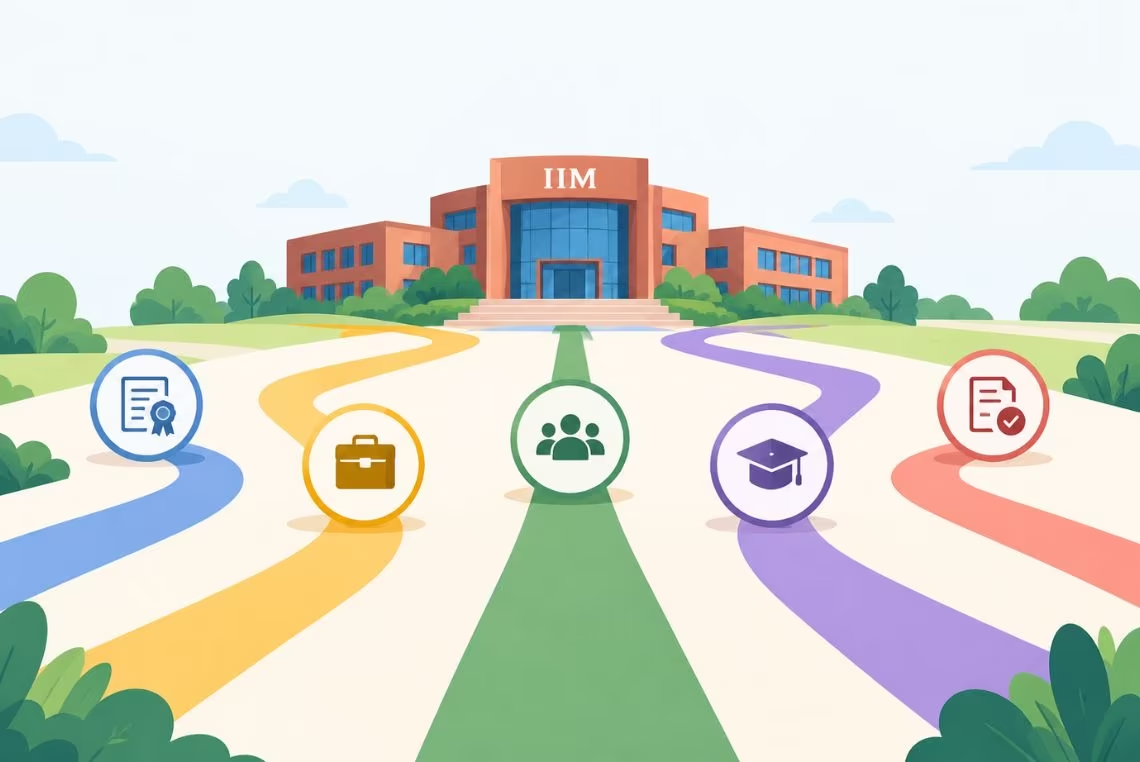
They have launched new undergraduate programs.
That alone should tell you something important.
Education is finally catching up with the market.
This article will help students and parents understand:
- Why the IIM undergraduate landscape is shifting
- What these new programs actually mean
- How business education is merging with data and technology
- How to choose the right path based on your profile
Let’s break this down clearly.
Why Plain “Management” Isn’t Enough Anymore
Let’s ask a simple question:
Which company hires a management graduate straight after 12th grade, with no real skills or experience?
Very few.
Management is applied decision-making. And decision-making today is driven by:
- Data
- Technology
- Analytics
- Economics
- Policy understanding
A modern business graduate must understand how systems work, not just how to talk about them.
Earlier, the structure was simple:
Undergraduate → MBA → Corporate role.
Now, that linear path is dissolving.
Today’s industries demand hybrid thinkers.
And that’s exactly why the IIM's new programs are structured differently.
The Market Shift: Business + Data + Technology
According to industry reports from firms like McKinsey & Company and the World Economic Forum, data-driven roles and AI-integrated decision-making are among the fastest-growing job segments globally.
Business leaders today must understand:
- AI implementation
- Data interpretation
- Digital transformation
- Economic policy implications
- Platform-based business models
You cannot separate business from technology anymore.
That separation ended five years ago.
And the IIMs know it.
The IIM Undergraduate Revolution
Let’s look at what’s actually happening.
IIM Bangalore: Economics + Data Science
Indian Institute of Management Bangalore now offers a BSc (Hons) in Economics with Data Science.
Why does this matter?
Because it creates two clear career tracks:
Consulting & Policy Track
Strong foundation in economics + analytics = strategy roles.
Business Intelligence & Analytics Track
Data science + economic modelling = high-demand analytical roles.
This is not a “soft” degree.
It’s quantitative. Technical. Market-aligned.
It reflects where global business education is heading.
IIM Mumbai: Digital Sciences & Business Management
The Indian Institute of Management Mumbai launched programs in Digital Sciences and Business Management.
Why?
Because tech companies don’t just need coders.
They need professionals who understand:
- Product lifecycle
- Digital ecosystems
- Platform economics
- Business model innovation
- Operations in tech-enabled environments
The digital economy requires interdisciplinary thinkers.
This program sits at that intersection.
IIM Lucknow: Business + Data Science + Economics
Indian Institute of Management Lucknow integrates business, economics, and analytics.
That combination is powerful.
Why?
Because data without context is useless.
Economics gives context.
Business gives an application.
Data science gives tools.
Together, they create employability.
IIM Sambalpur: Data Science with AI & Public Policy
Indian Institute of Management Sambalpur offers:
- Data Science with AI
- Management with Public Policy
That tells you something crucial:
The future of management isn’t only corporate.
It includes governance.
It includes regulation.
It includes a technology policy.
It includes sustainability.
AI and public policy will shape the next 20 years.
Forward-looking institutions are preparing students for that world.
What This Means for Students After Grade 12
This shift changes how students should think about undergraduate education.
Earlier mindset:
“I’ll do BBA. Then MBA. Then figure it out.”
New reality:
“You must build relevant skills from Year 1.”
If even the IIM undergraduate model is becoming interdisciplinary, that means:
- Specialisation starts earlier
- Quantitative exposure matters
- Analytical thinking is non-negotiable
- Tech literacy is essential
The undergraduate degree is no longer just a stepping stone.
It’s a foundation.
Why This Shift Improves Employability
Let’s be honest.
Traditional BBA-style degrees often struggle with direct employability unless followed by an MBA.
But programs combining:
- Economics
- Data science
- AI
- Digital sciences
- Public policy
…offer real technical skill sets.
Graduates can enter:
- Business analytics
- Consulting
- Economic research
- Digital strategy
- Product management
- Policy advisory
This diversification reduces risk.
And in today’s market, risk reduction matters.
How to Choose the Right IIM Undergraduate Program
Now let’s get practical.
Step 1: Assess Your Academic Strength
Ask yourself:
- Are you strong in mathematics?
- Do you enjoy statistics?
- Are you comfortable with coding basics?
- Do you like analytical problem-solving?
If yes → Economics + Data Science paths make sense.
If not → Pure management might feel safer, but long-term growth will still require tech exposure.
Step 2: Clarify Your Career Direction
If you’re aiming for:
Consulting / Corporate Strategy
→ Economics + Analytics track
Tech Business Roles
→ Digital Sciences + Business
AI / Data-Heavy Roles
→ Data Science with AI
Policy / Governance / Development Sector
→ Management + Public Policy
Clarity saves years.
Step 3: Think Long-Term, Not Just Brand
Many parents focus on the IIM brand.
But brand alone is not a strategy.
The question is:
Does the curriculum match the future?
The new programs exist because industry demand exists.
Industry demand should drive course choice.
The Bigger Picture: Education Is Catching Up
For years, business education in India was slow to evolve.
Now, change is visible.
Globally, top institutions like Harvard Business School and MIT Sloan School of Management have integrated analytics, digital strategy, and AI deeply into curricula.
India is following that direction — not copying blindly, but adapting to domestic economic realities.
The Indian economy itself is shifting toward:
- Digital payments
- Startup ecosystems
- AI-led services
- Policy-driven reforms
Business education must reflect that.
The IIM's new programs are evidence of structural change.
Common Mistakes Students Make
They assume:
“IIM means MBA.”
That thinking is outdated.
The undergraduate shift is strategic.
It indicates:
- An MBA alone won’t dominate forever
- Specialisation will matter earlier
- Skill-based learning is rising
- Hybrid degrees are the future
Ignoring this trend could mean choosing outdated paths.
Is the MBA Still Relevant?
Yes.
But differently.
An MBA now builds on:
- Technical foundation
- Work experience
- Analytical maturity
If you complete an undergraduate degree in economics + data science, and later pursue an MBA, your profile becomes exponentially stronger.
The layering matters.
Undergraduate depth + MBA polish = powerful combination.
What Parents Should Understand
Parents often ask:
“Isn’t management safer?”
Safety has changed.
The safest degrees today are those that:
- Offer transferable skills
- Build quantitative strength
- Allow lateral movement across industries
- Align with tech-driven economies
Business without analytics is fragile.
Analytics without business is incomplete.
The IIMs are balancing both.
Final Reality Check
When top institutions change direction, you pay attention.
The IIM undergraduate expansion into:
- Economics
- Data science
- AI
- Digital sciences
- Public policy
…is not random.
It reflects:
Market correction.
Industry pressure.
Global alignment.
Future readiness.
The question is not whether this trend will continue.
It already has.
The IIMs have already moved on.
The real question is:
Have you?
A Final Thought
Choosing an undergraduate degree today is not about following tradition.
It’s about reading the direction of the market.
The smartest students aren’t asking,
“Which brand?”
They’re asking,
“Which skills?”
If you want clarity on which IIM undergraduate path aligns with your academic strengths, long-term goals, and global opportunities, take the time to build a structured admissions strategy.
Because in today’s education landscape, guessing is expensive.
Strategy is powerful.
Explore Related Resources & Tools
Free tools and expert services from Karan Gupta Consulting
Frequently Asked Questions
Are IIM undergraduate programs better than traditional BBA degrees?
Can I pursue an MBA after completing an IIM undergraduate program?
Do these new IIM programs require strong mathematics skills?
Is management with public policy a good career option?
Are these programs suitable for students without coding experience?
Why Choose Karan Gupta Consulting?
- 27+ years of expertise in overseas education consulting
- 160,000+ students successfully counselled
- Personal guidance from Dr. Karan Gupta, Harvard Business School alumnus
- Licensed MBTI® and Strong® career assessment practitioner
- End-to-end support from career clarity to visa approval
SHARE THIS ARTICLE

Dr. Karan Gupta
Founder & Chief Education Consultant
Harvard Business School alumnus and India's leading career counsellor with 27+ years guiding 160,000+ students to top universities worldwide. Licensed MBTI® practitioner. Managing Director of IE University (India & South Asia).